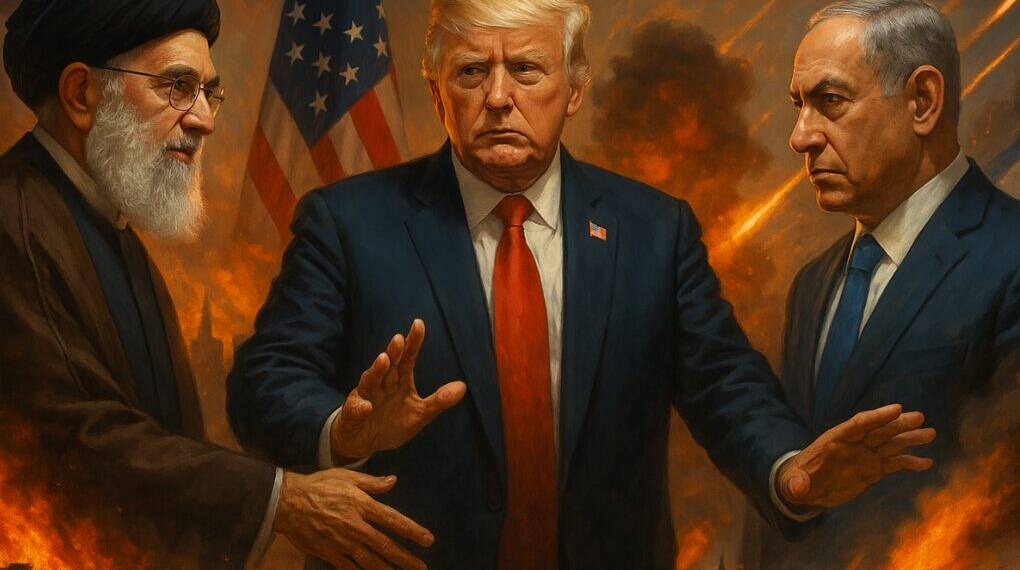
As military tensions escalate between Iran and Israel, U.S. President Donald Trump has claimed of knowing the exact location of Iran’s Supreme Leader Ayatollah Ali Khamenei — after rejecting Israeli Prime Minister Benjamin Netanyahu’s proposal to assassinate him. The discussion on Khamenei has sparked renewed speculation over possible regime change in Iran and the future of its leadership.
Could the fall of Supreme Leader Ayatollah Ali Khamenei trigger a seismic political shift? Will Iran’s exiled crown prince Reza Pahlavi re-enter the frame in a post-regime scenario? Who will be Khamenei’s successor? As the conflict deepens, the possibility of a leadership vacuum — or even a full-blown regime change — is no longer theoretical.
Trump Abruptly Exits G7, Blocks Israeli Plot to Kill Khamenei
In a rare move, U.S. President Donald Trump left the G7 summit midway — one of the few times in recent history that a U.S. leader has exited a major global forum before its conclusion. Trump insisted he was acting on something “very big.” French President Emmanuel Macron claimed Trump’s departure was tied to ceasefire talks between Israel and Iran. Trump, however, dismissed those reports, cryptically stating that “something very big” was unfolding.
Hours later, Trump issued a stark warning to Tehran, revealing that U.S. intelligence has “precise” knowledge of Ayatollah Khamenei’s location and the ability to strike — but had chosen not to, “at least for now.”
Sources say Trump had just blocked an Israeli operation aimed at assassinating the Supreme Leader — a move Israeli Prime Minister Benjamin Netanyahu had reportedly endorsed as a way to decisively end the conflict. Netanyahu told ABC News, “Taking out Khamenei wouldn’t escalate — it would finish this war.”
As per a report, Israel’s Defense Minister, Israel Katz compared Khamenei’s future to that of Saddam Hussein, hinting at a potential collapse of Iran’s ruling elite.
According to a survey by BBC Persian conducted on March 2 of 30 Iranian experts, found that most believe Ayatollah Khamenei’s second son, Mojtaba, is the likely successor to his father. But both Khomeini and Khamenei have opposed hereditary rule, equating it with an illegitimate monarchy.
Iran’s revolutionary leader, Ayatollah Ruhollah Khomeini — who overthrew the Shah in 1979 — strongly opposed hereditary rule, equating it with an illegitimate monarchy and calling it un-Islamic. He expressed this stance repeatedly in his writings and speeches, compiled in the 21-volume Sahifeyeh Imam Khomeini.
Khamenei, who succeeded Khomeini in 1989 has also echoed these views. In multiple public remarks, including a speech in July 2023, he emphasized that “dictatorship and hereditary government are not Islamic.” His statements suggest that handing power to his son could contradict the very principles on which the Islamic Republic was founded.
After Israel launched Operation ” The Rising Lion” against Iran and Netanyahu saying that the operation will continue for 14 days, 22 Muslim-majority nations including those who have diplomatic relation with Israel and are at odds with Iran, have warned that continued escalation threatens to ignite a wider regional conflict and destabilize the Middle East.
Contenders who can replace Khamenei
Iran’s Supreme Leader holds near-absolute authority. His departure, by natural death, internal revolt, or foreign intervention, would create a leadership vacuum. If Iran’s clerical system survives, the Assembly of Experts (a body of 88 Islamic scholars) is constitutionally tasked with selecting the next Supreme Leader.
However, a full regime collapse by foreign intervention could throw that entire system into disarray and shift the balance of power toward opposition groups or military actors.
Mojtaba Khamenei
Ayatollah Khamenei’s second son, Mojtaba, is considered a top contender in case of succession. He is closely connected to the Revolutionary Guard and hardline clerics. Many believe he is being quietly positioned for leadership. However, critics argue that any hereditary succession contradicts the Islamic Republic’s founding principles, which rejected dynastic rule.
Ayatollah Alireza Arafi
Arafi is a high-ranking cleric who oversees the Qom seminary, Iran’s top religious institution. As a member of both the Assembly of Experts and the Guardian Council, he has deep roots in Iran’s political and religious structures. A conservative figure with loyalty to the regime, he could be a compromise candidate if the system seeks stability.
Sadeq Larijani: A close aide to Khamenei and former head of the judiciary, seen as a potential successor.
Mohsen Araki: A senior cleric and scholar, mentioned as a possible successor.
Ayatollah Hashem Hosseini Bushehri
Bushehri serves as Deputy Chairman of the Assembly of Experts and heads the Qom Seminary Society. He also leads Friday prayers in Qom — a role personally assigned by Khamenei.
Hassan Khomeini
Hassan Khomeini, the reformist grandson of Iran’s revolutionary leader Ayatollah Ruhollah Khomeini, potentially representing a more moderate faction.The 43-year-old was deemed by the Guardian Council to lack the required Islamic credentials to help choose the next Supreme Leader.
What If the Entire Regime Falls?
A collapse of the Islamic Republic would open up possibilities for political change far beyond the current power structure. In such a case, figures who have long operated outside Iran’s political system could come to the forefront. It seems bleak, but talks are there
Reza Pahlavi
The son of former Shah Mohammad Reza Pahlavi, Reza Pahlavi lives in exile in the United States and has become a leading voice among Iranian opposition movements. He advocates for a secular and democratic Iran.
In a statement on social media, he claimed the Supreme Leader had gone into hiding and lost control of the country. “The end of the Islamic Republic is the end of its war against the Iranian people,” he wrote, calling for national unity and mass mobilization to reclaim the country.
Whether Iran sees a transition within its current theocratic system or undergoes a total political overhaul remains uncertain.
One thing is clear and quite visible: countries where the United States has intervened militarily to bring about regime change — such as Iraq, Libya, and Syria — remain deeply unstable to this day. In Iraq, the 2003 U.S.-led invasion toppled Saddam Hussein but unleashed years of sectarian violence, insurgency, and the eventual rise of ISIS. Libya, after the 2011 NATO-backed ouster of Muammar Gaddafi, plunged into chaos, leading to the emergence of two rival governments — one based in the east, backed by military commander Khalifa Haftar, and another in the West, internationally recognized and based in Tripoli. The country remains divided, plagued by sporadic violence and foreign interference.
Former al Qaeda member Ahmad al-Sharaa, formerly known as Abu Mohammad al-Jolani, was named as Syria’s president for a transitional period. Al-Sharaa was the leader of the main militant group that overthrew last year of Syrian dictator Bashar al-Assad, whose regime had been in power for several decades, in just 11 days. In Syria, he founded a militant group known as Jabhat al-Nusra (“the Victory Front” in English), which pledged allegiance to al Qaeda, but in 2016, he broke away from the terror group, according to the US Center for Naval Analyses. President Donald Trump also met Syrian President Ahmad in Riyadh and lifted sanctions against Syria.
What remains clear is that externally imposed regime change has rarely delivered stability in the Middle East. The lasting chaos in Iraq, Libya, and Syria serves as a stark reminder. As both Iran and Israel suffer mounting losses, the path forward is perilous — with consequences that could ripple far beyond the region, threatening global security.