
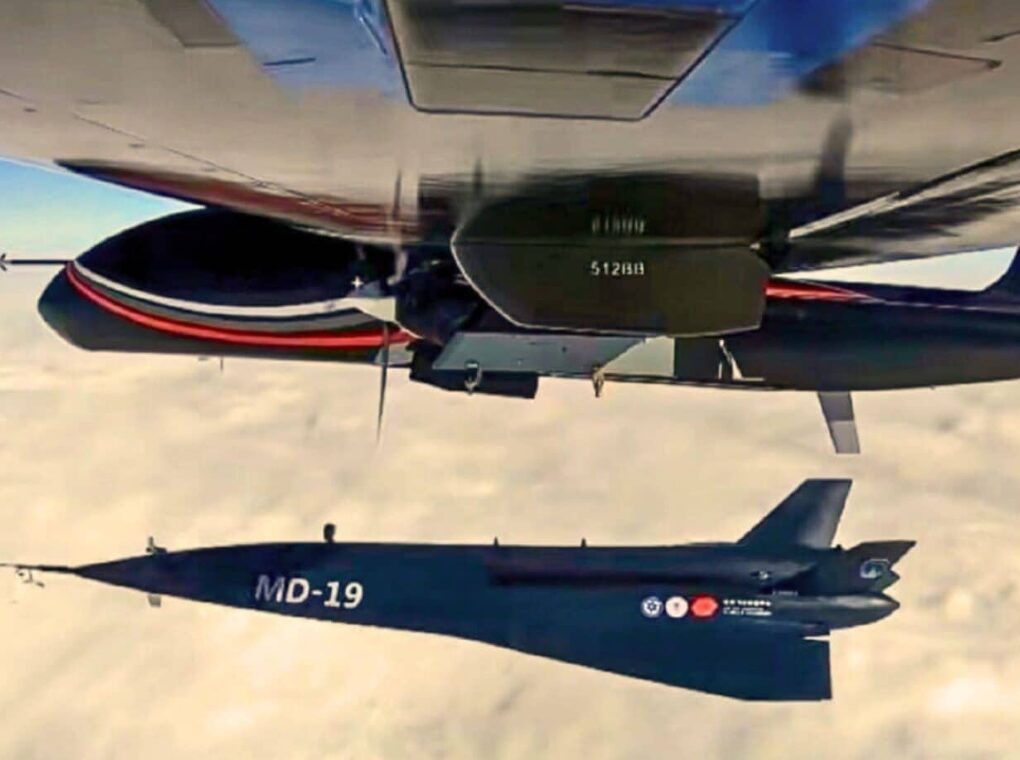
In a development that could significantly disrupt global military balances, Chinese researchers have proposed a next-generation weapons system capable of launching hypersonic missiles from space. According to a recent study linked to the People’s Liberation Army Rocket Force (PLARF), these Mach 20-capable glide vehicles could strike any point on Earth in under 30 minutes, dramatically reducing reaction times for targeted nations and complicating existing missile defense strategies.
This revelation, first reported by the South China Morning Post, points to China’s accelerating advancements in aerospace and hypersonic technology—areas already central to the intensifying global arms race.
Striking From Orbit: A New Military Doctrine
The study outlines a potential future in which hypersonic glide vehicles (HGVs) are deployed not only from terrestrial platforms, but from space-based infrastructure such as satellites or orbital stations. Capable of reaching speeds of approximately 21,000 km/h, these weapons would re-enter the Earth’s atmosphere and use lift-based maneuvering to evade detection and interception.
Researchers noted that this orbital launch capability would “compress the adversary’s early-warning system response time and operational scope, thereby enhancing the probability of successful penetration.” The unpredictable nature of these gliders’ flight paths—unlike conventional ballistic arcs—further complicates defensive calculations, providing a strategic edge in any high-stakes military conflict.
This concept appears to validate longstanding concerns from Western intelligence agencies. As early as 2021, U.S. sources claimed China tested an orbital hypersonic delivery system—an allegation met with skepticism at the time but now supported by this latest Chinese study.
Technical Hurdles: Heat, Maneuverability, and Communication
Despite the alarming implications, several engineering challenges persist.
One of the most significant issues is the extreme heat generated by hypersonic flight. The friction with Earth’s atmosphere produces a strong infrared signature, making these weapons more visible to infrared tracking systems. Additionally, the HGVs’ maneuverability is limited to 3–5 Gs of gravitational force, restricting their ability to sharply change direction during evasive maneuvers.
Communication and targeting also remain critical vulnerabilities. During the final moments of reentry and target approach—when precision is most essential—bandwidth and signal integrity degrade, limiting real-time adjustments.
East vs. West: Diverging Hypersonic Strategies
While China explores the possibilities of orbital deployment, Western powers are advancing along a different path. Both the United States and United Kingdom are heavily invested in air-breathing hypersonic propulsion technologies. The UK-led Team Hypersonics program, for example, has completed over 230 successful tests of a next-generation scramjet engine, paving the way for hypersonic cruise missiles by the end of the decade.
These Western systems emphasize sustained flight, propulsion control, and agility—focusing on ground- or air-launched platforms rather than unpredictable orbital drops. The differing strategies reflect broader doctrinal priorities: while Western programs aim for operational flexibility and precision, China appears to be betting on speed and first-strike capability.
Strategic Shockwave: Rethinking Deterrence
The implications for global security are immense.
In a November 2024 interview, U.S. Secretary of Defense Pete Hegseth issued a stark warning: “Chinese hypersonic missiles can take out 10 aircraft carriers in the first 20 minutes of the conflict.” Such capabilities threaten to neutralize traditional force projection tools, such as naval carrier groups, before they even have a chance to respond.
Images from past Chinese military parades, including the 70th anniversary of the People’s Republic, have prominently displayed platforms like the DF-17—believed to be operational HGV launchers. These public displays serve not only as demonstrations of capability, but as signals of strategic intent.
A Race Against Time
With hypersonic technology rapidly evolving and space becoming an increasingly contested domain, the world may be approaching a new era of strategic vulnerability. Space-launched missiles capable of striking within minutes could fundamentally alter the calculus of deterrence, stability, and defense.
While China pushes forward with bold and aggressive designs, the rest of the world must decide how to respond: escalate, counterbalance—or find new avenues for arms control in an era where speed, not size, defines power.