
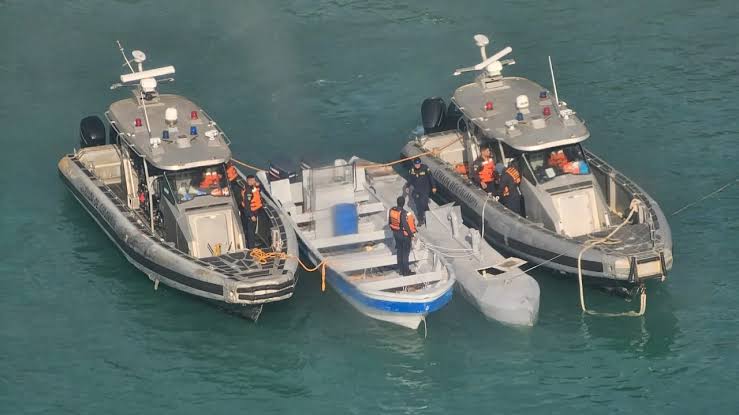
In a historic bust that signals a new chapter in global narcotics trafficking, Colombian naval forces have intercepted the region’s first unmanned, Starlink-equipped narco-submarine off the coast of Santa Marta in the Caribbean. The seizure marks a turning point in the war on drugs, as cartels increasingly turn to high-tech, crewless vessels capable of long-distance, stealth operations.
A Silent, High-Tech Smuggling Machine
The intercepted vessel was a low-profile semi-submersible—commonly referred to as a “narco-sub.” It had no cargo aboard, but authorities believe it was undergoing a trial run. The sub was equipped with:
A Starlink satellite internet terminal
GPS and camera-based navigation systems
Fiberglass hull for low radar signature
Range exceeding 800 miles, capable of carrying up to 1.5 tons of cocaine
According to the Colombian Navy, the vessel was remotely operated, with full communication support via SpaceX’s Starlink, allowing it to avoid traditional tracking methods.
Growing hi tech Smuggling
This is not the first time traffickers have employed sophisticated technology. A growing list of incidents suggests that unmanned, tech-enabled smuggling is rapidly becoming the norm:
India (2024): $4.2 Billion Meth Bust Involving Starlink
In December 2024, Indian authorities seized a Sri Lankan vessel carrying over 3,300 kg of methamphetamine—one of the largest maritime drug hauls in Indian history. What stunned investigators was the use of Starlink terminals on board, which enabled real-time sea navigation and communication with coordinators outside India’s jurisdiction.
Spain (2022): Remote-Controlled Narcos Subs Found in Galicia
In 2022, Spanish authorities seized several remotely controlled narco-sub prototypes in Galicia. The craft were capable of transporting 200 kg of drugs and were intended for cross-Mediterranean smuggling. They were built with sophisticated autonomous steering and GPS-guidance systems.
Ecuador (2010–Present): Birthplace of Narco-Subs
Ecuadorian authorities have been seizing drug subs for over a decade—mostly crude manned vessels. However, recent finds indicate that cartels are now shifting toward automated or partially automated designs, incorporating satellite modems and encrypted comms.
Cartels Are Going Remote
Unmanned smuggling offers several key advantages for traffickers:
No crew means no arrests, no interrogations, and minimal human risk.
High stealth via fiberglass materials, low thermal signatures, and deep-sea navigation.
Global satellite internet (like Starlink) enables transoceanic control, even in remote regions.
Colombian naval officers confirm that this intercepted sub is part of an emerging trend, not a one-off operation.
“We’re facing an arms race in maritime smuggling,” said a senior Colombian defense official. “Criminal organizations are investing in technologies that allow them to operate without borders, without people, and without fear.”
The use of civilian space-based technologies in crime poses new regulatory questions:
Should satellite internet services like Starlink be restricted or monitored in high-risk areas?
How can law enforcement agencies detect unmanned vessels in international waters?
What legal frameworks can be enforced when a crime is committed autonomously and remotely?
Experts are urging a multinational approach, with real-time satellite monitoring, tighter export controls on navigation tech, and cooperation between telecom companies and law enforcement.
With the seizure of a Starlink-enabled narco-submarine in the Caribbean, the global community has been given a stark warning: drug cartels have entered the digital age. As these organizations embrace autonomous vehicles, satellite connectivity, and remote logistics, governments must move quickly to respond.
The sea lanes of the 21st century are no longer just patrolled by ships—they are being navigated by silent, invisible drones, operated from afar, beyond borders and beyond reach. And tech like Starlink is being proven as a boon for them, out maneuvering the local governments and authorities.
Nations the world over will soon have to find a way around this, as unlimited access to such tech is bound to give rise to linked crimes. While connectivity is important it cannot come at the cost of National sovergnity and the safety of the public.
A line will soon have to be drawn as countries will have to reasess how they will use this tech while cutting down on its negative effects.