As the global balance of power shifts, all eyes are on the upcoming Shanghai Cooperation Organisation (SCO) Summit, set to take place this August. With major world leaders, including Russian President Vladimir Putin, Indian Prime Minister Narendra Modi, and Iran’s President — now representing a full SCO member state — scheduled to attend, this year’s summit is shaping up to be one of the most significant geopolitical gatherings in recent history.
Their participation signals more than just diplomatic engagement; it reflects the SCO’s rising influence, not only as a regional alliance but as a global security platform challenging the existing Western-led order.
That influence is drawing increasing concern from NATO, the U.S.-led military alliance that has dominated the global security landscape since the Cold War.
As geopolitical tensions rise, many are beginning to ask: Is the SCO becoming NATO’s 21st-century rival? And are we on the brink of a new Cold War?
SCO’s Expanding Footprint
Unlike BRICS, which primarily functions as an economic forum akin to the G7, the SCO is centered around strategic cooperation and security coordination. With China as a driving force — and Russia as a key pillar — the SCO represents an alternative model of regional integration and multipolarity, distinct from the Western liberal democratic order.
This increasingly positions the SCO as a counterweight to NATO, evoking comparisons to the Cold War-era standoff between NATO and the Warsaw Pact. While the SCO is less rigid and more diverse in its membership, the strategic motivations are beginning to mirror historical patterns of East-West division.
The Trump Effect: Tariffs, Tensions, and Realignment
A major catalyst in this shifting global alignment has been the foreign policy legacy of former U.S. President Donald Trump. His administration’s protectionist trade policies, including sweeping tariffs and sanctions — even against traditional allies — created a wave of uncertainty among nations long aligned with the West.
India, Brazil, Japan, and even Switzerland were hit with economic penalties once reserved for adversaries. As the U.S. increasingly blurred the line between friend and foe, countries began reassessing their dependencies and exploring alternative alliances.
In this context, the SCO has emerged as a platform for strategic diversification — a space where countries can pursue their interests without the constraints of a U.S.-dominated framework.
Strategic Realignment in Action
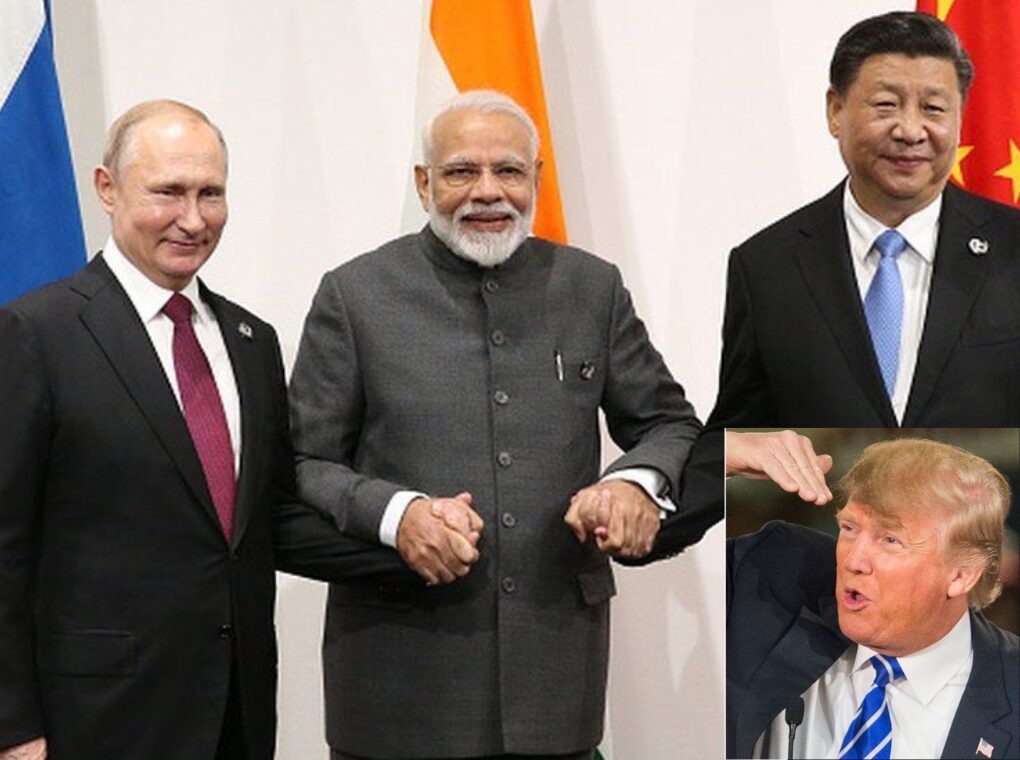
The shifting alliances are already visible. Despite recent border tensions with China, India has confirmed Prime Minister Modi’s participation in the SCO Summit — a move signaling that New Delhi is prioritizing broader regional cooperation over isolated conflicts.
The image of Modi, Putin, and Chinese President Xi Jinping sharing a stage will send a clear message to the West: the days of unipolar dominance may be coming to an end. Even Brazil’s President has voiced a preference for working with China and India over engaging with a U.S. administration perceived as unpredictable and unilateral.
These developments indicate a larger strategic recalibration, as countries seek to secure their interests in a world no longer defined by Western dominance.
NATO’s Growing Unease
The rise of the SCO has deeply unsettled NATO and Western policymakers. While the SCO has long included India — often cited as proof of its non-aligned, balanced posture — nearly all other members, including China, Russia, Iran, and Belarus, have strained or hostile relationships with the West.
As India faces increasing pressure from U.S. trade policies and shifting global priorities, even its position may become less neutral over time. Trump’s tariffs and sanctions, intended as instruments of pressure, may instead be driving traditional allies into the arms of America’s strategic competitors.
In what some analysts describe as a geopolitical miscalculation, Trump may have “gifted Asia to China” — with the SCO serving as the mechanism for that handover.
Echoes of the Cold War: SCO and the Warsaw Pact
Comparisons between the SCO and the Warsaw Pact are increasingly being drawn. While the SCO is not a formal military alliance and accommodates a variety of political systems, its core function echoes that of the Warsaw Pact — a coalition formed to challenge Western hegemony and promote a separate, sovereign sphere of influence.
Both blocs were conceived as responses to Western dominance: the Warsaw Pact to counter NATO’s military reach; the SCO to resist U.S. strategic and economic coercion.
In both cases, the unifying thread is clear: a shared commitment to pushing back against Western pressure, asserting autonomy, and reshaping the international order on their terms.
De-Dollarization: A Strategic Priority
One of the most anticipated topics at the upcoming SCO Summit is de-dollarization — the collective effort by member states to reduce reliance on the U.S. dollar in international trade and finance.
With Washington weaponizing the dollar through SWIFT exclusions and secondary sanctions, many countries are now turning to local currencies and alternative payment systems. China, Russia, and Iran already conduct a significant portion of their trade outside the dollar. India is also exploring similar options.
This push is not just economic — it’s a matter of sovereignty. Reducing dependency on the dollar is viewed as a way to protect national interests from political interference and ensure long-term strategic independence.
The Rise of a Multipolar World
The 2025 SCO Summit may come to be seen as a turning point in global politics — the moment when the East signaled its intent to play by a new set of rules.
The world is moving away from the unipolar structure that followed the Cold War, toward a multipolar landscape where several powers compete, collaborate, and co-exist.
Whether this transition leads to a new Cold War or a more balanced and inclusive global order remains to be seen. But one thing is clear: the SCO vs NATO rivalry is no longer theoretical — it’s becoming the new geopolitical reality.
So, is the world headed for renewed bipolarity? Or are we simply witnessing the growing pains of a multipolar future?
One summit may not decide the answer — but it will certainly help define the questions.