
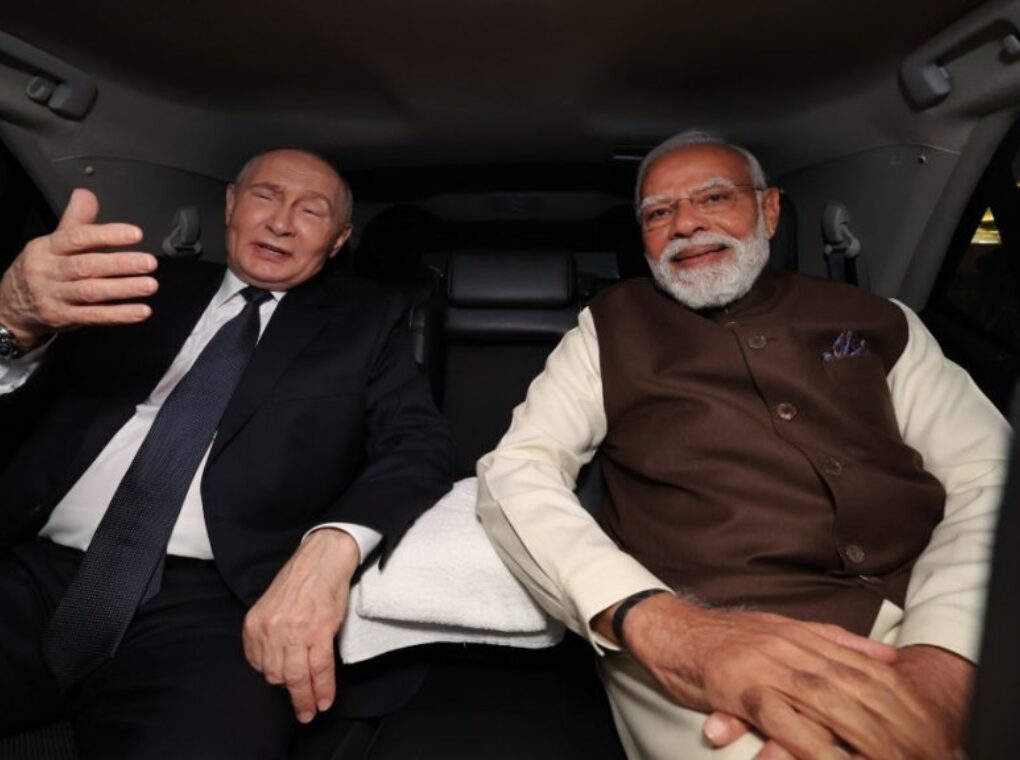
In a significant boost to defence cooperation, India and Russia have operationalized the Reciprocal Exchange of Logistics Support Agreement (RELOS), a landmark military logistics pact signed in February 2025. The agreement, now in effect, allows both nations to station up to 3,000 troops, along with a limited number of warships and aircraft, in each other’s territory—marking a new phase in their long-standing strategic partnership.
What is the RELOS Pact?
The RELOS (Reciprocal Exchange of Logistics Support) agreement enables mutual access to military facilities, including bases, ports, airfields, and airspace. Under the terms of the pact, both countries can deploy up to five warships, ten aircraft, and 3,000 personnel simultaneously on each other’s soil.
The agreement will remain valid for an initial period of five years and can be extended further by mutual consent. It came into force after ratification by Russia’s parliament, the State Duma, in December 2025.
Beyond military deployments, RELOS simplifies procedures for logistics support such as refuelling, maintenance, and resupply during joint exercises, training missions, humanitarian assistance, and disaster relief operations.
Strategic Significance: Expanding India’s Global Reach
One of the most crucial aspects of RELOS is its strategic geography. The agreement provides India access to key Russian Arctic ports, including Murmansk and Severomorsk—regions that are rapidly emerging as critical global maritime corridors due to melting ice and increasing geopolitical competition.
For India, this opens up new opportunities in the Arctic, not just for defence but also for energy and trade. Indian naval and commercial vessels can now benefit from Russian infrastructure, including icebreaker escorts for navigating frozen waters.
This access aligns with India’s growing interest in Arctic energy resources, especially liquefied natural gas (LNG) imports from Russia’s northern regions. The pact thus strengthens both strategic and economic cooperation between the two countries.
Benefits for Russia in the Indian Ocean
While India gains Arctic access, Russia stands to benefit from logistical support in the Indian Ocean Region (IOR). With RELOS, Russian naval vessels can utilise Indian facilities for refuelling, repairs, and replenishment, significantly enhancing their operational endurance far from home waters.
This reciprocal arrangement helps both nations reduce operational costs and improve mission efficiency, particularly during long-distance deployments.
Operational Flexibility in Peace and Conflict
A key feature of the RELOS agreement is its applicability during both peacetime and conflict scenarios. This ensures that logistical cooperation remains uninterrupted, whether during joint military exercises or in times of crisis.
Additionally, the pact introduces a simplified notification system for port calls and airspace usage, reducing bureaucratic delays and enhancing real-time coordination between the two militaries.
Interestingly, the agreement also allows for cost reimbursement through barter systems, enabling the exchange of goods and services instead of direct monetary transactions—adding flexibility to defence logistics.
RELOS vs LEMOA: India’s Multi-Alignment Strategy
India’s RELOS pact with Russia is often compared with its similar agreement with the United States—the Logistics Exchange Memorandum of Agreement (LEMOA). While both agreements facilitate mutual logistical support, RELOS goes a step further by explicitly allowing the stationing of troops.
This distinction highlights India’s evolving “multi-alignment” strategy, where it maintains strong defence ties with multiple global powers without being tied to a single bloc.
India’s balancing act is further underscored by data from the Stockholm International Peace Research Institute, which notes that Russia remains India’s largest arms supplier, accounting for about 36% of its defence imports between 2020 and 2024.
Implications for Global Geopolitics
The operationalization of RELOS comes at a time of heightened geopolitical tensions, particularly in regions like West Asia, Europe, and the Indo-Pacific. The agreement signals a deepening of India-Russia ties even as New Delhi strengthens relations with Western powers.
For global observers, RELOS represents more than just a logistics pact—it is a strategic statement. It underscores India’s intent to expand its military footprint globally while maintaining strategic autonomy.
At the same time, the agreement could raise concerns among Western nations, especially given ongoing tensions involving Russia. However, India has consistently maintained that its foreign policy is driven by national interest and strategic independence.
The India-Russia RELOS pact marks a pivotal development in bilateral defence relations, offering both nations enhanced operational flexibility, strategic reach, and cost efficiency. From Arctic access to Indian Ocean logistics, the agreement reshapes how the two militaries collaborate across regions.
More importantly, RELOS reinforces India’s position as a key player in an increasingly multipolar world—capable of engaging with diverse global powers while safeguarding its own strategic interests.