In a major development that deepens strategic ties between Moscow and Beijing, Russia and China have signed a long-anticipated agreement to build the Power of Siberia 2 gas pipeline, an energy project expected to be worth over $400 billion across its 30-year term. The deal marks a significant pivot in global energy dynamics, as both nations continue to challenge EU and Western pressures.
President Vladimir Putin had first pitched the $13.6 billion pipeline to Chinese leader Xi Jinping in 2022. The project, which would deliver 50 billion cubic meters of gas annually to northwest China, had stalled amid lengthy negotiations over pricing and volumes.
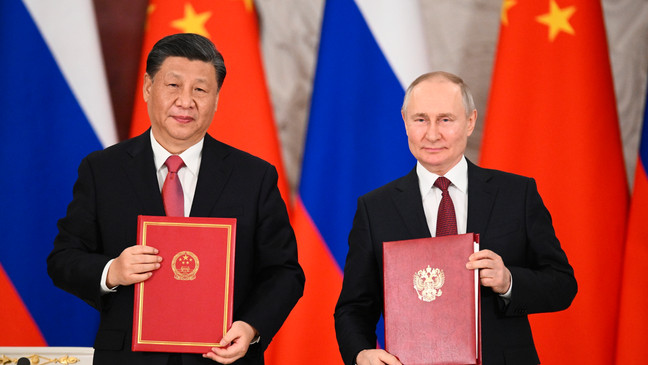
However on 2 sept 2025, Russia and China signed a “legally binding” memorandum to advance construction of the long-delayed Power of Siberia 2 pipeline, a project that would cement Beijing’s role as Moscow’s most important energy customer as it seeks to replace lost European markets.
The deal was one of four agreements struck between Russia’s state energy giant Gazprom and the China National Petroleum Corporation, Gazprom’s chief executive, Alexei Miller, told reporters.
“This will now be the largest, most ambitious and most capital-intensive project in the global gas industry,” Miller said.
A Game-Changing Deal
Russian energy giant Gazprom and China’s CNPC (China National Petroleum Corporation) formalized a legally binding memorandum to construct the massive pipeline stretching from Russia’s Yamal gas fields, through Mongolia, into northern China. The Power of Siberia 2 pipeline is projected to carry up to 50 billion cubic meters (bcm) of natural gas annually—rivaling the scale of Russia’s now-defunct Nord Stream 1 pipeline to Europe.
While official numbers were not disclosed, analysts estimate that the 30-year deal could be worth $400–$450 billion, assuming conservative pricing models and historical LNG contracts. This valuation would place it among the largest bilateral energy trade agreements in modern history.
50 bcm/year x 30 years = 1.5 trillion cubic meters
Based on an average price of $270–$300 per 1,000 cubic meters (comparable to past China-Russia deals), the total deal value lands in the $405–$450 billion range.
Power of Siberia 1: Gas exports via this operational pipeline will increase from 38 to 44 bcm annually, an additional 12 bcm per year will be supplied through the far east corridor.
The new pipeline is expected to begin construction within the next few years, with initial flows projected by early 2030s.
The pipeline will originate in northwest Siberia, traverse Mongolia, and connect to China’s industrial regions—mirroring the route originally intended for Western Europe.
Geopolitical Implications
This deal arrives at a moment when Russia faces deepening isolation from Europe due to sanctions following the invasion of Ukraine. By redirecting its energy exports eastward, Moscow not only salvages its gas industry but also cements a long-term partnership with Beijing—one that Western leaders view with increasing alarm.
China, for its part, gains a stable, long-term energy source insulated from volatile maritime trade routes. It also diversifies away from Middle Eastern and seaborne LNG sources, reinforcing its energy security amid rising tensions with the U.S. and its allies.
The growing energy axis between Russia and China comes as Western nations struggle to isolate Moscow economically. Analysts warn that as Russia becomes more embedded in Asian markets, Western sanctions lose leverage, and global energy flows realign in ways that could prove difficult to reverse.
U.S. and EU officials have expressed frustration over Beijing’s continued support for Russian energy exports, arguing that it undermines efforts to constrain Moscow’s military ambitions.
The Power of Siberia 2 deal is not just a pipeline project—it’s a geopolitical statement. It signals the rise of a new Eurasian energy corridor and a growing resistance to Western energy dominance. As the world’s energy map continues to shift, this partnership between Russia and China will likely remain at the center of global energy politics for decades to come.