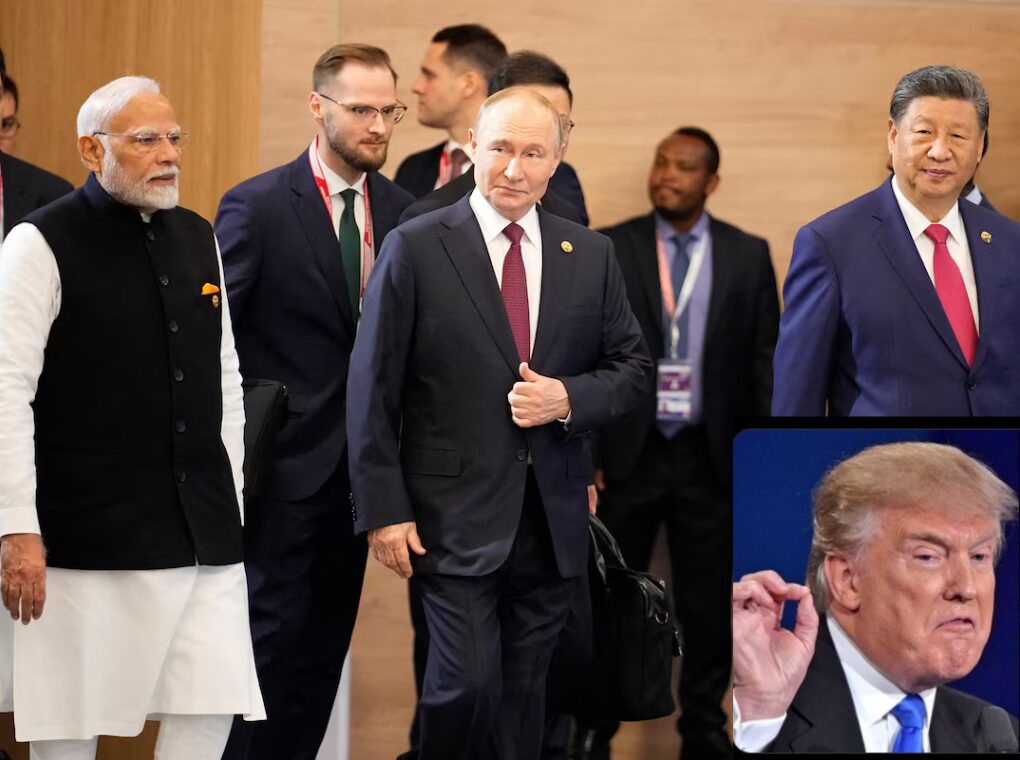
In a recent statement, U.S. President Donald Trump remarked, “Looks like we’ve lost India and Russia to deepest, darkest China,” sparking widespread discussion about the state of international relations and U.S. foreign policy.
This provocative comment, made amidst ongoing geopolitical shifts, highlights concern about the strengthening ties between India, Russia, and China, and the potential implications for U.S. influence in the region.
Trump’s Statement and Its Context
President Trump’s comment comes at a time of heightened global tensions, with the United States navigating complex relationships with India, Russia, and China. The statement appears to reflect frustration over India’s continued engagement with Russia and its participation in multilateral frameworks like the Shanghai Cooperation Organisation (SCO), where China plays a significant role.
Trump’s administration has been vocal about India’s refusal to sever historic ties with Russia, especially in light of U.S. efforts to isolate Russia amid the Ukraine conflict.
Additionally, Trump’s remarks may be linked to trade disputes, as he has reportedly threatened high tariffs on Indian goods, a move that some analysts interpret as an attempt to pressure India into aligning more closely with U.S. interests.
These developments raise questions about the strategic partnership between the U.S. and India, which has been a cornerstone of U.S. policy in the Indo-Pacific region.
India’s Balancing Act in Global Diplomacy
India has long maintained a policy of strategic autonomy, balancing relationships with major powers like the United States, Russia, and China. Its deep ties with Russia, rooted in decades of defense and energy cooperation, remain robust despite Western sanctions on Moscow.
India’s participation in the SCO summit in Tianjin, alongside plans to host Russian President Vladimir Putin later in 2025, underscores its commitment to maintaining strong ties with Russia.
Simultaneously, India has been engaging with China on trade and regional issues. China’s recent announcement of openness to importing more Indian products signals a potential warming of economic ties, which could further complicate U.S.-India relations.
This development aligns with Russia’s offer to welcome Indian goods in its market if U.S. tariffs create barriers, suggesting a coordinated effort by Russia and China to counter U.S. influence.
The U.S. Strategic Concerns
Trump’s statement reflects broader U.S. concerns about losing influence in Asia as India and Russia deepen their engagement with China. The U.S. has invested heavily in the Quad (comprising the U.S., India, Japan, and Australia) to counter China’s growing assertiveness in the Indo-Pacific. However, India’s refusal to fully align with U.S. policies on Russia, combined with its participation in China-led initiatives like the SCO, has raised eyebrows in Washington.
Analysts suggest that Trump’s rhetoric may also be driven by domestic political considerations, as he seeks to project strength and rally support by criticizing perceived foreign policy setbacks. His administration’s focus on tariffs and trade restrictions indicates an attempt to leverage economic tools to influence India’s geopolitical choices. However, such measures risk alienating India, which has historically resisted external pressure on its foreign policy.
Regional Dynamics: The Arakan Army and Geopolitical Shifts
Adding to the complexity, recent developments in Myanmar’s Rakhine State, where the Arakan Army has seized control of key townships, highlight the strategic interests of both India and China in the region. Rakhine is home to critical infrastructure projects, including an Indian port and Chinese oil and gas pipelines tied to the Belt and Road Initiative.
The Arakan Army’s advances could disrupt these projects, further complicating India and China’s regional strategies. This situation underscores the delicate balance India must maintain as it navigates its relationships with both China and the U.S. while pursuing its own interests.
Implications for U.S.-India Relations
Trump’s comments have sparked concerns about the future of the U.S.-India strategic partnership, his approach as a “grave strategic miscalculation” that could undermine years of progress in bilateral ties. India’s leadership, including Prime Minister Narendra Modi, has emphasized that trade disputes have not been a central focus of discussions with the U.S.
Nevertheless, the perception of U.S. pressure could push India closer to Russia and China, particularly if economic incentives from these countries grow stronger.
President Trump’s statement about “losing” India and Russia to China underscores the challenges facing U.S. foreign policy in a rapidly changing geopolitical landscape. India’s strategic autonomy, coupled with its growing economic ties with Russia and China, poses a dilemma for the U.S. as it seeks to maintain influence in the Indo-Pacific.
While Trump’s rhetoric may aim to pressure India into aligning more closely with U.S. interests, it risks straining a critical partnership. As global alliances continue to evolve, the U.S. must navigate these complexities with diplomacy and foresight to avoid further alienating key partners like India.