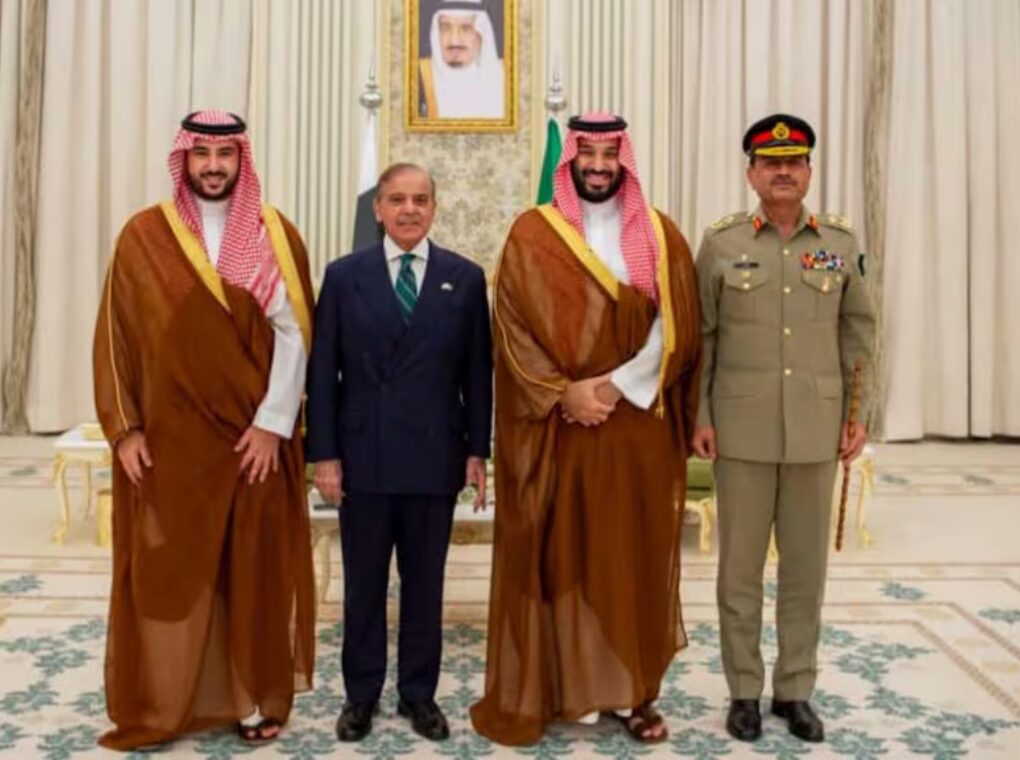
In a development that could reshape the strategic landscape of the Middle East, Saudi Arabia and Pakistan have signed a Mutual Defense Treaty—an agreement declaring that an attack on one will be treated as an attack on both. The pact formalizes decades of informal cooperation and signals a striking shift away from sole reliance on American protection.
For decades, the United States stood as the uncontested security guarantor in the Gulf. Washington armed its allies with billions in advanced weaponry, stationed tens of thousands of troops across the region, and promised protection from adversaries like Iran, Yemen’s Houthis, and extremist groups. But this treaty sends a blunt message: America is no longer the only game in town.
A Catalyst for Change
The timing of the agreement is no coincidence. Reports of an alleged Israeli strike on Qatar rattled Gulf capitals in recent weeks. Qatar hosts Al Udeid Air Base, the largest U.S. military facility in the Middle East, yet Washington’s response was limited to a token condemnation.
For Gulf states, this underscored an uncomfortable reality: U.S. commitments are conditional, and when Israeli interests are at stake, Washington’s loyalties lean in one direction. For Crown Prince Mohammed bin Salman (MBS), this episode was a wake-up call that Saudi Arabia could no longer rely solely on America’s promises.
Why Pakistan?
Saudi Arabia’s choice of Pakistan as a defense partner is rooted in history as much as strategy.
Military Power: Pakistan fields one of the world’s largest, battle-tested armies, with experience in counterterrorism and conventional warfare. For years, Saudi Arabia has effectively “rented” Pakistani troops for internal security.
Nuclear Deterrence: As the only Muslim-majority nation with nuclear weapons, Pakistan brings a deterrent value that no Arab state can match.
Historic Ties: For decades, Saudi Arabia has extended billions in loans, oil subsidies, and aid to Pakistan. In return, Pakistani forces have guarded Saudi soil, trained the kingdom’s military, and manned key installations.
The treaty merely formalizes what has long existed in practice. Now, it is official—and its announcement has sent shockwaves across the region.
A Direct Rebuke to Washington
For the United States, the pact is a symbolic and strategic blow. Washington has long positioned itself as the Gulf’s ultimate protector, leveraging arms sales and troop deployments to secure its influence. Yet, Riyadh’s decision to sign a binding agreement with Islamabad reveals deepening distrust.
This is not simply about defense cooperation. It is a declaration of a post-American Middle East—a signal that U.S. dominance is shrinking, and that new players, from Pakistan to China to Russia, are carving out space in the regional security order.
Regional Implications
The treaty carries far-reaching consequences:
Iran: Tehran is likely to view the pact as encirclement, prompting deeper alignment with Russia, China, and proxies like the Houthis.
Israel: For Tel Aviv, the deal is troubling. Any future clash with Saudi Arabia might draw in Pakistan, a nuclear-armed state far outside Israel’s traditional Arab rivals.
Gulf States: Qatar and others may now consider bilateral defense arrangements of their own, further weakening the U.S.-led Gulf Cooperation Council framework.
Pakistan: Islamabad stands to benefit significantly, gaining Saudi funding, economic lifelines, and recognition as a key player in Middle Eastern security.
This is the architecture of a multipolar Middle East, one no longer dictated solely by Washington.
India’s Concerns
The agreement also raises alarm bells in New Delhi. While Saudi troops are unlikely to march into a conflict over Kashmir, Saudi funding could strengthen Pakistan’s military and economy. That, in turn, emboldens Islamabad in its rivalry with India.
New Delhi may now accelerate its own strategic partnerships—with the U.S., Israel, and the Quad—to offset this emerging Saudi-Pakistani axis.
Symbolism vs. Reality
Critics caution that mutual defense treaties often carry more symbolic weight than practical guarantees. NATO’s Article 5 has only been invoked once in history. The Saudi-Pakistan agreement may similarly prove difficult to operationalize due to geography, differing threat perceptions, and political constraints.
But symbols matter. Even if Saudi forces never deploy to Pakistan’s defense, Riyadh’s financial and diplomatic backing could significantly alter the balance of power.
The Saudi-Pakistan Mutual Defense Treaty is more than ink on paper. It is a strategic pivot—a declaration that Riyadh will no longer rely solely on U.S. protection.
For decades, the Middle East revolved around American power. But this pact marks the rise of a multipolar order, where new alliances define security, and Washington’s monopoly is broken.
The message is clear: the balance of power in the Middle East has shifted.