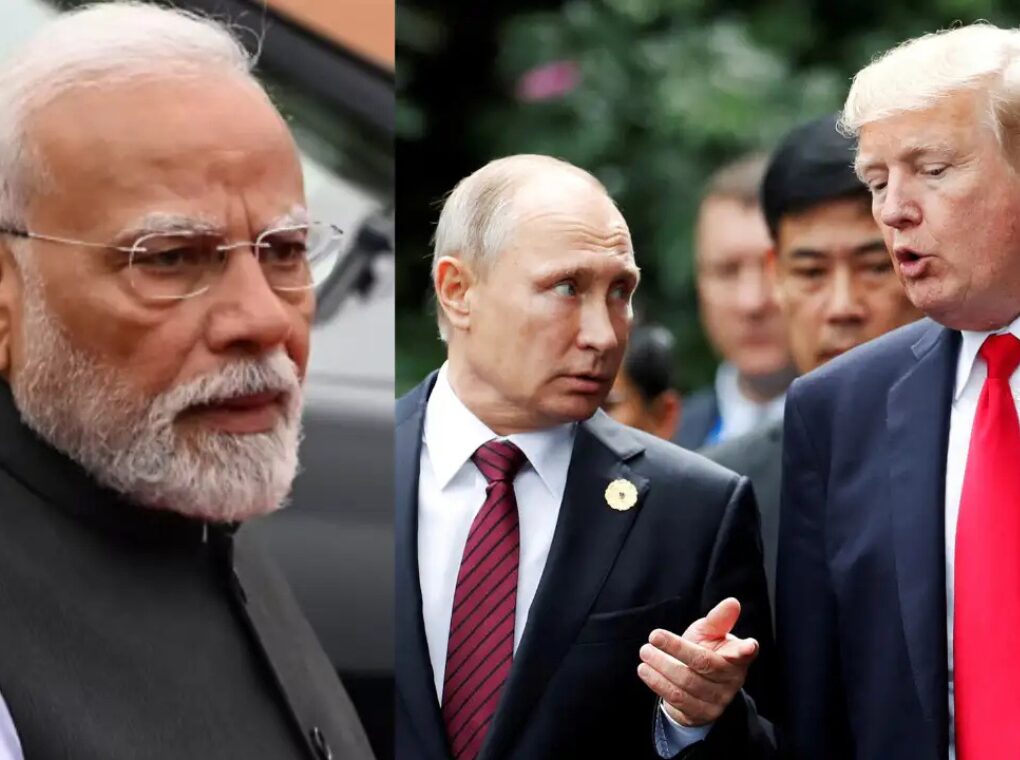
The global chessboard of energy and geopolitics is shifting once again. U.S. President Donald Trump, now in his second term, has made cutting off Russia’s oil revenue one of his defining foreign policy goals. But while Trump pushes for punishing tariffs on nations still buying Russian crude, America’s closest allies in the G7 and European Union are charting a different path.
Rather than isolating India, they are doubling down on engagement with New Delhi—underscoring its growing importance as a strategic partner they cannot afford to alienate.
Trump’s Hardline Stance
Since returning to office in 2025, Trump has adopted a combative position on Russian oil. In August, he slapped a 50% tariff on Indian imports, blasting New Delhi for continuing to purchase discounted Russian crude. He called on G7 allies and the EU to follow suit, even suggesting tariffs of up to 100% on India, China, and Brazil.
Trump’s advisors, including Stephen Miller and Peter Navarro, accused India of indirectly fueling Moscow’s war effort. Senator Lindsey Graham echoed the rhetoric, insisting that nations buying Russian oil would face inevitable penalties.
For Trump, the logic is simple: every barrel purchased from Russia helps Vladimir Putin prolong the war in Ukraine.
India’s Energy Calculus
Yet India sees things differently. Since the war’s outbreak in 2022, it has emerged as one of Russia’s biggest energy customers, with Russian crude accounting for over 40% of India’s imports by mid-2025.
Indian officials argue this is a matter of strategic autonomy and economic stability. Russian oil, bought at discounted rates, helps keep domestic fuel prices manageable in a country of 1.4 billion people.
Crucially, Indian refiners have complied with the G7 price cap system, meaning purchases technically remain within Western rules. For Europe, this provides political cover; for Trump, it is a loophole that undermines his pressure campaign.
Europe’s Softer Approach
Unlike Trump, the G7 and EU have avoided direct confrontation with India. The reason is straightforward: New Delhi’s strategic weight.
As a counterbalance to China in the Indo-Pacific, India is viewed as indispensable. Alienating it with sanctions or tariffs could backfire, pushing it closer to Moscow—or even Beijing.
Japan captured the sentiment bluntly, with Finance Minister Katsunobu Kato saying Trump’s call for tariffs on India was “too difficult.”
Instead, Europe has chosen pragmatism. Its sanctions have zeroed in on Russia’s shadow fleet and evasion networks rather than punishing buyers like India. Behind the scenes, officials stress the risks of alienating New Delhi, opting instead for trade talks, technology partnerships, and defense cooperation.
Trump’s Frustration and Tactical Shift
Trump’s frustration has been visible. In September, his Treasury Department again urged allies to impose “meaningful tariffs” on India and China. But European leaders largely brushed it off.
Then came a telling pivot. In a September 18 Fox News interview, Trump avoided naming India altogether, focusing criticism squarely on Beijing. “If China stopped buying Russian oil, the war could end quickly,” he declared.
That omission was no accident. U.S.-India negotiations are ongoing, and Trump’s team appears to recognize that New Delhi is too critical to alienate completely.
The Tariff Backtrack
The clearest signal of this recalibration came from India’s Chief Economic Adviser, who revealed that Washington may slash or remove tariffs on Indian goods after November 30, 2025. Talks are already underway to reduce the current 25% duty to around 10–15%.
The reasoning is both strategic and economic. Indian officials warned the tariff could cut U.S. orders by up to 30%, a blow American businesses cannot afford. Combined with India’s geopolitical importance, Trump’s hardline stance is showing signs of softening.
The Bigger Picture
This episode underscores the deepening fault lines in Western unity. Trump favors maximum pressure, tariffs, and confrontation. The G7 and EU prefer strategic patience and engagement.
For India, the outcome is clear: its balancing act is working. By buying cheap Russian oil, it shields its economy. By maintaining ties with the West, it cements its role as a rising global power.
For Russia, loopholes remain. For the West, the divergence highlights a hard truth—unity is easier to demand than to sustain.
In the great game of oil, tariffs, and alliances, one fact has become undeniable: India has emerged as the kingmaker.