
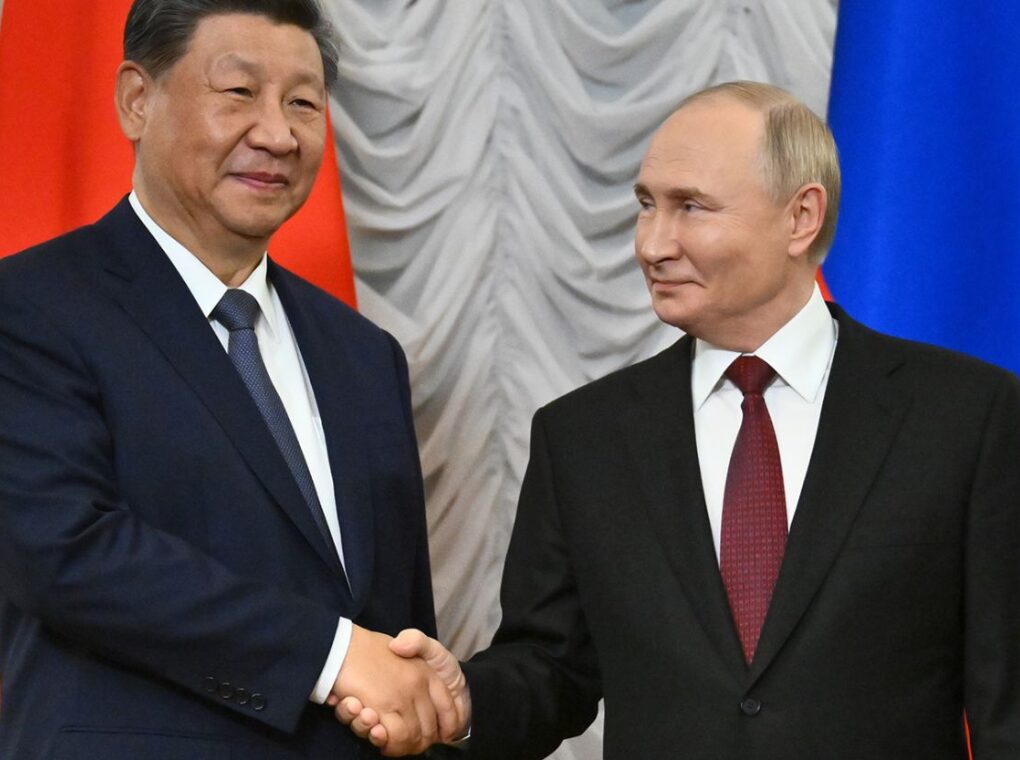
In a surprising and consequential move, China has reportedly restricted the export of critical high-tech components to Russia, a decision that could severely hamper Moscow’s defense industry and its ability to sustain large-scale weapons production.
This development marks a potential turning point in the Russia–China partnership, which has so far helped Moscow bypass Western sanctions and maintain the flow of essential technology for its war effort in Ukraine.
A Sudden Shift in Beijing’s Strategy
For the past two years, Russia has relied heavily on China to supply crucial “dual-use” technologies — materials and components that can serve both civilian and military purposes. These include advanced microchips, precision machinery, optical systems, and specialized chemicals vital for modern weaponry.
China’s decision to tighten export controls on such goods signals a growing awareness of the political and economic costs of being perceived as Russia’s technological lifeline. Beijing is increasingly cautious about attracting Western sanctions or diplomatic backlash at a time when its economy is facing domestic headwinds and global scrutiny over trade practices.
While Chinese officials continue to deny supplying weapons or direct military assistance to Moscow, the new export restrictions indicate a more measured stance. Beijing appears keen to distance itself from accusations of enabling Russia’s war machine, while still preserving its image as a global power capable of balancing both East and West.
Russia’s Defense Industry Feels the Strain
The consequences of these restrictions could be profound. Russia’s defense manufacturing has long depended on imported high-tech components — many of which are difficult or impossible to produce domestically.
1. Microchips and Electronics:
Modern missiles, drones, communication systems, and targeting equipment rely on sophisticated microprocessors. Russia’s own semiconductor industry is decades behind global leaders, and without Chinese supplies, it faces an immediate shortfall.
2. Precision Machinery:
The production of tanks, artillery, and advanced weapon systems requires specialized computer-controlled machines and precision tools. These machines, primarily imported from China, are essential for maintaining production speed and quality.
3. Specialty Materials and Chemicals:
Critical minerals such as gallium, germanium, and other rare materials — mostly refined in China — are necessary for missile guidance systems, sensors, and optics. Restricting their export will disrupt multiple stages of Russia’s defense production line.
4. Optics and Sensors:
High-quality optics, infrared sensors, and laser guidance modules are the backbone of Russia’s precision weapons. Many of these depend on Chinese-supplied components or subassemblies, meaning any disruption will degrade accuracy and effectiveness.
Taken together, these factors point toward an impending slowdown in Russia’s arms production capacity. Moscow may soon face shortages not only in cutting-edge systems but also in the spare parts needed to maintain existing stockpiles.
Moscow’s Limited Options
The Kremlin has few viable ways to offset this setback. Some analysts believe Russia will attempt to source banned items through third countries, smuggling networks, or black-market intermediaries — a tactic it has used before to evade Western sanctions. However, tighter global monitoring makes this increasingly difficult.
Another option is to ramp up domestic production, but rebuilding an entire ecosystem of advanced manufacturing, semiconductor fabrication, and precision engineering would take years — possibly decades. In the short term, Russia may be forced to simplify designs, use lower-quality substitutes, or downgrade certain weapons systems to keep factories running.
Moscow might also try to pressure Beijing through diplomatic channels, invoking the “no-limits partnership” both countries have publicly celebrated. Yet China’s latest actions suggest its strategic calculus is shifting: maintaining stable global trade relations may now outweigh the benefits of unconditionally supporting Russia.
Strategic Implications
If China maintains its restrictions, the impact on Russia’s long-term military capability could be substantial. A steady decline in the quality and quantity of Russian weapons would weaken its position in Ukraine and diminish its global arms exports — one of the Kremlin’s major sources of revenue and influence.
For the West, this represents a quiet victory. The effectiveness of sanctions depends on closing every technological loophole, and Beijing’s cooperation — even partial — would greatly amplify that pressure.
For China, however, the balancing act continues. By tightening controls, it signals responsibility and restraint to the international community, but it also risks alienating a key geopolitical ally.
In essence, China’s decision to cut off vital technological supplies to Russia marks more than a trade policy change — it could be a strategic recalibration with global consequences. As Moscow scrambles to sustain its defense industry under mounting isolation, the once-unshakeable partnership between the two powers is showing its first real signs of strain.