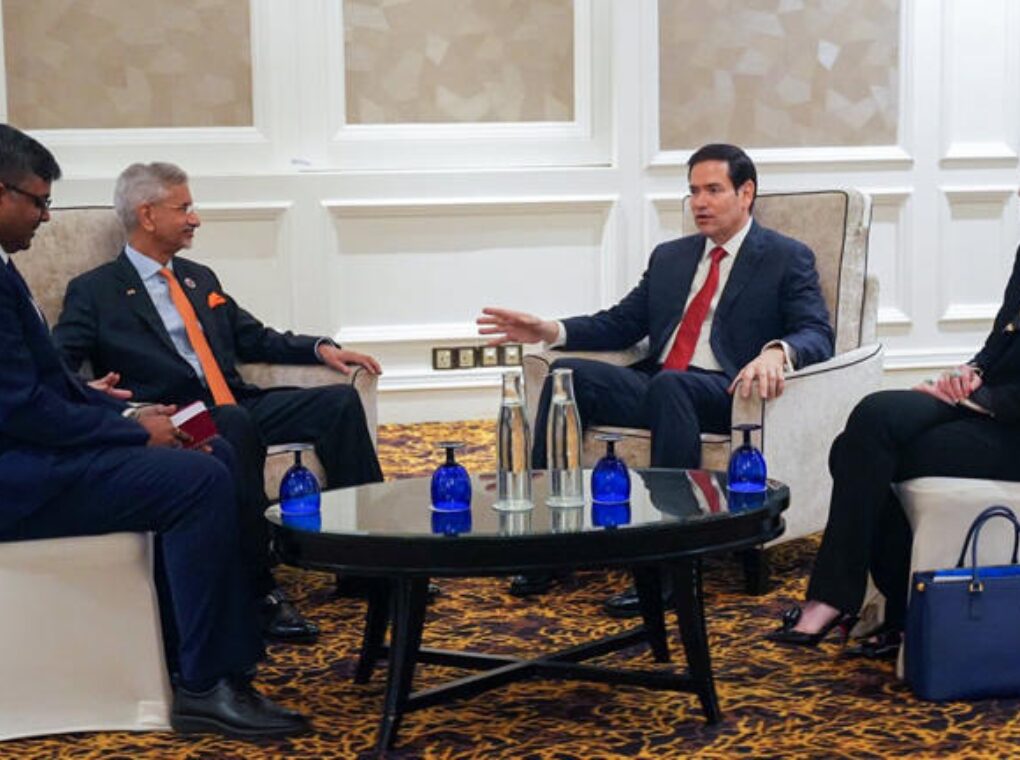
India’s External Affairs Minister S. Jaishankar delivered a pointed and wide-ranging address at the East Asia Summit in Kuala Lumpur on Monday, hours after meeting U.S. Secretary of State Antony Blinken. In a veiled critique of Washington’s recent tariff actions against India, Jaishankar warned that the global energy market and trade frameworks are being increasingly distorted by the selective application of principles and inconsistent policies by major powers.
Energy Trade and U.S. Tariffs
The remarks came in the backdrop of the Trump administration’s decision to impose an additional 25% tariff on India’s imports of Russian oil, alongside a similar tariff on a range of Indian goods. The United States, however, has refrained from applying such penalties on Europe and China, both of which continue to source energy from Moscow.
“Energy trade is increasingly constricted, with resulting market distortions,” Jaishankar said during his intervention at the summit. “Principles are applied selectively, and what is preached is not necessarily practiced.”
This sharp observation reflects New Delhi’s growing concern over the weaponisation of trade and economic policy in a geopolitically fragmented world. India, which has sought to balance its energy security needs with diplomatic considerations, views the U.S. move as discriminatory and inconsistent with the idea of a “rules-based order” often championed by Washington.
A Call for Realism in Global Supply Chains and Technology
Without naming China, Jaishankar also addressed the mounting challenges of economic dependence, supply chain vulnerability, and the growing competition over technology and natural resources.
“We meet in complicated times,” he said. “There are growing concerns about the reliability of supply chains and access to markets. Technology advancement has become very competitive, and the quest for natural resources even more so.”
Emphasizing the inevitability of global transformation, Jaishankar observed that “change has a life of its own.” He underscored the importance of adaptation and innovation as the world transitions toward a more multipolar order.
“At the end of the day, the realities of technology, competitiveness, market size, digitization, connectivity, talent, and mobility cannot be ignored. Multipolarity is not just here to stay but to grow,” he asserted. His remarks signaled India’s belief that no single power can dictate the terms of global order in the 21st century and that cooperation must evolve in line with diverse national interests.
On Global Conflicts and Peace Initiatives
Turning to ongoing crises, Jaishankar expressed concern over the wars in Europe and the Middle East, pointing to their far-reaching humanitarian and economic impacts. “We are also witnessing conflicts that have significant repercussions, near and far. Deep human suffering apart, they undermine food security, threaten energy flows, and disrupt trade,” he said.
He reiterated India’s support for the Gaza peace plan — a diplomatic initiative backed by Prime Minister Narendra Modi and endorsed by New Delhi earlier this month. “India, therefore, welcomes the Gaza peace plan. We also seek an early end to the conflict in Ukraine,” he added, signaling India’s consistent advocacy for dialogue and peaceful resolution of disputes.
Firm Stand Against Terrorism
In one of the most forceful parts of his address, Jaishankar drew attention to the persistent threat of terrorism, referencing the recent Pahalgam attack and India’s counter-operation, codenamed Operation Sindoor. Without naming Pakistan, he made clear India’s position: “Terrorism poses a continuous and corrosive threat. The world must display zero tolerance; there is no room for ambivalence. Our right of defence against terrorism can never be compromised.”
Maritime Cooperation and Indo-Pacific Strategy
Amid China’s growing assertiveness in the South China Sea, Jaishankar underscored India’s commitment to maritime cooperation within the ASEAN and Indo-Pacific frameworks. He highlighted India’s alignment with the ASEAN Outlook on the Indo-Pacific (AOIP) and reaffirmed adherence to the principles of the 1982 UN Convention on the Law of the Sea (UNCLOS).
“2026 will be observed as the ASEAN-India Year of Maritime Cooperation,” Jaishankar announced, noting that more nations have joined the Indo-Pacific Oceans Initiative (IPOI). India has also proposed an EAS Maritime Heritage Festival in the ancient port city of Lothal, Gujarat, and plans to host the 7th EAS Conference on Maritime Security Cooperation.
Regional Cooperation and Connectivity
The minister also touched on ongoing regional initiatives, including humanitarian efforts and cross-border connectivity projects. Referring to Myanmar, he said India was among the “first responders” during the March earthquake and reaffirmed India’s commitment to the India–Myanmar–Thailand Trilateral Highway, a strategic connectivity project linking South and Southeast Asia.
On the cyber front, Jaishankar expressed concern over scam centres in the region that have entrapped Indian citizens. “We share the concern about cyber scam centres in the region which have also entrapped our nationals,” he said, highlighting the growing transnational dimension of cybercrime.
India’s Broader Message: Multipolarity and Strategic Autonomy
Jaishankar’s remarks — particularly his implicit rebuke of Washington’s selective trade policy — reaffirm India’s stance as a self-confident actor pursuing strategic autonomy in a multipolar world. By juxtaposing the issues of energy security, trade fairness, terrorism, and maritime stability, the External Affairs Minister projected India as a responsible and principled power seeking equitable global cooperation.
Earlier in the day, Jaishankar met with U.S. Secretary of State Marco Rubio on the sidelines of the summit. In a post on X, he said he “appreciated the discussion on our bilateral ties as well as regional and global issues.”
The Kuala Lumpur engagements, including his meetings with leaders from Malaysia, Singapore, and Thailand, underscored India’s active diplomacy in the Indo-Pacific — one rooted in partnership, pragmatism, and principle.