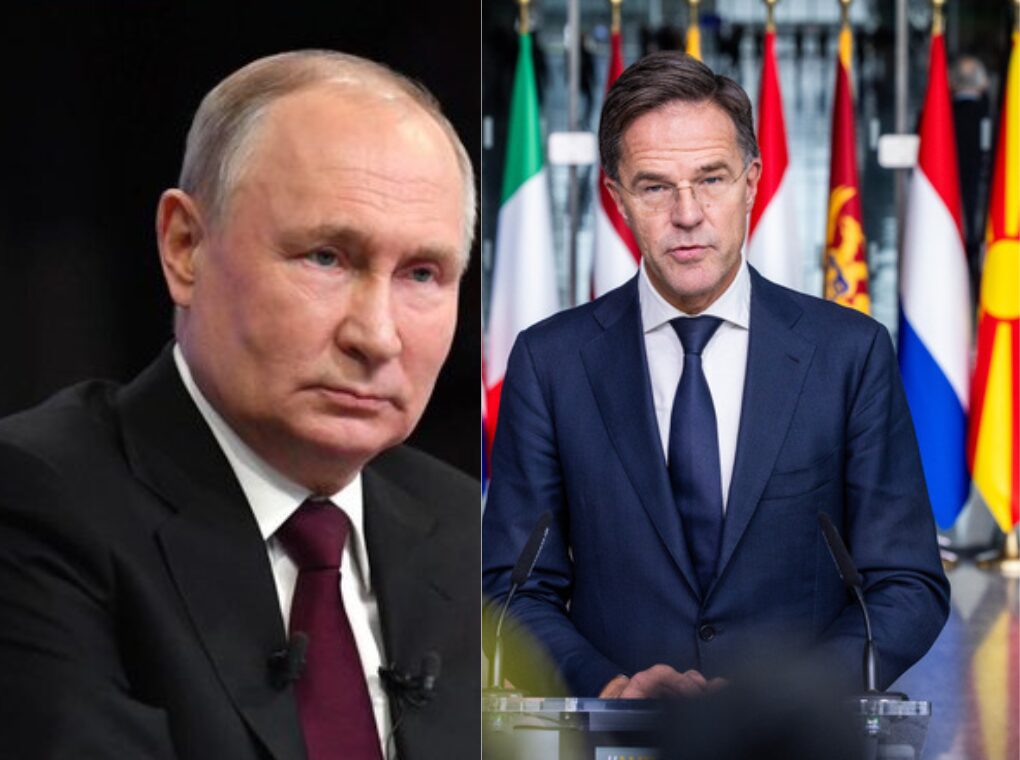
In a speech that will be remembered as one of the most sobering delivered by a NATO leader since the end of the Cold War, Secretary General Mark Rutte warned Thursday that Russia could be ready to launch a direct military attack on a NATO member state as early as 2030 and urged European governments to prepare for a conflict “on the scale of war our grandparents and great-grandparents endured.”
Speaking at the German Council on Foreign Relations in Berlin, the former Dutch prime minister pulled no punches. “Conflict is at our door. Russia has brought war back to Europe,” he declared. “We must be prepared for the scale of war our grandparents or great-grandparents endured.”
Rutte’s five-year timeline aligns with increasingly urgent assessments from Western intelligence agencies, including Britain’s MI6, Germany’s BND, and the U.S. Defense Intelligence Agency, all of which have privately briefed governments that Moscow could reconstitute sufficient combat power for a limited conventional campaign against NATO’s eastern flank by the end of the decade.
Russia’s Industrial Surge and Hybrid Escalation
The NATO chief painted a grim picture of Russia’s transformation into a full-scale war economy. Since 2022, Russian factories have been running three shifts a day. According to the latest estimates from the Kiel Institute for the World Economy, Russia is currently producing approximately 150 tanks, 550 infantry fighting vehicles, 120 Lancet loitering munitions, and more than 50 artillery systems every single month—figures that dwarf the combined output of Western Europe.
This year alone, Russia has fired more than 46,000 drones and missiles at Ukraine, Rutte revealed, underscoring Moscow’s ability to sustain high-intensity warfare for years. Meanwhile, hybrid attacks—cyber intrusions, sabotage of undersea cables, GPS jamming, and unexplained drone flights over airbases and nuclear sites in Germany, Sweden, and the Baltic states—have surged across the continent.
“Russia is already escalating its covert campaign against our societies,” Rutte said. “These are not isolated incidents. They are part of a deliberate strategy.”
The China Factor
Rutte reserved some of his strongest language for Beijing, describing China as Russia’s “lifeline.” He accused the People’s Republic of supplying the overwhelming majority of critical electronic components—microchips, guidance systems, and solid-state circuitry—without which Russia’s drone and missile programs would collapse.
“China wants to prevent its ally from losing in Ukraine,” he stated bluntly. The warning comes just weeks after the European Union imposed new sanctions on Chinese firms accused of circumventing export controls.
A Direct Rebuke to Complacency
Perhaps the most politically explosive part of the speech was Rutte’s direct criticism of European governments for what he called “quiet complacency.” Despite three years of war on the continent, only a minority of NATO’s 32 members currently meet the 2 percent of GDP defense-spending target agreed in 2014.
In follow-up remarks to journalists, Rutte went further, openly endorsing calls—first floated by Polish Prime Minister Donald Tusk and Estonian Prime Minister Kaja Kallas—for a new 5 percent benchmark.
“An increase in defense spending to 5 percent is needed to reach our capability targets,” he said, “to make sure that we can fight the Russians if they would attack us—and of course we also have the huge military build-up in China. You see Europe stepping up.”
France and Germany have already begun reviving voluntary (and in some cases mandatory) national service programs for 18-year-olds. Poland has announced plans to double the size of its armed forces to 500,000 by 2035. The United Kingdom is debating the return of some form of conscription for the first time since 1960.
The Trump Shadow
Rutte’s speech coincided with intense diplomatic activity in Washington, where President Donald Trump is pushing for a rapid end to the Ukraine war. On Thursday, the NATO chief participated in a high-level video call that included Ukrainian President Volodymyr Zelensky, U.S. Secretary of State Marco Rubio, Defense Secretary Pete Hegseth, Trump special envoy Steve Witkoff, and Jared Kushner to discuss possible U.S. security guarantees for Kyiv.
European officials privately worry that any deal perceived as rewarding Russian aggression would only embolden Moscow. Rutte made that concern public: “Just imagine if Putin got his way—Ukraine under the boot of Russian occupation, his forces pressing against a longer border with NATO, and the significantly increased risk of an armed attack against us.”
He dismissed Vladimir Putin’s recent claim that Russia has no intention of fighting Europe, pointing out that identical assurances were given in the weeks before the full-scale invasion of Ukraine in February 2022.
A Continent at a Crossroads
As delegates left the Berlin auditorium, the mood was somber. For decades, Europeans had grown accustomed to viewing large-scale conventional war as a relic of history. Rutte’s message was that history may be returning—with tanks, artillery, and conscription.
“NATO’s own defenses can hold for now,” he concluded, “but conflict is next door. Allied defense spending and production must rise rapidly. Our armed forces must have what they need to keep us safe.”
Whether Europe heeds the warning in time remains the most urgent question facing the continent since 1945.