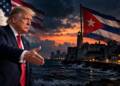

In the final weeks of Nicolás Maduro’s rule, it was not diplomacy, sanctions, or even covert threats that tipped the balance — it was symbolism. According to multiple U.S. and Venezuelan officials involved in back-channel negotiations, Maduro’s repeated public displays of defiance, particularly his on-air dancing amid escalating U.S. pressure, were interpreted inside the Trump White House as open mockery. For President Donald Trump, that perceived taunt became the final straw.
By late December, Washington had presented Maduro with what officials described as a “gilded exile” offer: step down peacefully and relocate to Turkey. Maduro refused. Days later, as the U.S. intensified pressure with a strike on a Venezuelan dock allegedly linked to drug trafficking, Maduro appeared on state television dancing to electronic music, his prerecorded voice repeating in English, “No crazy war.”
Inside the White House, the message was received loud and clear. According to sources familiar with the deliberations, Trump and his advisers concluded that Maduro believed Washington was bluffing. Within days, the United States followed through.
A Decisive Military Move
In a pre-dawn operation, elite U.S. forces entered Caracas, encountered minimal resistance, destroyed multiple military installations, and extracted Maduro and his wife, Cilia Flores, from a heavily guarded compound. They were flown to New York to face long-standing drug trafficking charges. At least 40 Venezuelans — civilians and soldiers — were reported killed during the operation, though no American casualties were announced.
The raid marked one of the most extraordinary unilateral uses of American military power in Latin America in decades. But the operation had not been improvised. Well before Maduro’s capture, Washington had already settled on who it considered an “acceptable” interim leader for Venezuela.
Why Delcy Rodríguez Became Washington’s Choice?
That choice was Vice President Delcy Rodríguez — a loyalist of the Maduro system, but one who had earned quiet respect inside U.S. policy circles.
Rodríguez, 56, is widely credited with stabilizing Venezuela’s shattered economy and gradually increasing oil production despite U.S. sanctions. Her ability to navigate energy markets, manage elite interests, and maintain state control while opening limited space for private capital impressed several Trump officials, particularly those focused on oil security.
Intermediaries convinced the administration that Rodríguez would safeguard future American energy investments and potentially cooperate on restoring U.S. access to Venezuelan oil. One senior U.S. official described her as “someone we think we can work with at a professional level,” in stark contrast to Maduro.
For Washington, this was not about democratic purity — it was about leverage, predictability, and control over strategic resources.
The Rejection of María Corina Machado
Perhaps the most controversial aspect of Trump’s decision was whom he rejected: María Corina Machado.
Machado, a longtime opposition leader, organized the opposition’s winning presidential campaign in 2024 — a victory widely recognized internationally as having been stolen by Maduro. She was awarded the Nobel Peace Prize this year and spent months courting Trump’s favor, praising him publicly, echoing his rhetoric on election fraud, and even dedicating her Peace Prize to him.
None of it mattered.
Trump never warmed to Machado. On the day Maduro was captured, he publicly dismissed her, saying she lacked the “respect” and domestic support necessary to govern. Within hours of Machado declaring she was ready to assume power, Trump stated that they had not even spoken.
For the Trump administration, Machado represented unpredictability — an independent political force with moral legitimacy but limited control over the armed forces and state institutions. Rodríguez, by contrast, came from within the system and was seen as capable of holding it together.
Washington’s High-Risk Bet
Trump’s declaration that the United States would effectively “run” Venezuela for an unspecified period and reclaim American oil interests stunned even seasoned observers. It signaled a shift from regime-change rhetoric to direct, expansionist control — justified less by democracy than by drugs, energy, and national security.
Yet contradictions remain. Rodríguez publicly condemned the U.S. operation, called it an illegal invasion, and insisted Maduro remains Venezuela’s legitimate leader. Venezuelan state media continues to refer to her as vice president, not president — a calculated move to pacify military and party loyalists still reeling from the humiliation of Maduro’s capture.
Sanctions remain in place, oil tankers are still being detained, and Washington has made clear that further military action remains on the table if Rodríguez defies U.S. expectations.
A Technocrat Born of the System
Rodríguez is no outsider. She is the daughter of a Marxist guerrilla, educated in France, and politically shaped by the Chávez-Maduro era. While she softened Venezuela’s economic collapse and built bridges with business elites and foreign diplomats, she has never condemned the repression or corruption that sustained the regime.
Her rise reflects a familiar historical pattern: insiders of authoritarian systems stepping forward as transitional figures when the strongman falls.
Whether Delcy Rodríguez becomes a stabilizing bridge or merely a more polished face of the same power structure will depend less on her rhetoric — and more on how long Washington believes she serves its interests.
For now, Trump has made his calculation clear: democracy is secondary; control is primary. And Maduro’s final dance may have sealed his fate.