
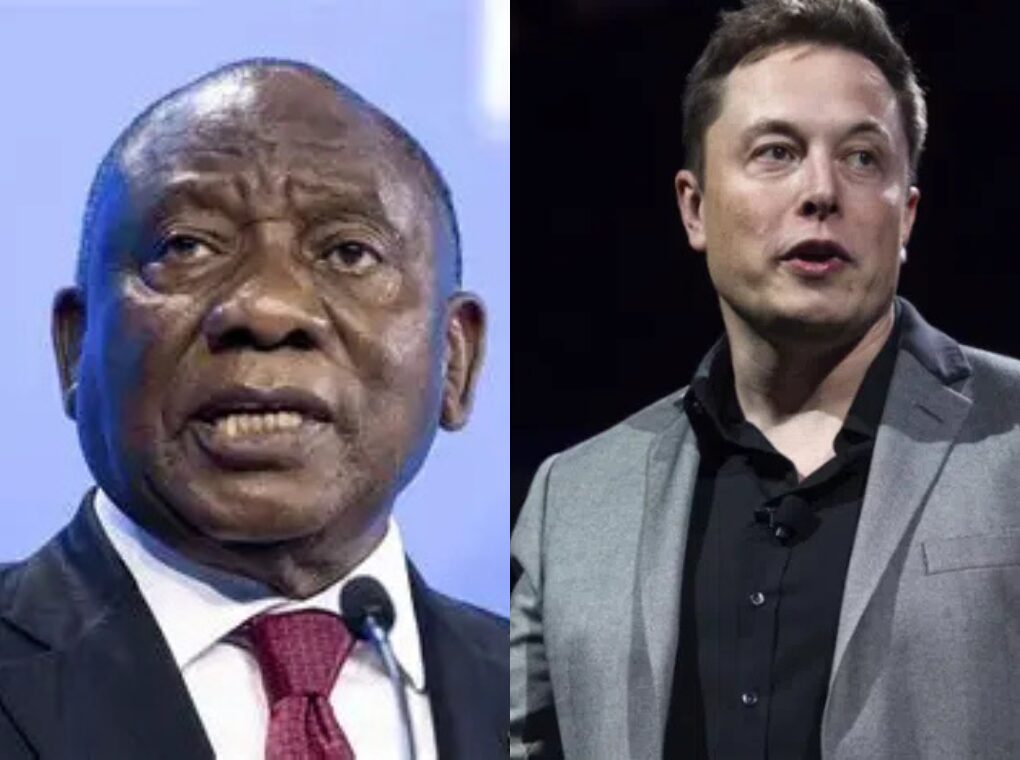
Tech Billionaire Elon Musk has launched a blistering attack on South Africa’s race-based economic policies, accusing the government of blocking his satellite internet service Starlink simply because he is not Black, despite being born in Pretoria in 1971. In a series of fiery posts on social media X, Musk described the country’s Broad-Based Black Economic Empowerment (B-BBEE) regulations as “evil” and “openly racist,” claiming officials repeatedly offered Starlink a workaround involving a “pretend Black executive” — an offer he rejected as a bribe.
Musk wrote: “South Africa won’t allow Starlink to be licensed, even though I was BORN THERE, simply because I am not Black! We were offered many times the opportunity to bribe our way to a license by pretending that a Black guy runs Starlink SA, but I have refused to do so on principle. Racism should not be rewarded, no matter to which race it is applied. Shame on the racist politicians in South Africa.”
The outburst has reignited global debate over South Africa’s post-apartheid affirmative action policies and whether they now constitute systemic discrimination against the White minority.
What are South Africa’s B-BBEE Laws and Why Do They Block Starlink?
It was introduced after the end of apartheid in 1994. B-BBEE aims to correct historical economic imbalances by giving preference to “historically disadvantaged individuals” — primarily Black South Africans, as well as Asians, women, and people with disabilities. In the telecommunications sector, the Electronic Communications Act and ICASA licensing rules typically require at least 30% ownership by such groups for operators to qualify for a licence.
Starlink, owned by Musk’s SpaceX, operates on a global model that avoids diluting equity through local partners. Musk argues that forcing foreign companies to transfer ownership based purely on race violates basic principles of merit, fairness, and non-discrimination. He has repeatedly pointed out the irony: a South African-born entrepreneur is being excluded from his country of birth due to the color of his skin.
Critics of B-BBEE, including Musk and local groups like Solidarity and the Democratic Alliance (DA), say these policies have evolved from redress into rigid racial quotas that harm economic growth, deter foreign investment, and discriminate against Whites, who make up roughly 7.2% of South Africa’s population. They argue the laws prioritize race over competence, skills, and actual contribution — especially in high-tech sectors like satellite broadband, where expertise and capital are critical.
Musk’s Strong Stance: Principle Over Profit
Musk has refused to compromise. He has called the laws “extremely racist” and urged international sanctions against politicians who support them. His position echoes a broader critique of race-based policies worldwide: discrimination in any direction remains discrimination.
This is not Musk’s first clash with South African authorities. He has previously highlighted farm attacks on White farmers, high crime rates, and emigration trends among skilled Whites. Supporters praise him for standing on principle rather than buying compliance through what he describes as a “bribe.” Detractors accuse him of ignoring apartheid’s legacy, but Musk counters that punishing individuals today for historical sins committed before many were born is itself unjust.
South African Government’s Response: “Move On to 192 Other Markets”
Pretoria has pushed back firmly. Presidential spokesperson Vincent Magwenya told Musk there are 193 UN member states and “surely there’s good money to be made out of 192 markets. It’s okay to move on.” Another official, Clayson Monyela, faced an expletive-laden reply from Musk after defending the laws.
The government insists Starlink must comply with local legislation like every other company. Over 600 U.S. firms operate successfully in South Africa by meeting B-BBEE requirements. President Cyril Ramaphosa has repeatedly stated that B-BBEE and affirmative action will not be abandoned, declaring those who call for an end to such policies are “dreaming.”
However, not all voices in government agree. Communications Minister Solly Malatsi issued a policy directive in December 2025 allowing Equity Equivalent Investment Programmes (EEIPs) as an alternative to direct 30% Black ownership. This would let foreign operators like Starlink invest in infrastructure, digital inclusion, or rural development instead of selling equity. Starlink has proposed significant investments, including free internet for thousands of schools. Yet the directive has divided the coalition government, with ANC factions opposing any dilution of strict B-BBEE rules.
As of April 2026, Starlink has still not received a full operating licence from ICASA, despite launching successfully in many other African countries with less stringent racial ownership demands, such as Nigeria and Kenya.
Broader Context: Racial Discrimination Against Whites in South Africa
Musk’s stand highlights deeper issues with South Africa’s race-based policies beyond Starlink:
Employment Equity Act and strict racial targets in hiring and promotions have led to qualified White applicants (especially young White males) being sidelined.
White South Africans, despite being a tiny minority, still hold a disproportionate share of top management roles due to historical education and skills advantages — but new regulations impose enforceable quotas with penalties.
Land reform and the Expropriation Act raise fears of race-targeted property seizures.
Persistent high crime, including brutal farm attacks disproportionately affecting White commercial farmers, adds to a sense of vulnerability.
These policies, while framed as redress, have contributed to White emigration, skills flight, and economic stagnation in a country already grappling with one of the world’s highest unemployment and inequality rates. Many argue that true progress requires shifting from race-based to needs-based empowerment, focused on poverty, education, and merit principles that Musk champions.
Why This Matters: Innovation, Investment, and the Future of South Africa
Starlink could bring high-speed internet to millions of underserved rural and township South Africans, bridging the digital divide far faster than traditional infrastructure. Blocking it over racial ownership rules not only hurts ordinary citizens but signals to global investors that South Africa prioritizes ideology over practical development.
Elon Musk’s unapologetic defence of colour-blind principles has amplified calls for reform. His refusal to engage in what he sees as corrupt racial proxy arrangements sets a powerful example: success should come from innovation and value creation, not skin color.
As the standoff continues, South Africa faces a choice — cling to divisive racial policies that risk isolating the country further, or embrace reforms that welcome talent and investment regardless of race. Musk’s bold criticism may prove uncomfortable for some, but it underscores a universal truth: racism in any form, including “reverse” discrimination, ultimately harms everyone.
South Africa’s “Rainbow Nation” ideal of non-racialism, championed by Nelson Mandela, risks being undermined by laws that continue to classify and divide citizens by race more than three decades after apartheid ended. Whether Musk’s pressure leads to meaningful change or simply more deflection remains to be seen — but the global spotlight on these policies is now brighter than ever.