
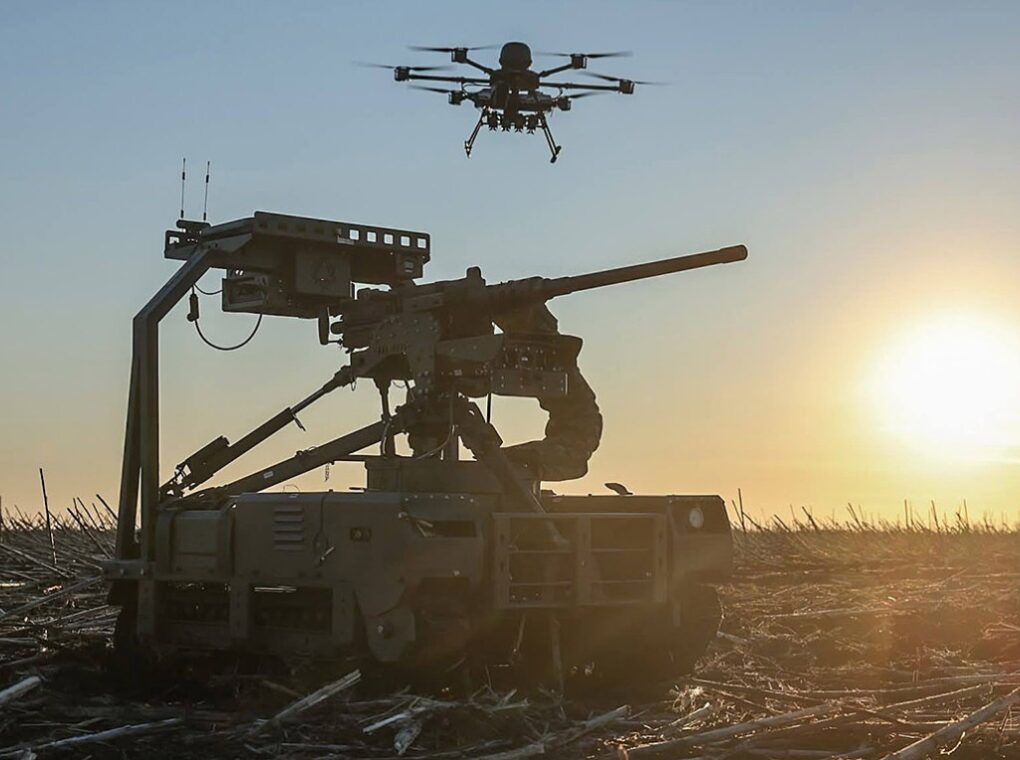
Ukrainian President Volodymyr Zelensky has claimed that Kyiv’s forces achieved a historic battlefield milestone by capturing a Russian military position using only unmanned systems — without deploying a single soldier. The announcement, made amid the ongoing Russia-Ukraine War, is being seen as a potential glimpse into the future of warfare, though experts urge caution in calling it a breakthrough.
A First-of-Its-Kind Operation
According to Zelensky, Ukrainian forces successfully seized an enemy position using a combination of aerial drones and unmanned ground vehicles (UGVs). “For the first time in the history of this war, an enemy position was taken exclusively by unmanned platforms,” he said in a public statement.
He further claimed that the operation resulted in zero Ukrainian casualties and led to the surrender of an unspecified number of Russian troops. Notably, no infantry units were involved, marking a significant departure from conventional combat tactics that rely heavily on human soldiers for territorial control.
While Kyiv did not disclose the exact location or scale of the operation, the claim has drawn global attention as militaries worldwide increasingly explore autonomous and remote-controlled systems.
Experts: Tactical Success, Not Strategic Breakthrough
Despite the bold claim, military analysts suggest the operation may have been limited in scope. Ukrainian military expert Ivan Stupak noted that the captured position was likely small and not strategically critical.
“This is probably not a major battlefield breakthrough,” Stupak said, adding that the development should be viewed more as a proof of concept rather than a decisive shift in the war.
However, he acknowledged the broader implications: if such operations can be scaled, they could significantly alter combat dynamics. “If a small position can be captured without human involvement, larger operations could follow,” he said.
Rise of Unmanned Warfare
The war between Russia and Ukraine has rapidly evolved into a testing ground for modern military technologies, especially drones. Both sides have heavily invested in unmanned aerial vehicles (UAVs), electronic warfare systems, and now ground-based robots.
Ukraine, in particular, has leveraged drone technology to offset manpower shortages and counter Russia’s numerical advantage. From reconnaissance missions to precision strikes, drones have become central to Kyiv’s battlefield strategy.
The introduction of UGVs into offensive operations represents the next phase of this evolution. These robotic systems can navigate dangerous terrain, deliver explosives, and even engage enemy positions, reducing the risk to human soldiers.
Psychological and Strategic Impact
Beyond the tactical success, the operation carries psychological significance. The idea that positions can be overtaken without human troops could impact troop morale on both sides. For Russian forces, the prospect of facing autonomous systems may introduce new uncertainties, while for Ukraine, it reinforces confidence in technological innovation.
Additionally, such operations could influence military planning globally. Nations observing the conflict may accelerate investments in robotics, artificial intelligence, and autonomous combat systems.
Limitations and Challenges
Despite the hype, unmanned warfare is not without limitations. Drones and robotic systems are highly vulnerable to electronic warfare tactics such as jamming and signal disruption — areas where both Russia and Ukraine are actively competing.
Moreover, autonomous systems still lack the adaptability and decision-making capabilities of human soldiers in complex combat scenarios. Urban warfare, for instance, remains particularly challenging for robots due to unpredictable environments.
Logistics, cost, and maintenance also pose challenges. Scaling such operations would require significant resources and technological reliability.
A Glimpse Into the Future?
Zelensky’s announcement may be partly aimed at boosting morale and showcasing Ukraine’s technological edge to international allies. However, it also underscores a real trend: warfare is becoming increasingly automated.
As the Russia-Ukraine War continues, the integration of drones and robotic systems is expected to deepen. While this particular operation may not change the course of the war immediately, it highlights a shift that could redefine military strategy in the years to come.
Whether this marks a true game changer or simply an incremental step forward remains to be seen. But one thing is clear — the battlefield of the future is arriving faster than many had anticipated.