
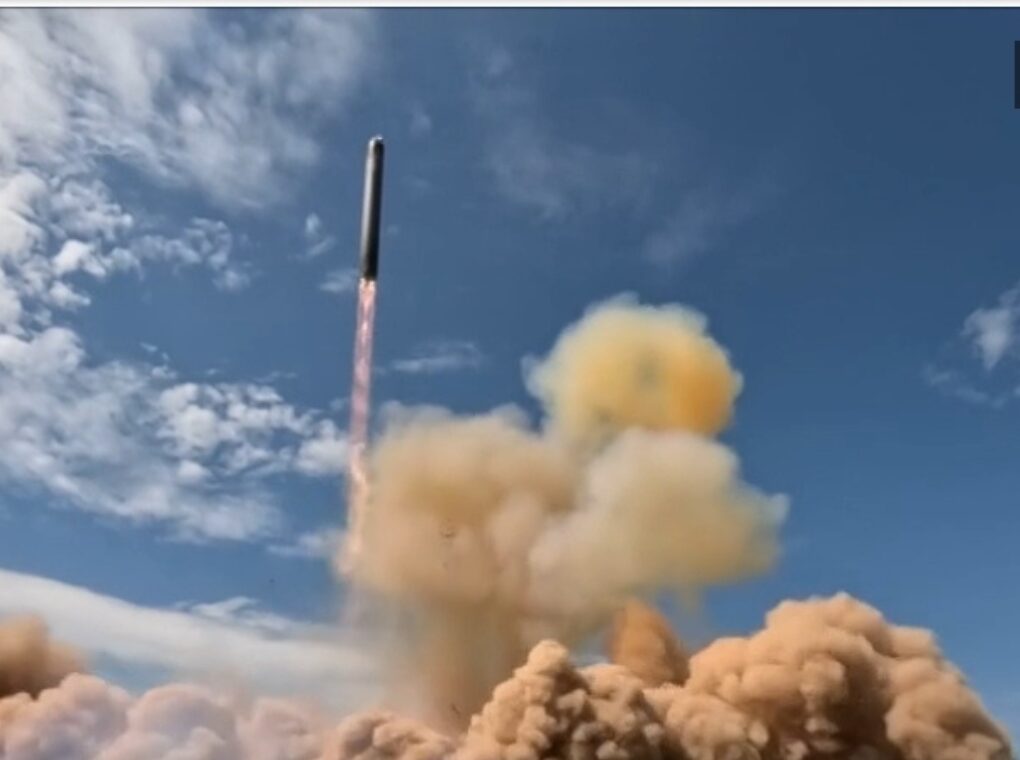
Russia has successfully test-fired its advanced RS-28 Sarmat intercontinental ballistic missile (ICBM), known in the West as “Satan II,” in a move widely viewed as a strategic message to Washington, NATO, and global powers amid rising geopolitical tensions.
The launch, confirmed by Russian President Vladimir Putin and the Russian Defense Ministry, marks the first successful high-profile test of the nuclear-capable missile after a series of setbacks and failed launches over the past two years.
According to Russian officials, the missile was launched from the Plesetsk Cosmodrome in northern Russia and successfully struck its target range in Kamchatka, covering nearly 5,500 kilometers in roughly 30 minutes.
Putin Declares Sarmat ‘World’s Most Powerful Missile’
Speaking shortly after the launch, Putin hailed the RS-28 Sarmat as “the most powerful missile system in the world,” claiming it can carry a payload significantly larger than any Western equivalent and bypass all existing missile defense systems.
The liquid-fueled heavy ICBM is designed to replace the aging Soviet-era RS-20V Voevoda missile, better known by NATO as the SS-18 Satan. Russian military officials say the Sarmat represents a new generation of strategic deterrence weapons capable of overwhelming advanced anti-ballistic missile networks.
General Sergey Karakaev, commander of Russia’s Strategic Missile Troops, informed Putin that the first combat-ready regiment armed with the Sarmat missile system is expected to be deployed by the end of 2026.
The missile reportedly supports multiple independently targetable reentry vehicles (MIRVs), allowing a single rocket to carry up to 16 nuclear warheads aimed at different targets simultaneously.
Why the Sarmat Missile Matters
Military analysts consider the RS-28 Sarmat one of the most dangerous strategic weapons ever developed because of its range, payload capacity, and unconventional flight paths.
Russian officials claim the missile can travel over 35,000 kilometers and attack targets through the South Pole, potentially bypassing parts of America’s northern missile warning infrastructure and interceptor systems in Alaska.
The Sarmat is also believed to be compatible with Russia’s hypersonic Avangard glide vehicle, capable of maneuvering at extreme speeds within the atmosphere to evade missile defenses.
The successful launch comes after months of speculation surrounding the missile program’s future. In 2025, reports emerged that one Sarmat prototype exploded inside its silo during testing, leaving a massive crater at the Plesetsk launch facility. Western intelligence assessments also suggested the missile had suffered multiple failed tests since 2022.
Adding to the controversy, the head of the Russian factory responsible for manufacturing the missile was reportedly arrested last week amid corruption and production-related investigations.
Despite those setbacks, Tuesday’s successful launch signals that Moscow may have stabilized the troubled strategic weapons program.
Timing Raises Global Concerns
The timing of the launch is drawing international attention.
The test occurred on the same day Iran reiterated that uranium enrichment remains “non-negotiable” during ongoing nuclear discussions with the United States. It also came as former US President Donald Trump traveled to Beijing for high-level talks amid worsening geopolitical instability.
Meanwhile, the fragile US-Iran ceasefire framework has reportedly come under strain, with Trump recently describing negotiations as being on “massive life support.”
Against this backdrop, Russia’s decision to publicly showcase one of its most advanced nuclear weapons appears highly calculated.
Defense experts believe the launch was intended not merely as a technical demonstration but as geopolitical signaling aimed at multiple audiences — including Washington, NATO, China, and Iran-related negotiators.
Message to the West?
Putin linked Russia’s advanced missile development directly to the United States’ withdrawal from the Anti-Ballistic Missile (ABM) Treaty under President George W. Bush, arguing that Moscow was forced to modernize its nuclear arsenal to preserve strategic balance.
According to the Kremlin, systems like Sarmat, Avangard, Poseidon, and Burevestnik are designed specifically to overcome Western missile defense shields and ensure Russia retains credible nuclear deterrence capabilities.
The Sarmat launch also reinforces Moscow’s broader strategy of emphasizing strategic nuclear power at a time when the Ukraine conflict, NATO expansion, and tensions in the Middle East are reshaping global security dynamics.
Whether the missile test was directed primarily at the United States, NATO, or broader geopolitical negotiations, one thing is clear: Russia wanted the world to notice.
As global diplomatic channels grow increasingly fragile, the successful launch of the RS-28 Sarmat sends a stark reminder that nuclear deterrence remains central to 21st-century great power politics.