Tensions between the United States and Iran have surged dramatically, raising fears of a dangerous military escalation in the Middle East after senior Iranian officials issued chilling warnings against the ongoing American naval blockade near the Strait of Hormuz. With diplomatic talks stalled, military rhetoric intensifying, and regional security incidents increasing, analysts warn that the possibility of a wider conflict is growing rapidly.
Iranian military adviser Mohsen Rezaei, one of Tehran’s most influential strategic voices and a member of Iran’s Expediency Discernment Council, delivered a sharp warning to Washington during remarks aired on Iranian state television. Addressing the US naval presence in the Gulf region, Rezaei declared that the Gulf of Oman could become a “graveyard for American ships” if Washington continues what Tehran considers a hostile naval blockade.
“My advice to the US militarily is to back off before the Gulf of Oman turns into a graveyard for your ships,” Rezaei said. He further warned that Iran considers a naval blockade an “act of war,” stressing that Tehran reserves the right to respond militarily if provoked.
The remarks come amid a deteriorating diplomatic environment between Washington and Tehran following the collapse of key peace negotiations. According to reports, the breakdown of the Islamabad talks in April 2026 marked a turning point in relations, after which the United States reportedly tightened maritime restrictions and increased naval deployments around Iranian shipping routes.
Iranian officials argue that American military operations around the Strait of Hormuz amount to economic warfare aimed at strangling the country’s oil exports and trade. Tehran has repeatedly warned that any attempt to block Iranian access to strategic waterways would trigger a forceful response from the Islamic Revolutionary Guard Corps (IRGC).
Rezaei also accused the United States of concealing battlefield losses, claiming satellite imagery allegedly showed damage to American vessels that Washington had not publicly acknowledged. While no independent confirmation has emerged regarding such claims, Tehran’s rhetoric signals growing confidence in its asymmetric naval strategy, which relies heavily on drones, missile boats, coastal missile batteries, and underwater capabilities.
The Strait of Hormuz remains one of the world’s most strategically sensitive maritime chokepoints. Roughly one-fifth of global oil shipments pass through the narrow waterway connecting the Persian Gulf to the Gulf of Oman. Any disruption to maritime traffic in the region could trigger massive spikes in oil prices, disrupt global supply chains, and shake international markets.
At the same time, US President Donald Trump has reportedly toughened his stance toward Iran, warning that “the clock is ticking” for Tehran to agree to a new peace arrangement. Trump has also reportedly threatened strikes “much harder than before” if Iran continues military provocations or refuses diplomatic concessions.
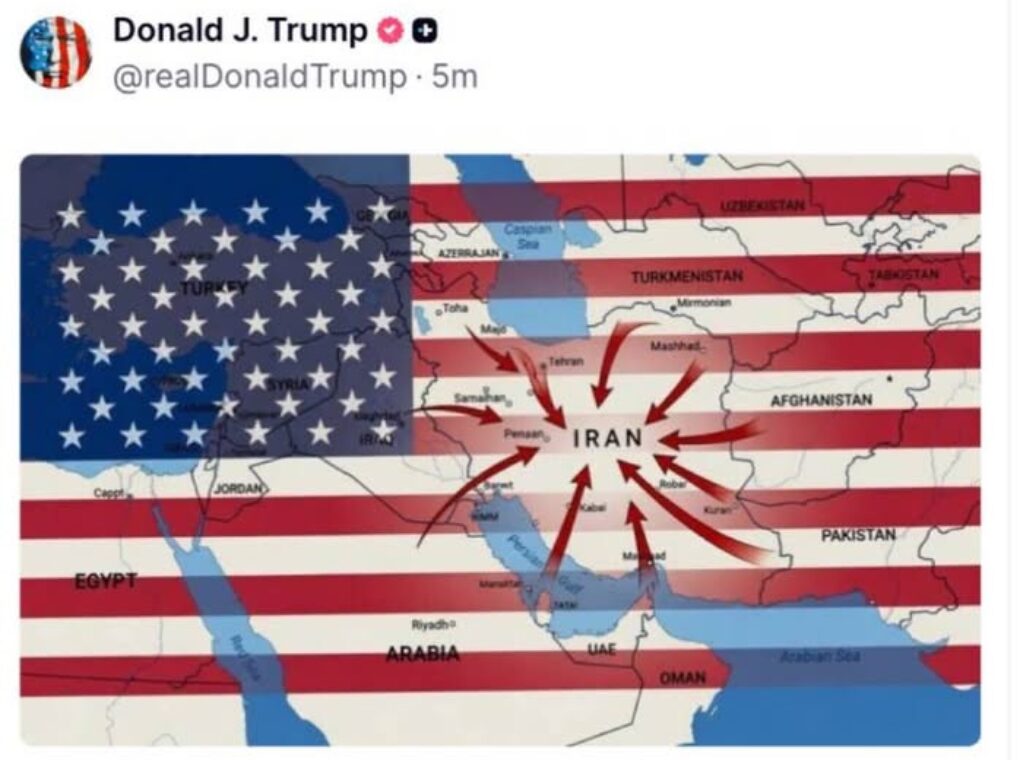
Fueling further speculation, Trump recently shared a dramatic image on Truth Social appearing to depict Iran surrounded by military pressure from multiple directions. While the post did not explicitly announce military action, observers interpreted it as a message of deterrence—or potentially preparation for a more aggressive strategic posture.
Regional tensions have also expanded beyond US-Iran exchanges. Saudi Arabia recently announced it intercepted three drones believed to be linked to escalating regional hostilities, while the United Arab Emirates reported a separate drone incident near the Barakah nuclear power facility that reportedly triggered a fire scare. Though details remain limited, the incidents have heightened fears that a broader regional confrontation could spill into Gulf states.
Military analysts believe that any direct clash between Iran and the United States would likely begin at sea, particularly around the Strait of Hormuz and the Gulf of Oman. Iran has long developed a military doctrine centered on asymmetric warfare, designed specifically to challenge superior American naval power through swarm attacks, anti-ship missiles, drones, underwater mines, and rapid coastal strikes.
However, despite increasingly aggressive rhetoric from both sides, experts caution against assuming an inevitable war. Diplomatic backchannels often remain active even during periods of intense public confrontation. Historically, both Washington and Tehran have stepped back from direct full-scale war despite repeated crises over nuclear ambitions, sanctions, tanker seizures, and regional proxy conflicts.
Still, the current situation appears unusually volatile. With peace talks frozen, military deployments rising, regional drone incidents multiplying, and public threats escalating, many fear the Middle East may be approaching one of its most dangerous moments in years.
Whether the coming weeks bring diplomacy or military confrontation remains uncertain. But one reality is becoming increasingly clear: the Gulf region stands at a critical crossroads, and any miscalculation could ignite a conflict with global consequences.