
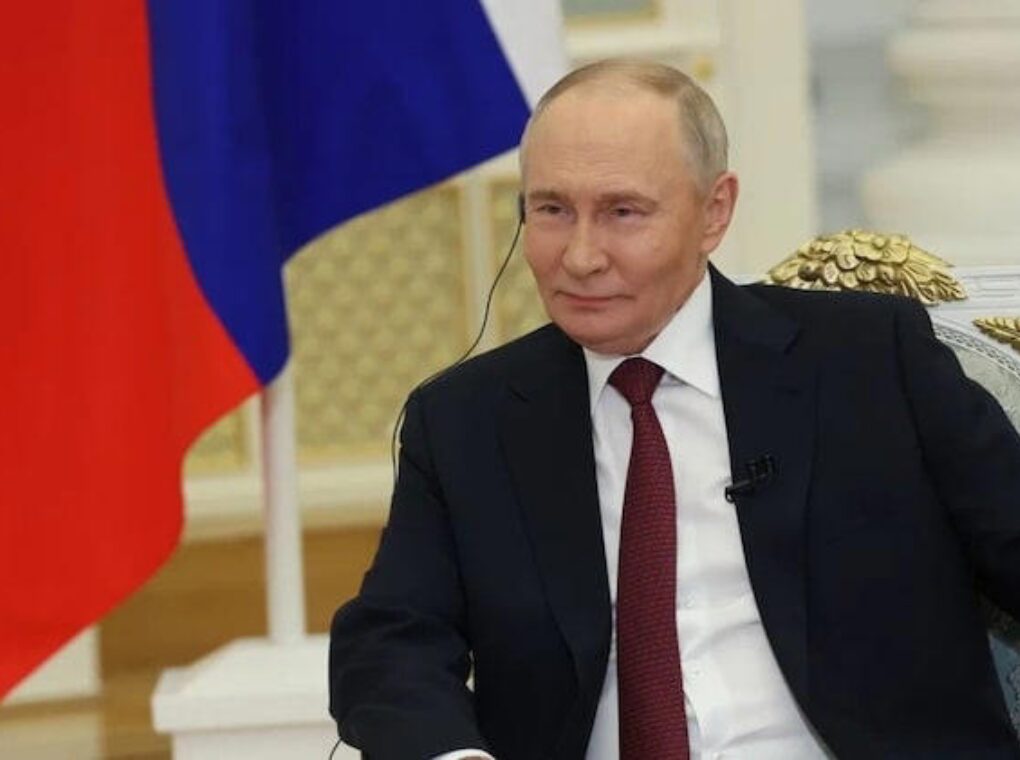
Russian President Vladimir Putin addressed a wide range of geopolitical and economic issues during a high-profile question-and-answer session with international news agency heads on the sidelines of the St. Petersburg International Economic Forum (SPIEF) on Thursday. The event, held at the Konstantinovsky Palace near St. Petersburg, focused on Russia’s foreign policy, the Ukraine conflict, global partnerships, and Moscow’s economic priorities.
The annual interaction, considered a key feature of Putin’s SPIEF schedule, brought together media representatives from multiple countries to discuss Russia’s domestic and international agenda amid rising global tensions.
Putin Says Russia Ready for Ukraine Peace Settlement
One of the key moments of the discussion came when Putin reiterated Moscow’s willingness to pursue a peaceful settlement with Ukraine. According to the Russian president, Russia remains prepared to negotiate based on the framework discussed during talks in Anchorage with US President Donald Trump.
Putin stated that a resolution could be achieved quickly if Ukraine agrees to the proposed compromises. “It is important that Ukraine also agrees to the compromise discussed,” he said, adding that the conflict could “peter out naturally, and very quickly.”
The Russian leader also emphasized that Moscow has not rejected diplomatic dialogue and remains open to negotiations if European countries believe talks are appropriate. However, he stressed that future negotiations “must involve people who can be trusted,” signaling skepticism toward previous diplomatic efforts.
Russia Claims Battlefield Momentum in Ukraine
Addressing military developments, Putin asserted that Russian armed forces are advancing across the entire frontline in Ukraine. He claimed there was “no place we are not advancing,” while also alleging that Ukrainian military forces are suffering from severe personnel shortages.
Putin claimed that Ukraine has lost around 100,000 troops and estimated monthly military losses at approximately 40,000 personnel. He also criticized Ukraine’s mobilization methods, alleging that military officers are forcibly recruiting citizens from the streets.
On military capabilities, Putin argued that Russia maintains a robust integrated air and strike system that continues to strengthen. In contrast, he claimed Ukraine lacks an effective air defense system despite receiving drones and military assistance from Western allies.
Russia Expands Strategic Investment in India
During the Q&A session, Putin highlighted Russia’s growing economic cooperation with India, describing New Delhi as a “specially privileged strategic partner.”
Speaking to India’s Press Trust of India, Putin said Moscow intends to continue investing heavily in the Indian economy and has “promising, far-reaching plans” for future cooperation. He expressed confidence that bilateral trade between the two countries could reach $100 billion in the coming years.
Putin also dismissed concerns over Western pressure on India regarding its relations with Russia, saying New Delhi remains free to pursue partnerships with any nation it chooses. According to him, attempts by the United States to influence India’s foreign policy are “useless” and have not affected Russia-India ties.
Putin Calls Xi Jinping an ‘Old Friend’
On Russia’s relations with China, Putin described Chinese President Xi Jinping as an “old friend,” emphasizing that the phrase was “not just a figure of speech.”
Speaking to China’s Xinhua news agency, Putin rejected suggestions that Russia had shifted strategically toward Asia due to tensions with the West.
“We did not pivot anywhere,” Putin said, stressing that Russia and China are “natural allies and partners” due to geography and longstanding cooperation. He added that the bilateral relationship is not aimed against any third country and pointed to a treaty signed 25 years ago as the foundation of what he described as an “unprecedented” level of partnership.
Russia Deepens Eurasian Cooperation
Putin also used the opportunity to underline Russia’s expanding role in Eurasia. Speaking about relations with Kazakhstan, he praised ties with Astana as “developing successfully” and highlighted cooperation in energy, transportation, industry, and space exploration.
He noted that Russia is expected to assist Kazakhstan in constructing a nuclear power plant, expanding bilateral cooperation into new strategic sectors.
On Armenia’s growing engagement with the European Union, Putin struck a measured tone, saying there was “nothing wrong” with countries aligning themselves with Western standards. However, he stressed that Armenia would eventually need to decide the direction of its partnerships, especially regarding integration with the Eurasian Economic Union (EAEU).
Egypt Nuclear Project Advances
Putin also confirmed that Russia is making progress on constructing a nuclear power plant in Egypt’s Nile Valley. He expressed optimism that the first reactor unit could become operational by 2028, emphasizing active construction efforts and the involvement of local specialists in the project.
SPIEF 2026 Draws Global Attention
The St. Petersburg International Economic Forum, one of Russia’s premier business and investment events, runs from June 3 to June 6 and has attracted participants from more than 100 countries, including political leaders and business delegations.
Attention is now turning to Friday’s plenary session, where Putin is expected to deliver a major speech addressing Russia’s economic outlook, geopolitical strategy, and global partnerships amid intensifying international tensions.