
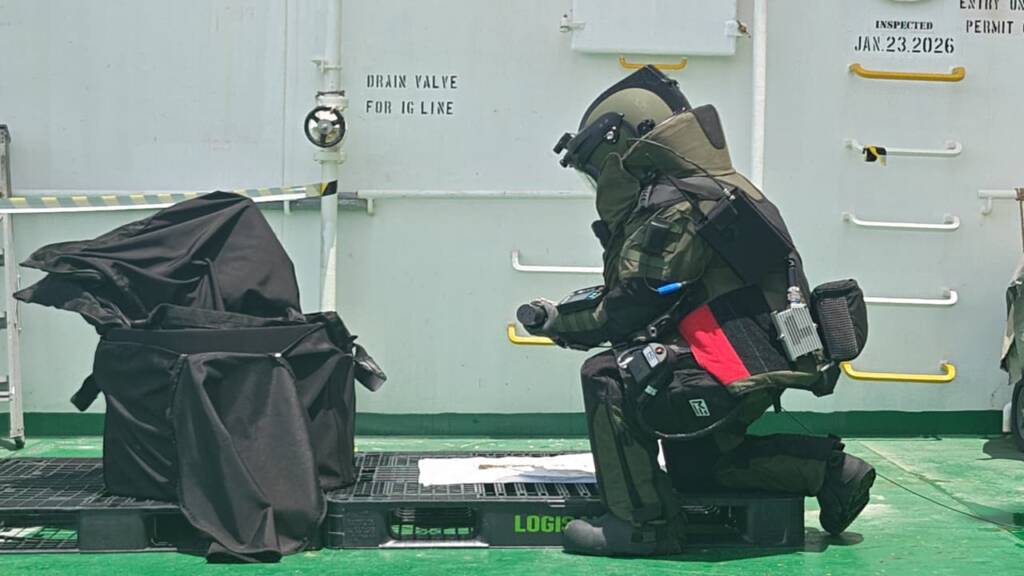
The Indian Navy has successfully carried out one of its most complex explosive ordnance disposal operations in recent years, recovering and safely neutralising an unexploded missile warhead discovered aboard the crude oil tanker MT Olympic Life.
The incident comes at a time when maritime security in the Gulf of Oman and the wider Arabian Sea region is deteriorating rapidly. Over the past week alone, three commercial tankers with Indian crew members have reportedly come under attack amid the escalating regional crisis. Two of those incidents involved action by the U.S. Navy, and three Indian seafarers have lost their lives in these attacks.
Against this backdrop, the recovery of an unexploded missile warhead from a commercial tanker highlights just how dangerous the region’s shipping lanes have become.
The Marshall Islands-flagged MT Olympic Life was sailing from Fujairah in the UAE to Kochi when it reported damage to its hull off the coast of Oman on 26 May 2026. Although the vessel continued its voyage, authorities were later informed that an unexploded ordnance remained lodged inside the ship.
Upon receiving information through the Information Fusion Centre – Indian Ocean Region (IFC-IOR), the Indian Navy immediately launched a coordinated response. The Southern Naval Command based in Kochi dispatched a specialist Explosive Ordnance Disposal (EOD) team to inspect the vessel.
Indian Navy Recovers Missile Warhead From Tanker
Investigators found that a missile projectile had pierced the ship’s outer hull, passed through multiple structural compartments and eventually become embedded inside a fuel storage tank. Had the warhead detonated inside the tanker, the consequences could have been catastrophic, potentially triggering a massive fire, loss of life and an environmental disaster.
Given the sensitivity of the situation, the Indian Navy adopted a phased and methodical approach. After implementing extensive safety measures, specialists used advanced diagnostic equipment to identify the warhead’s detonation mechanism and isolate it before safely extracting the missile component along with associated debris.
The recovered ordnance has since been transferred to a secure facility for detailed forensic and technical examination.
The operation is being viewed as a major demonstration of India’s growing maritime security capabilities. More importantly, it underscores the increasingly volatile security environment stretching from the Strait of Hormuz to the Gulf of Oman.
The region has witnessed a surge in attacks on commercial shipping in recent months, forcing several countries to enhance naval deployments and maritime surveillance. India, whose energy security depends heavily on sea lanes passing through the Gulf, has already expanded naval monitoring and escort operations in the area.
The timing of this operation is particularly significant. Just days before the recovery mission, multiple Indian-crewed tankers were caught in the crossfire of the ongoing regional confrontation. In one of the most serious incidents, three Indian sailors were killed following a strike on a commercial tanker near Oman, prompting strong diplomatic protests from New Delhi.
What makes the MT Olympic Life case even more remarkable is that the vessel was not an Indian-owned ship. Yet the Indian Navy responded immediately, deployed specialist teams and successfully eliminated a potentially devastating threat.
At a time when critical maritime routes are becoming battlegrounds for larger geopolitical rivalries, the MT Olympic Life operation serves as another reminder that maritime security is no longer a regional issue, it is a global one, specially at a time when maritime security requires every stakeholder to step up, the Indian Navy has demonstrated its commitment through action