
Iran’s Shahed-class drones have become one of the most influential weapons in modern warfare, evolving from simple low-cost loitering munitions into a vast family of strike, surveillance, and stealth unmanned combat aerial vehicles (UCAVs). A new report by the Center for Strategic and International Studies (CSIS) highlights the full scale of Tehran’s growing Shahed arsenal, underscoring its impact on battlefields from Ukraine to the Middle East.
The Shahed drones first drew global attention after Iran-backed Houthi forces used them against Saudi oil facilities in 2019. However, their battlefield reputation surged in 2022 when Russia began deploying the Shahed-136 and Shahed-131 against Ukraine’s critical infrastructure.
These drones, locally produced by Russia under the “Geran-2” designation, became a symbol of asymmetric warfare due to their low cost and ability to overwhelm expensive air defense systems.
The “Poor Man’s Cruise Missile”
Military analysts often call Shahed drones the “poor man’s cruise missile” because of their cost-effectiveness. While a single Shahed drone reportedly costs between $20,000 and $50,000, intercepting them often requires expensive air-defense missiles worth hundreds of thousands—or even millions—of dollars.
This economic imbalance has transformed how militaries approach air defense. Large swarms of inexpensive kamikaze drones can exhaust enemy defenses, making them highly effective despite their relatively simple design.
The Shahed drones rely on commercial off-the-shelf parts, including piston engines, fiberglass airframes, and basic electronics. This allows Iran to mass-produce them quickly and export them to allied groups.
Shahed Family Growing Rapidly
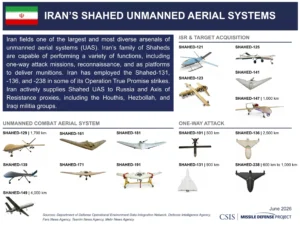
According to the CSIS Missile Threat Project, Iran now operates one of the world’s largest and most diverse drone arsenals.
Among the most prominent one-way attack drones:
Shahed-131 – Range: 900 km
Shahed-136 – Range: 2,500 km
Shahed-238 – Range: 600–1,000 km
Shahed-101 – Range: 500 km
Shahed-107 – Range remains unconfirmed

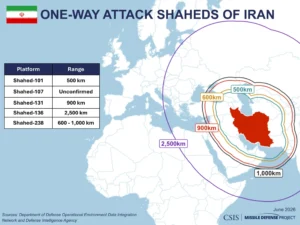
The Shahed-238 is particularly notable because it introduces jet propulsion into the Shahed family, significantly increasing speed to nearly 600 km/h compared to older variants.
Russia has reportedly deployed this version as the “Geran-3,” adding another layer of complexity to Ukraine’s air defense challenge.
Advanced Stealth Drones Inspired by US Technology
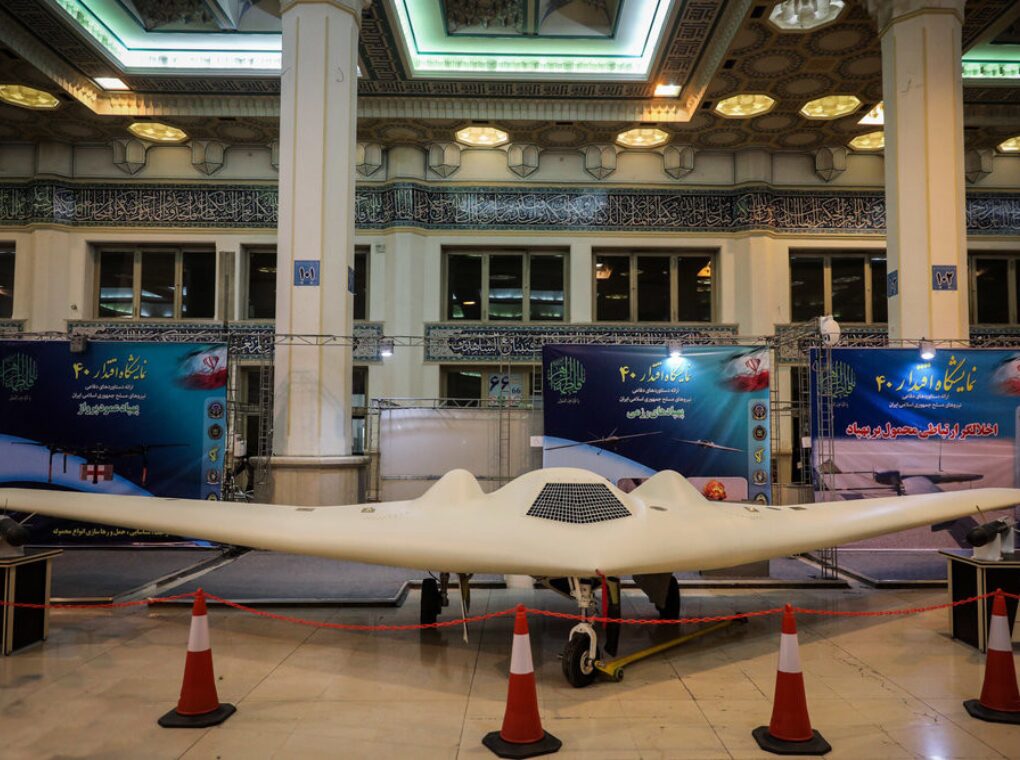
Iran has also developed advanced flying-wing stealth drones such as the Shahed-141, Shahed-171 Simorgh, Shahed-181, and Shahed-191. These systems were heavily inspired by the captured American Lockheed Martin RQ-170 Sentinel stealth drone that landed in Iran in 2011.
These stealth drones are designed for reconnaissance, surveillance, and strike missions, with some featuring internal weapons bays for improved radar evasion.
The Shahed-191, also known as “Saegheh,” is considered one of Iran’s most advanced combat drones and has been used in multiple regional operations.
ISR and Long-Endurance Capabilities
Beyond kamikaze and stealth variants, Iran’s Shahed lineup includes intelligence, surveillance, and reconnaissance (ISR) drones.
Notable among them:
Shahed-147 – Range: 1,000 km
Shahed-149 Gaza – Range: 4,000 km
Shahed-197 – Estimated combat range: 2,000 km
The Shahed-149 Gaza is often compared to the American General Atomics MQ-9 Reaper due to its long endurance, heavy payload capacity, and strike capabilities.

Changing the Rules of Warfare
Iran has used Shahed drones extensively in major military operations, including its strikes on Israel and US assets across the Middle East. Their effectiveness has inspired global military powers to develop similar low-cost drone systems.
Russia’s Geran-2 program is one example, while the United States has reportedly reverse-engineered Shahed-style drones into its Low-cost Unmanned Combat Attack System (LUCAS). China, Turkey, Egypt, and Taiwan are also exploring similar platforms.
The rapid spread of Shahed-like drones marks a significant shift in modern warfare doctrine. What began as a relatively cheap Iranian weapon has now become a global model for attritable, mass-produced strike systems.
As drone warfare continues to evolve, Iran’s Shahed family remains at the center of this transformation—proving that in modern conflict, affordability and mass production can be just as powerful as advanced technology.