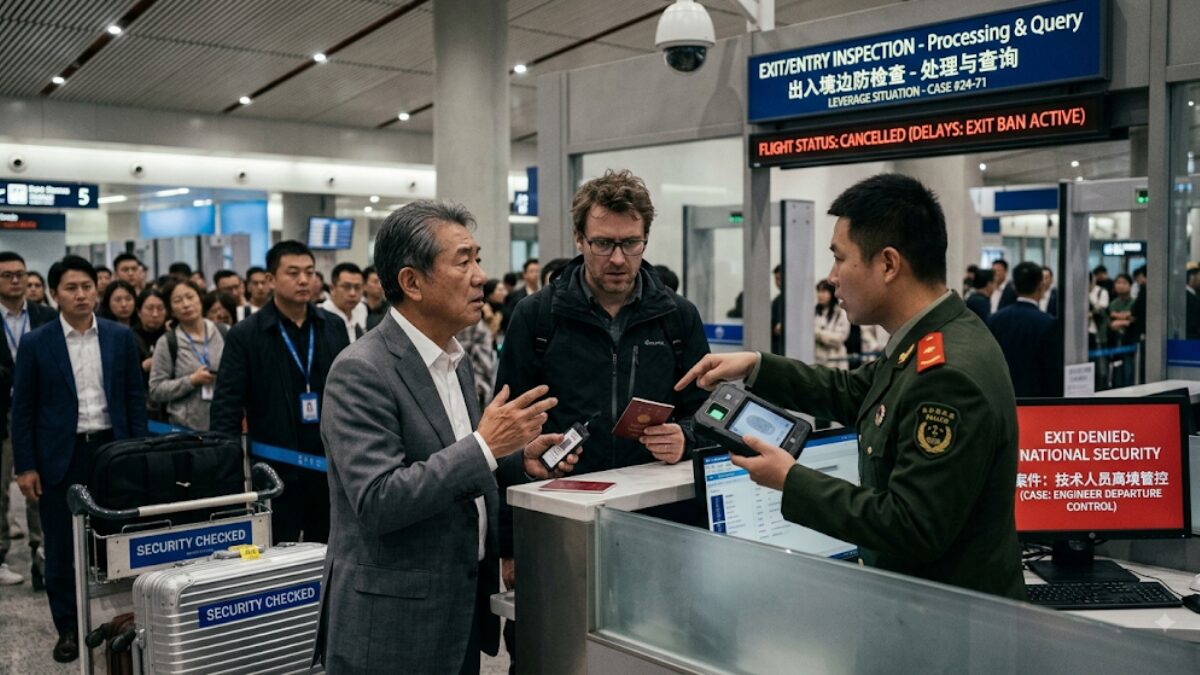
A rare earth separation line does not run on machinery alone. It runs on a few thousand people who know exactly when to adjust the solvent — and from 15 September, Beijing decides when those people may board a plane.
Premier Li Qiang signed State Council Decree No. 841 on 22 July, and Beijing published the text nine days later. The Regulations on Exit and Entry Administration take effect on 15 September 2026. The document runs to only 19 articles, yet marks the biggest overhaul of China’s border framework since the Exit and Entry Administration Law arrived in 2013.
One clause has drawn most of the attention. Commerce and other State Council departments may now stop a citizen from leaving the country if they breach export control or technology trade rules that “may endanger” industrial or technological security. The phrasing matters: officials need not wait for actual damage, and the rules set no fixed time limit for this category of ban.
Other grounds are drawn more tightly. Citizens who commit crimes abroad against national security face bans of six months to three years after returning, and document fraud or illegal border crossing also qualify. Officials must now notify the affected person in writing, supplying the facts, the reasons, the legal basis and the appeal channels — though they may withhold all of it during national security or criminal investigations.
Foreign nationals face their own squeeze. False information on a visa form can bring an entry ban of one to five years, and countermeasure lists, the Unreliable Entity List and the Malicious Entity List also block entry. Whoever issues an invitation letter, meanwhile, becomes liable for its accuracy; immigration intermediaries must register with local authorities, and border officers must warn travellers heading to “high-risk” destinations.
Why Now: The Bottleneck Is Human
China dominates rare earth processing, and that dominance sits inside people’s heads as much as inside mines. Marina Zhang of the University of Technology Sydney puts it plainly: “Rebuilding a rare earth supply chain is fundamentally a human capital challenge.” China holds several thousand separation specialists; America has fewer than 100, and they are ageing fast.
The pipeline gap looks starker still. Thirty-nine Chinese universities ran rare earth programmes in January 2026. Europe and the United States ran none.
Beijing spotted the risk early. State media reported a wave of senior resignations at state-owned rare earth producers in June 2025, warning that industry veterans had become prime recruitment targets. Local pilot schemes followed: some employers barred departing staff from joining similar foreign firms for three years, others buried digital watermarks in internal documents that fire an alert if the file surfaces overseas, staff in sensitive posts had to report their children’s study-abroad plans in advance, and relatives of core personnel needed clearance before travelling.
Even so, gaps remained. Authorities could only block a departure once a criminal investigation had opened, and retirees or resigned staff owed nobody an explanation.
Prosecutions show the stakes. In April, the Ministry of State Security disclosed a 2023 case in which a rare earth company manager surnamed Cheng drew 11 and a half years for leaking state secrets, having pocketed roughly $510,000. Recruiters, meanwhile, had worked the other side of that equation for years, dangling salaries, equity and green cards before building near-identical plants in Vietnam, India or Mexico. “That path is now closed under the new regulation,” one Chinese commentator wrote.
The practice already reaches beyond minerals. Authorities stopped the two co-founders of the AI start-up Manus from leaving in March, and researchers at Alibaba and DeepSeek reportedly now need approval before flying out.
The Rivalry Sitting Behind the Rulebook
None of this happened in a vacuum. Washington restricts chips and tools; Beijing restricts minerals. In April 2025 China curbed exports of seven rare earth elements, and in October it went much further, before suspending the sweeping controls until 10 November 2026 after the Busan summit.
The truce has broadly held. Yet in June, Beijing added ten American firms to its own control list, several of them rare earth companies Washington has championed.
Money has poured into alternatives. Benchmark Mineral Intelligence counted $6.3 billion of investment outside China last year, more than 60 per cent of it from the US government, with another $2.8 billion following in the first quarter of 2026. The Pentagon wants Chinese-origin rare earths out of defence supply chains by 2027.
Those projects need experienced hands, and American firms already fight each other for them — MP Materials sued USA Rare Earth in May over the recruitment of a senior engineer and seven colleagues. The logic runs symmetrically: America controls the machines. China now controls the people who know how to run them.
Japan sits inside the same frame. After Prime Minister Sanae Takaichi’s pro-Taiwan remarks last November, Beijing discouraged travel there, and Chinese arrivals fell 56.4 per cent year on year in the first half of 2026, to 2.06 million. The new warning mechanism gives that pressure a legal home.
Who Pays for It
Engineers pay first. The legal threshold has shifted from proven harm to possible risk, and analysts note that the technology clause carries no maximum term, no review timetable and no defined route out.
Multinationals pay next. Lawyers now urge clients to audit travel policies, assignments and visa paperwork before September, since one clerical slip could cost an executive five years of access. Western supply chains pay too, though more slowly — capital buys equipment quickly, but it does not buy process memory, and fewer Chinese veterans working abroad means longer ramp-ups, weaker yields and higher costs.
China may pay as well. Critics call the move self-isolation, and ambitious professionals now weigh exit risk when choosing an employer. “People are deeply concerned,” one Beijing resident told The Globe. Officials reject that reading, arguing the rules standardise a previously murky practice and protect lawful rights, pointing to the new duty to give written reasons and appeal channels — a duty that simply did not exist before. Both claims hold. The regulation adds procedure. It also adds power.
The Boarding Gate as Chokepoint
Nothing will change at China’s ports on 15 September. Cargo will move as it did the day before. The change will show up somewhere quieter — at boarding gates, in HR compliance files, in late-night conversations about that job offer in Texas.
Beijing has spent a decade proving that it controls the world’s most strategic minerals. From next month, it also decides who may carry the knowledge out. The most tightly guarded rare earth, it turns out, may not be a metal at all.