
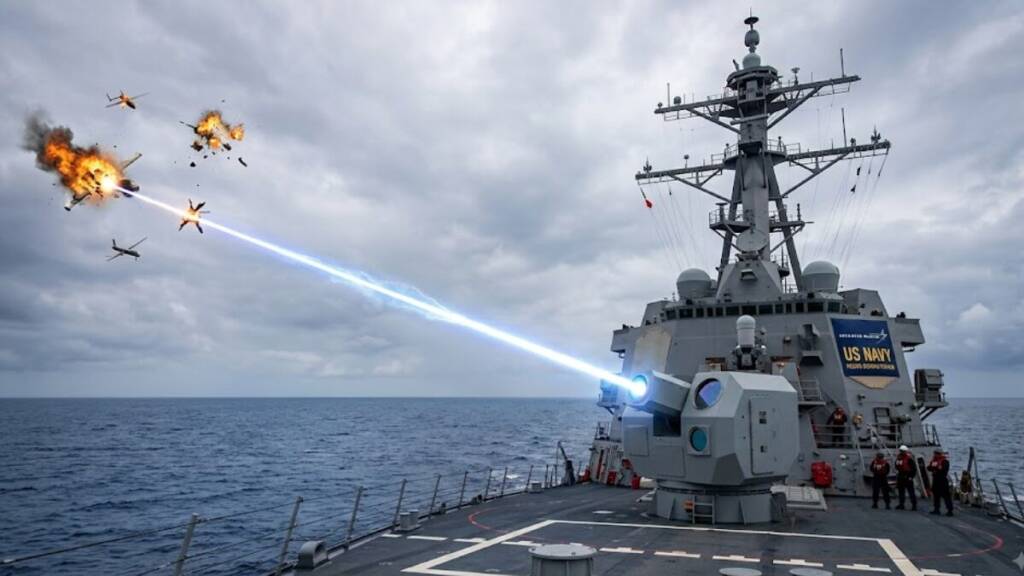
A US Navy destroyer used a ship-mounted laser to destroy four drones during an at-sea demonstration, Lockheed Martin has confirmed — the clearest sign yet that directed-energy weapons are edging toward frontline use.
The ship was USS Preble, an Arleigh Burke-class destroyer. The weapon was HELIOS, the High-Energy Laser with Integrated Optical Dazzler and Surveillance system that Lockheed builds for the Navy.
Lockheed chief executive Jim Taiclet described the engagement on a quarterly earnings call, saying the laser knocked an incoming drone “right out of the sky.” He said HELIOS neutralised four drone threats in a Navy-run counter-drone demonstration, and framed the shot as a way to conserve costly interceptor missiles for targets that need them more.
The test itself isn’t new. According to Defense Daily, it took place in October 2025, once engineers had finally pushed the weapon to its full power rating. The Navy has yet to release further detail — target profiles and engagement timelines remain undisclosed.
What HELIOS Actually Does
HELIOS is a 60-kilowatt-class laser, designated Mk 5 Mod 0, and it plugs directly into the Aegis combat system. That means crews can fire it through the same radars and consoles they already use to fire missiles.
The weapon works two ways. It can dazzle, flooding a drone’s camera to blind whoever is piloting it, or it can burn, heating the airframe until the target breaks apart or falls from the sky.
Lockheed delivered the system in August 2022, and Preble has carried it ever since — she remains the only US warship equipped with it. Other destroyers currently make do with the weaker ODIN dazzler. Lockheed has said HELIOS could eventually scale up to 150 kilowatts.
Why Four Targets Matters
Earlier trials were far more modest. Preble downed a single drone in 2024, a shot the Pentagon’s Office of the Director, Operational Test and Evaluation disclosed in a report published in January 2025. Hitting four targets in one exercise marks a clear jump in capability.
The reasoning behind the push is largely financial. Across 15 months of Red Sea operations, US warships fired 120 SM-2s, 80 SM-6s and 20 other interceptors, defeating 380 Houthi drones and missiles in the process. A single SM-2 costs roughly $2.1 million, while the attack drones it’s shooting down can cost just a few thousand dollars. A laser shot, by comparison, costs little more than the power it draws.
The Catch
Lasers are no cure-all. A single beam can only engage one target at a time, and its power drops as it travels through the air — rain, fog and dust weaken it further. Magazine depth is no longer about rounds in a locker; it depends instead on the ship’s generators and cooling systems.
Progress has also been slow. Vice Admiral Brendan McLane, then commander of Naval Surface Forces Pacific, said in 2024 that he was “not content with the pace of directed energy weapons.” The Navy has spent years trying to move lasers from trial runs to genuine frontline deployment.
Britain Is on the Same Road
The Royal Navy is chasing a similar capability with DragonFire, built by MBDA, Leonardo and QinetiQ, and ministers have pulled the timeline forward sharply. Vernon Coaker, Minister of State for Defence, confirmed on 18 March that the first unit will reach a Type 45 destroyer in 2027 — about five years earlier than originally planned.
The Defence Investment Plan has set aside £490 million for directed energy weapons, with each DragonFire shot estimated to cost around £10 in electricity. The urgency followed HMS Diamond’s Red Sea deployment, during which she expended Sea Viper missiles against cheap drones.
Even so, industry figures are wary of overselling the technology. Oliver Mead, MBDA’s UK business manager for laser directed energy weapons, said it remains “extremely important to have a mix of systems.”
Taiclet, for his part, tied the HELIOS results to Golden Dome for America, the wider US homeland-defence programme. Preble, for now, keeps firing.