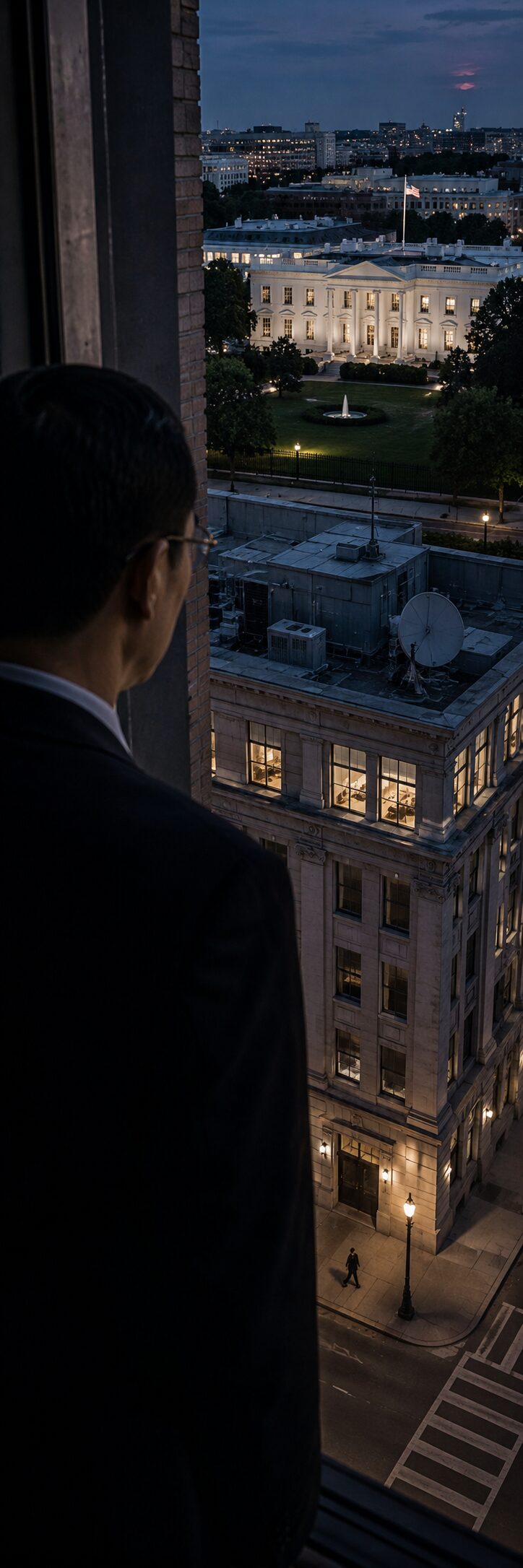
A senior Chinese Communist Party figure with a long record in Chinese policing and intelligence now owns a historic office building overlooking the White House. The Philip Qiu and Family Foundation purchased the 100-year-old Securities Building at 729 15th Street NW on July 21 for $8.4 million, per District of Columbia deed filings. The property sits roughly 650 feet — about 200 meters — northeast of the White House grounds. The buyer, Philip Qiu, is listed in Chinese records as Qiu Feili.
Who Is Philip Qiu?
Qiu began his career inside China’s police apparatus. He served as a detective on the criminal investigation team of the Shanghai Public Security Bureau, a local arm of the Ministry of Public Security. By 2011 he had also completed special forces training, according to Shanghai Jiaotong University announcements translated by the Daily Caller News Foundation (DCNF).
Since then, he has held at least three posts inside the United Front Work Department (UFWD). He chairs the Shanghai Overseas Chinese Foundation, described in Chinese state announcements as the only charity operating within the Shanghai UFWD system. United front work blends engagement, influence, and intelligence operations, according to both the House Select Committee on the CCP and the US-China Economic and Security Review Commission.
Qiu also co-founded the Chinese American Museum in Washington in 2017. The museum maintains that no foreign government funds or controls it.
What Worries Former US Intelligence Officers?
The site would suit a listening post or Stingray-style interception of calls and messages, Bryan Dean Wright, a former CIA operations officer, told the DCNF — adding, “This kind of property is where the next 9/11 will come from.”
Michael Lucci of State Armor called the risk obvious and urged a forced sale. China expert Gordon Chang argued that no Chinese citizen should hold property overlooking a sensitive federal site.
No US agency, however, has publicly assessed the purchase as a threat, and no charge has been filed. The concern so far rests on capability and proximity rather than proven activity.
Why Beijing Buys Ground, Not Just Secrets
China does not separate its commercial actors from the state the way the West does. The 2017 National Intelligence Law requires Chinese organizations and citizens to support state intelligence work. That means a foundation, a museum, or a corn mill can all serve a second purpose.
Property offers something agents cannot: a fixed site needs no visa. It sits still, draws power, can host equipment, and can watch patterns — who arrives, when convoys move, which frequencies fill the air — while also providing cover for spotting and recruiting nearby targets.
Farmland serves a similar function cheaply, often sitting near runways, radar arrays, and rail lines, while also offering leverage over the food supply itself.
The Wider Land Pattern
Chinese investors held about 277,336 acres of US agricultural land as of the end of 2023, per USDA figures — well under 1 percent of all foreign-held farmland. The following year’s data showed that total falling by nearly 30,000 acres. Location, rather than acreage, is what drives the concern. Several cases illustrate why:
• North Dakota: Fufeng Group bought 370 acres about 12 miles from Grand Forks Air Force Base. CFIUS found it lacked jurisdiction because the land sat undeveloped. The Air Force, however, warned the project “presents a significant threat to national security.” The city ultimately killed it.
• Texas: Billionaire Sun Guangxin assembled roughly 100,000 acres in Val Verde County, home to Laughlin Air Force Base.
• Wyoming: President Biden ordered a Chinese-backed crypto-mining firm to divest land within a mile of a nuclear missile base.
Washington’s Response
Treasury expanded CFIUS property jurisdiction to more than 60 additional installations in 2024. The following year, Agriculture Secretary Brooke Rollins launched the National Farm Security Action Plan. “I want to know who owns the land around our bases,” Defense Secretary Pete Hegseth said.
The Pentagon and USDA signed an information-sharing memorandum in early 2026. States have moved faster still — seven amended their foreign-ownership laws in 2026 alone, according to the National Agricultural Law Center.
Beijing rejects the framing: Foreign Ministry spokeswoman Mao Ning called the farmland ban plan “a typical act of discrimination.” Civil rights groups warn that the laws risk sweeping up ordinary Chinese-American buyers, and litigation continues in Florida, Arkansas, and Texas. Downtown Washington, though, falls outside the CFIUS base list entirely — a gap that is now, itself, the story.