
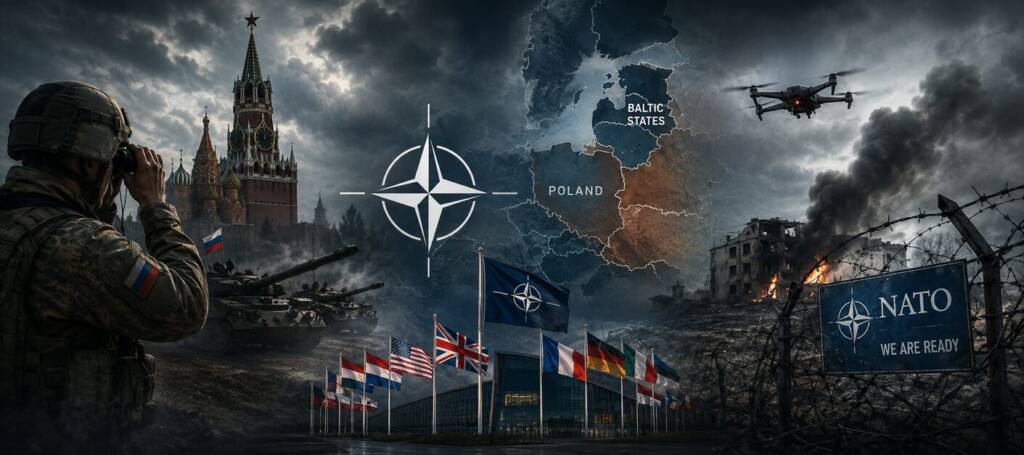
US intelligence now believes Russia could launch a limited strike on NATO as early as this autumn, according to reports published on August 6. The assessment marks a sharp shift in Washington’s thinking — until recently, American analysts had assumed Vladimir Putin would avoid direct confrontation with the alliance while his army remained bogged down in Ukraine. That assumption has now been discarded.
The assessments stop short of forecasting a full invasion. Instead, according to reports citing three sources familiar with the documents, they lay out a range of possible scenarios — from a cyberattack, to unmarked armed groups seizing a small patch of territory, to a limited incursion on the alliance’s eastern flank. Any such move would most likely target the Baltic states or Poland.
A Three-Year Window, Not a Date
The detail most headlines have glossed over is timing. The window described in the assessments runs from this autumn all the way to 2029 — a span of more than three years. The claim that Russia “could attack NATO next month” therefore refers to the earliest edge of that window, not a scheduled event.
Probability also varies sharply across the range of scenarios. According to reports, the odds of the most extreme option — a ground incursion — remain low, though growing. Officials reportedly judged an outright land grab the least likely scenario of all, given that it would directly test Article 5, the NATO clause treating an attack on one member as an attack on all.
Why the Assessment Has Changed
Two developments appear to be driving the shift. First, Ukrainian strikes on Russian energy infrastructure have caused significant damage. Second, Russian forces have made minimal territorial gains despite heavy losses. Together, these factors may be giving Putin incentive to seek a symbolic win elsewhere.
Heather Conley, senior fellow at the American Enterprise Institute, framed Russia’s broader objective bluntly: challenging NATO’s credibility and driving a wedge between the United States and its allies has “always been a goal” of Moscow’s, she said, adding that the real open question is how Washington would respond if tested.
European officials have voiced similar concerns for months. On August 6, Lithuania’s Defence Minister Robertas Kaunas told LRT Radio that the Kremlin “needs a new escalation, some kind of new victory,” naming the Baltic region and Poland as the most likely targets. Separately, a source close to the Polish president said Washington had been “systematically” briefing Warsaw on Russian planning along the eastern flank.
Recent incidents appear consistent with this pattern. A Russian drone struck a block of flats in Galați, Romania, on May 29, wounding two people. A Kh-101 cruise missile crossed Polish airspace on July 30 before coming down near Tarnawa-Kolonia. On August 5, staff discovered a modified drone beside a Ukrainian cargo plane at Leipzig Airport in Germany — an incident German Interior Minister Alexander Dobrindt described as a “hybrid attack scenario,” though he stopped short of naming Russia directly.
Reasons for Skepticism
Several factors weigh against the idea that an attack is imminent.
Moscow flatly denies any such intention. Russia “has never had and does not have such intentions,” Foreign Minister Sergei Lavrov told the UN General Assembly, with Putin dismissing similar claims as nonsense and Kremlin spokesman Dmitry Peskov questioning the reliability of leaked American assessments.
Capacity constraints are a second factor. Ukraine’s General Staff puts Russian personnel losses since February 2022 at more than 1.46 million — a figure published by Kyiv, disputed by Moscow, and unverified by any independent body. Despite this toll, Russian forces have been unable to break through Ukrainian lines.
NATO’s own response offers a third reason for caution. Allies who met in Brussels on August 12 assigned Russia “full responsibility” for recent airspace violations, calling them “dangerous and unacceptable” — yet no member state invoked Article 4, the clause that triggers formal consultations, and the alliance announced no new operational tasking. Meanwhile, Poland already spends 5 percent of GDP on defence, with Prime Minister Donald Tusk saying the country will soon field Europe’s largest army.
Finally, 2029 itself is not a new figure. Germany’s Chief of Defence, General Carsten Breuer, first named that year back in 2025, and Berlin has repeated it consistently since — repetition, analysts note, is not the same as imminence.
NATO’s public messaging has remained steady throughout: the alliance says it is reinforcing air and missile defences from the Baltic to the Black Sea and stands ready to deter and defend against any threat
What to Watch Next
One caveat buried within the reporting stands out: US stockpiles of Patriot and THAAD interceptors have run low, partly due to the ongoing war with Iran. Pentagon chief spokesman Sean Parnell rejected any suggestion of weakness, saying, “We have everything required to strike at the time and place of the president’s choosing.”
Going forward, three indicators are worth tracking closely: whether any NATO ally invokes Article 4 again; whether drone incidents escalate from border airspace violations to strikes on European infrastructure; and whether military activity increases around Kaliningrad and Belarus — the two staging points analysts consistently point to as potential launch bases