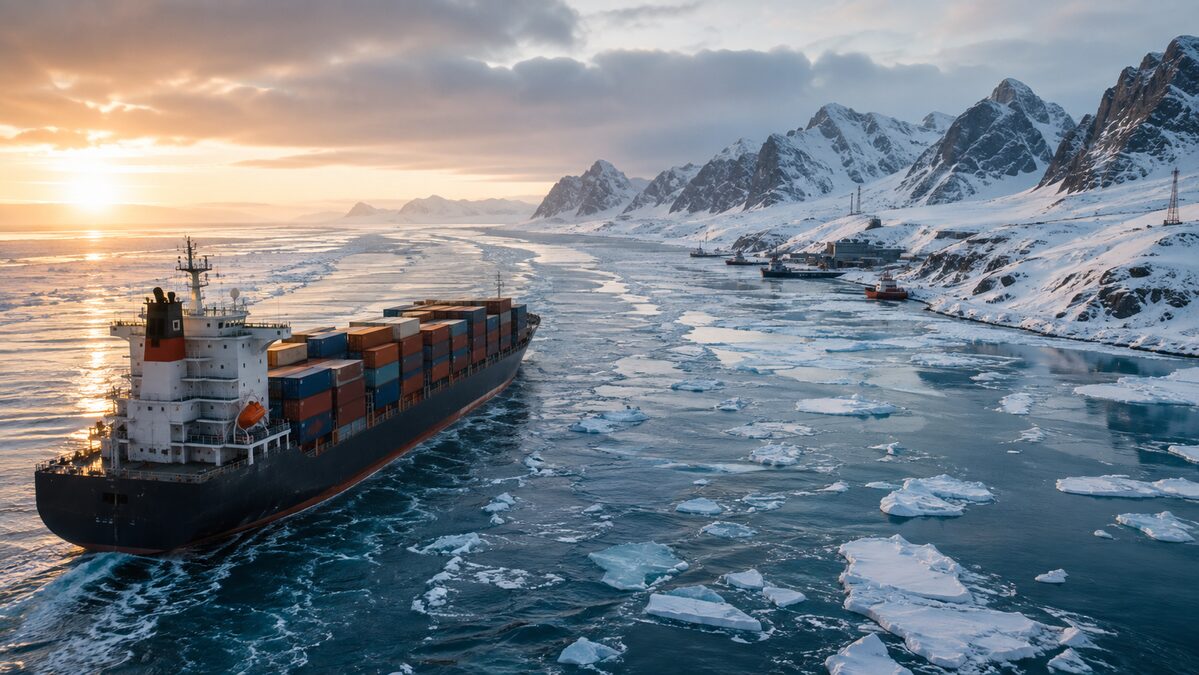
A Chinese container ship left the port of Ningbo-Zhoushan on August 15 and turned north, opening what its operator calls the world’s first regularly scheduled container line through the Arctic — and tying Beijing and Moscow together more tightly than any diplomatic summit could.
The vessel, the Dubai Tower, is now crossing Russia’s Arctic coastline en route to Britain. Its operator, Sea Legend Shipping, has branded the service the China-Europe Arctic Express.
How the Route Works
The route is built around a narrow summer window — ice typically clears the Northern Sea Route only between roughly July and October. Feeder ships gathered containers from Dalian, Qingdao, Shanghai, Taicang, Fuzhou, and Nansha, consolidating everything at Ningbo-Zhoushan starting August 12.
From there, the mainline vessel sails north through the Bering Strait, turns west, and hugs Russia’s northern coast for thousands of miles before dropping south into the North Sea toward Felixstowe, with calls at Rotterdam, Hamburg, and Gdynia to follow.
The Dubai Tower is scheduled to reach Felixstowe on September 7 — a journey of roughly 20 days. By comparison, the Suez Canal route takes about 40 days, and the Cape of Good Hope route around 50.
What It Can Carry
Capacity remains modest for now. The Dubai Tower holds 1,740 twenty-foot equivalent units (TEU), and Sea Legend plans eight sailings between August 15 and October 3 using seven ice-strengthened vessels, including the 4,890-TEU Istanbul Bridge and three Tiger-class ships. That puts the season’s total combined capacity at roughly 15,700 TEU — less than a single modern Suez-transiting container ship, which can carry more than 20,000 TEU on its own.
Ningbo-Zhoushan Port said the inaugural shipment carries energy-storage units, batteries, and solar modules manufactured in Ningbo and Yiwu. Sea Legend argues that the Arctic’s cold water is actually well-suited to transporting lithium batteries. Fang Yi, the company’s chief executive, told China Daily the ship will also call at Baltic ports, and British forwarder Davies Turner is marketing the available slots under the name “Polar Silk Road.”
Why the Route Suits Beijing
The corridor offers China a shipping lane that Western navies don’t patrol. The Strait of Malacca currently carries about 80 percent of China’s crude oil imports, while conditions along the Red Sea route have deteriorated further — Houthi attacks and the broader war involving Iran have effectively choked the Bab al-Mandeb Strait, prompting many shipping lines to avoid the passage altogether.
William Yang, who analyses Northeast Asia for the International Crisis Group, said China is currently the only country positioned to realistically use the route, since Russia controls the passage and other flags remain hesitant to rely on it. Yang added that the arrangement lets Beijing deepen its strategic foothold in the Arctic.
Where Russia Holds the Keys
Moscow controls every permit required to use the route. The Northern Sea Route Administration operates under Rosatom, Russia’s state nuclear energy company, which also owns the world’s only fleet of nuclear-powered icebreakers. Three of Sea Legend’s seven vessels require that icebreaker escort — meaning each escort fee flows directly to a sanctioned Russian state enterprise.
Russia is pushing for significantly more traffic on the route. Rosatom’s director general, Alexey Likhachev, pledged in July to double cargo volumes along the route, with Russia and China both targeting doubled bilateral volumes by 2030. Atomflot reported that bilateral cargo already surpassed five million tonnes in early 2026, with both governments aiming for 20 million tonnes annually by 2030. President Xi Jinping first proposed joint development of the route in 2017, but Western sanctions after 2022 ultimately pushed Moscow to open the door.
The Cracks in the Ice
Despite the ambitions, total route traffic actually declined last year — Rosatom recorded 37.02 million tonnes in 2025, down from 37.9 million the year before, with only 23 container ships making the crossing during that period. Insurance costs also run roughly 40 percent higher than for the Cape route, and search-and-rescue coverage in the region remains minimal.
Environmental groups have raised strong objections. Dr. Sian Prior, an advisor to the Clean Arctic Alliance, warned that black carbon emitted by ships settles on ice and accelerates melting, calling regular Arctic shipping traffic a serious concern for both wildlife and local communities.
Military planners have taken notice as well. NATO launched a dedicated mission, Arctic Sentry, in February 2026, and the United States commissioned its own icebreaker, the *Storis*, in 2025.
Not a Suez Replacement Yet
Dylan Loh, who teaches public policy at Nanyang Technological University in Singapore, described the route as a hedge rather than a strategic pivot, noting that it still lacks the reliability and predictability offered by established shipping lanes.
Other countries are watching closely. South Korean operator PanStar purchased a vessel for an Arctic trial run this month, and India signed its own Arctic logistics memorandum with Rosatom in August.
Regardless, the window will close again soon. When the ice returns in November, the route will shut down until next summer — though Sea Legend says it hopes to eventually stretch the sailing season to four months.