
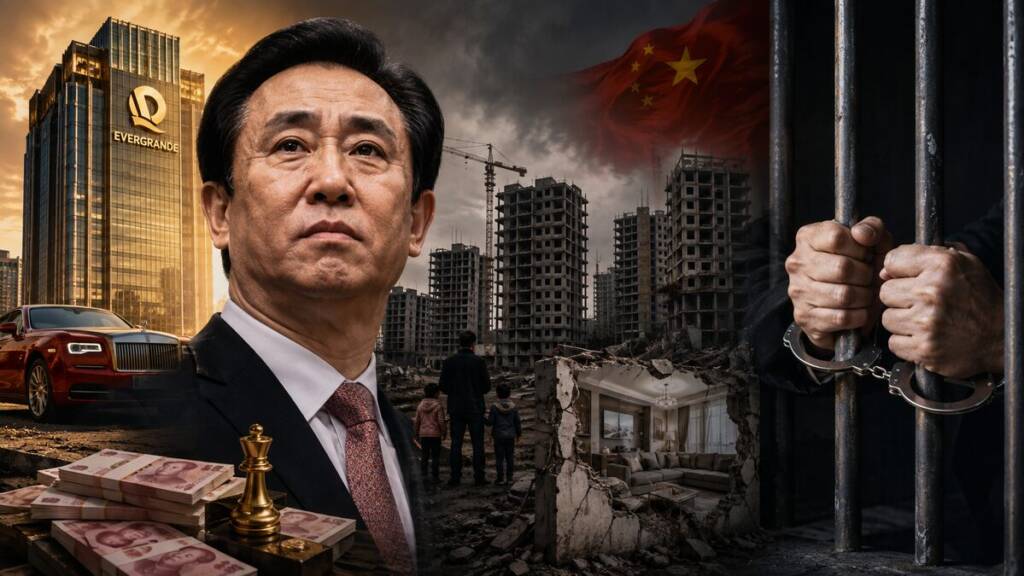
A court in Shenzhen has jailed the man who built China’s largest property empire. On August 20, the Shenzhen Intermediate People’s Court sentenced Evergrande founder Hui Ka Yan, 67, to life in prison. The court convicted him of large-scale financial fraud, bribery, and misusing company assets. It confiscated all his personal property and stripped his political rights for life.
Judges fined Evergrande Group 8.82 billion yuan and its onshore unit Hengda Real Estate 7 billion yuan. Together the penalties top $2.3 billion. Hui, also known as Xu Jiayin, had pleaded guilty in April.
The offenses ran from 2016 to 2021, the court said. Hui inflated Evergrande’s assets and concealed its liabilities. He also abused his position to move company money and gained control of financial institutions through bribery.
So far, more than 50 people have received prison terms of 22 months to 18 years. Those sentenced include Hui’s sons, Xu Tenghe and Xu Zhijian, along with several former executives.
China’s Real Estate Bubble
China’s property boom lasted roughly two decades. Developers bought land cheaply, borrowed heavily, and sold flats before building them — the “three highs” model of high debt, high leverage, and high turnover.
Buyers paid in full years ahead of completion. That cash funded the next land purchase, and the cycle repeated. Evergrande rode it hardest, listing in Hong Kong in 2009 and peaking above $50 billion in market value. Hui himself was ranked China’s richest man by Forbes in 2017, with a net worth above $40 billion.
Housing swelled to about a quarter of the economy, and roughly 70% of Chinese household wealth sits in property. Ordinary families, in other words, bet their savings on the boom.
Tofu Buildings and Broken Promises
Speed came at a cost. Buyers coined the phrase “tofu-dreg projects” for shoddy work that crumbles like bean curd — a term that spread after the 2008 Wenchuan earthquake, when badly built schools collapsed because contractors had swapped steel rods for thin iron wire.
Some “tofu buildings” leak, crack, and age fast; some collapse outright. Worse, developers never finished millions of flats — Nomura estimated about 20 million incomplete units nationwide. Chinese buyers call these concrete skeletons “rotten-tail buildings.”
Why the Crash Came
Beijing pulled the plug itself. In August 2020, regulators introduced the “three red lines” — capping developers’ liability-to-asset ratio at 70%, net gearing at 100%, and requiring cash to cover short-term debt. Firms breaching any line lost access to new borrowing.
Evergrande breached all three, carrying 716.5 billion yuan in interest-bearing debt by the end of 2020. The refinancing tap closed. Evergrande defaulted in 2021, Country Garden followed in 2023, and a Hong Kong court ordered Evergrande’s liquidation in 2024.
Hui’s Long March with the Communist Party
Hui was no outsider. He joined the Chinese Communist Party and served as party committee secretary at Evergrande. In 2008 he joined the National Committee of the Chinese People’s Political Consultative Conference, the country’s top advisory body; he was promoted to its Standing Committee in 2013 and attended the party’s centenary celebrations in 2021.
At the 2012 Two Sessions, Hui wore a Hermès belt to the podium, earning him the online nickname “belt brother.”
His political fall came first. He skipped a Standing Committee meeting in November 2022, was barred from the March 2023 session, and was detained that September. The court has now removed his political rights permanently.
What the Sentence Means for Private Business
The ruling reads as a policy statement. Private developers are already feeling the freeze — a loan officer at a large state bank told Reuters that lending to private builders dried up long ago, and state-owned developers now dominate what remains of the market.
President Xi Jinping has steered credit toward robotics and semiconductors instead, though those industries remain too small to plug the gap. The message to Chinese entrepreneurs looks blunt: political access protects a tycoon only while the numbers hold.
The Crisis Is Not Over
Hui’s life sentence closes a case, not a chapter. China’s property slump has entered its sixth year. New-home prices fell faster in July than in June, and second-hand prices in smaller cities sit well below 2020 levels.
Sam Radwan of Enhance International expects prices to fall a further 40% before the market bottoms out around 2030. Christopher Beddor of Gavekal Dragonomics takes a milder view — he doesn’t expect a substantial worsening from here, but sees the likely path as a continued grinding price correction that gradually clears the market rather than a swift recovery.
On Weibo, the sentencing hashtag drew more than 370 million views and 72,000 discussions. Many homeowners asked why judges spared Hui the death penalty.