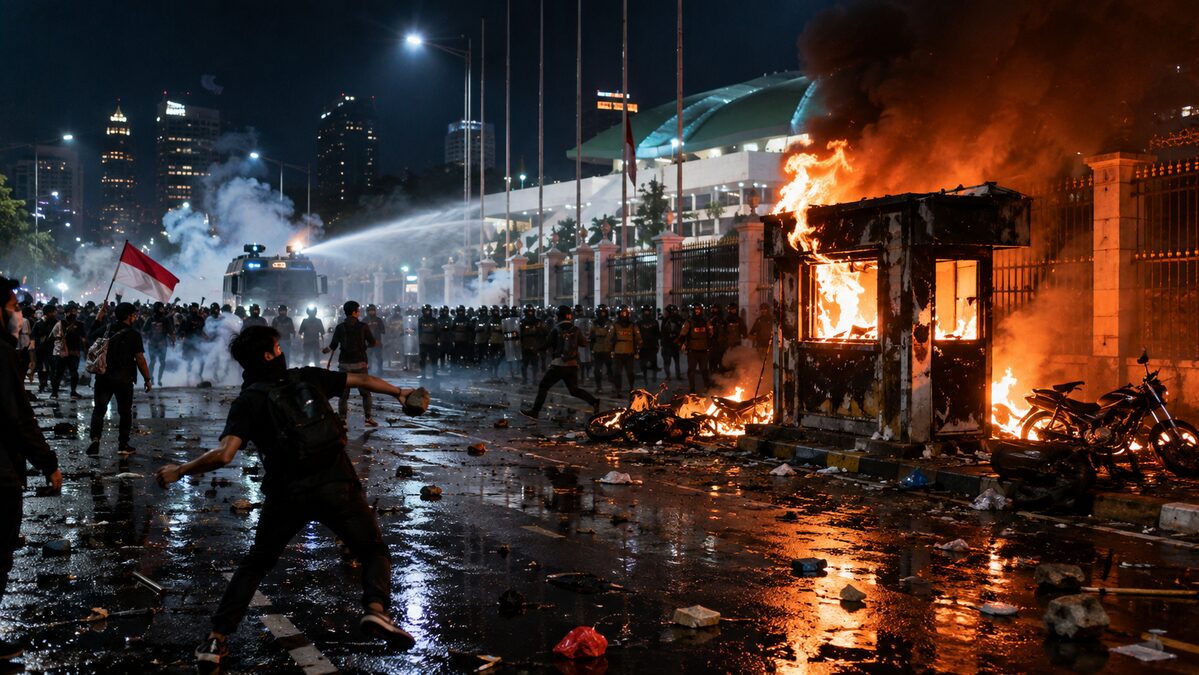
Police have detained 322 people after a Jakarta protest against corruption spilled into a night of rioting outside parliament. Forty-five were named as suspects on Friday, and one man collapsed at the scene and later died in hospital.
The rally began peacefully on Thursday, August 27, in Senayan, central Jakarta, where thousands gathered at the gates of the House of Representatives (DPR). The mood shifted after dark.
Local media reported that men in black shirts remained on the streets long after the main crowd dispersed, setting fire to a police post in Slipi and two motorcycles, blocking roads, and throwing rocks and sticks. Police responded with water cannon and tear gas.
Jakarta police spokesperson Budi Hermanto gave the arrest figures at a Friday press conference: 162 of those detained were adults aged 18 to 40, and another 160 were aged 12 to 19, with their legal status still unconfirmed. “After the majority of the crowd had dispersed, a group of rioters arrived and tried to disrupt public order and security,” Budi said, adding that some carried makeshift weapons. A second officer, Iman Imanuddin, said police were still “gathering facts” about the death.
Why the Protest Happened
One demand sat at the center of the rally: pass the asset forfeiture bill, which would let the state seize assets tied to corruption and money laundering. Parliament first received the bill in 2008; eighteen years later, it still hasn’t passed. Protesters also want tougher sentences for officials convicted of graft, with some calling for the death penalty.
Timing mattered too. The rally fell exactly one year after anti-government demonstrations turned into nationwide riots that killed about 10 people and led to nearly 7,000 arrests.
Who Organized the Protest
The main organizer was the United Pati Community Alliance (AMPB), a group from Pati regency in Central Java whose members reached the capital in chartered buses before dawn.
AMPB rose to prominence in 2025 by leading mass protests against a 250 percent hike in the local land and building tax — a rise the regency ultimately scrapped. Pati’s suspended regent, Sudewo, who had pushed the tax through, is now on trial for corruption.
AMPB coordinator Supriyono, known as Botok, kept the group’s demands narrow. “We are focusing on those two demands. There is no call for Prabowo-Gibran to step down,” he said Wednesday, August 26.
Students joined separately — about 200 arriving from several universities to demand the government scrap its free school meals program, which has faced corruption allegations and repeated food poisoning incidents. They also called for lower food prices and an end to the military’s widening role in civilian life. Their tone was deliberately cautious: “We chose August 27 to commemorate because last year there were riots and various other incidents. And today we want to convey our aspirations, not cause riots,” a student representative said.
How the State Responded
The government answered on two fronts at once — conceding inside parliament while deploying heavily outside it.
Inside, DPR Deputy Speaker Sufmi Dasco Ahmad signed a letter of commitment promising passage of the bill by December 15, 2026. Botok read the letter aloud to the crowd, and the Pati contingent began heading home.
Outside, security numbers were large but disputed: Al Jazeera cited 18,500 officers across the city, while the Jakarta Post reported 4,274 personnel securing the rally itself. Police also detained 65 people before the march on suspicion of stirring trouble, saying they had seized air guns and materials for petrol bombs. Chief Security Minister Djamari Chaniago defended the operation: “We will escort them so that their aspirations can be conveyed properly.”
Soldiers appeared the next morning — Tempo reported army personnel guarding the Slipi flyover by 9 a.m. Friday, while Central Jakarta Mayor Arifin visited the site to talk down a group still gathered underneath. Transport took the hit as operators suspended or diverted several commuter rail routes, and bus services near parliament closed before resuming later Friday.
What Comes Next
The protest has already extracted one written promise; pressure now shifts to meeting the December deadline. President Prabowo Subianto has ordered the government to speed the bill along — his law minister, Supratman Andi Agtas, confirmed as much on August 14 — and Commission III chairman Habiburokhman noted lawmakers have already held 35 public hearings.
Prabowo has little room for delay. He won office in 2024 by a wide margin, but his approval rating has since slid to 38 percent.