
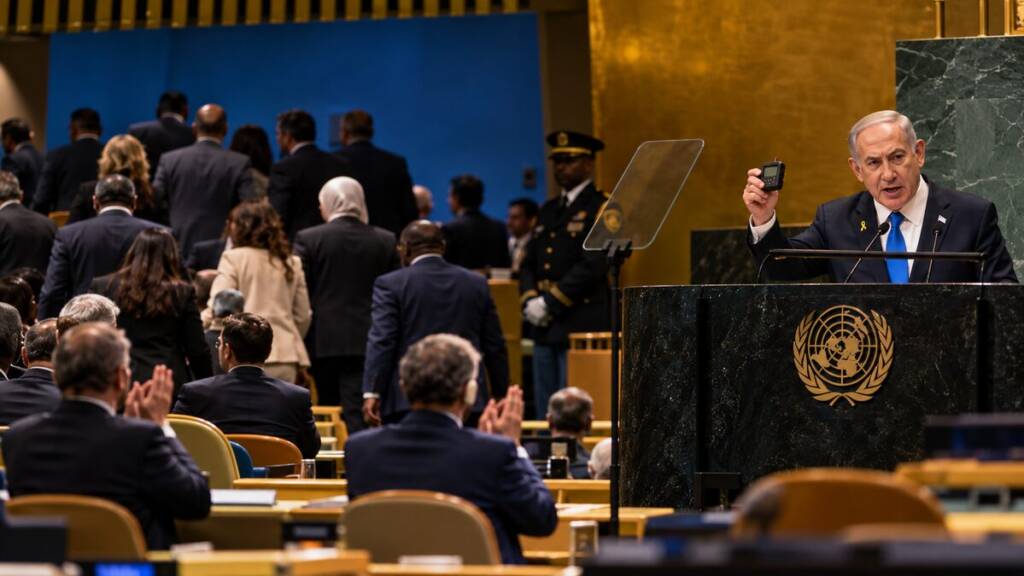
Israeli Prime Minister Benjamin Netanyahu addressed the UN General Assembly in New York on September 24, defending Israel’s wars in Iran and Gaza while diplomats walked out of the chamber as he approached the podium. He also took aim at New York City Mayor Zohran Mamdani by name — a speech delivered five weeks before Israelis head to the polls on October 27.
Walkout and Reaction in the UN
The Palestinian mission had urged UN member states to walk out together as Netanyahu spoke. He responded from the podium, inviting any remaining “moral cowards” to leave. It was his 15th address to the General Assembly. While some delegates left, others stood and applauded, and supporters in the gallery chanted.
Iran
Netanyahu opened by addressing Iran, telling the hall that without Israel’s strikes, “we’d all be dead.” As in previous years, he used visual props — this time holding up a pager resembling the devices Israel used against Hezbollah in 2024.
He voiced support for Iranian protesters and predicted the eventual fall of Iran’s government, thanking President Donald Trump and crediting Washington with helping secure the return of all Israeli hostages from Gaza.
Gaza
Netanyahu dismissed genocide allegations against Israel as “the biggest lie of the century,” invoking the memory of his late brother, Yoni, and repeating the phrase “we have no other choice.” Israel denies allegations of genocide and war crimes in Gaza — allegations that several world leaders, along with UN Secretary-General António Guterres, had raised earlier in the week.
Mayor Mamdani and Governor Hochul
A significant portion of the speech targeted Mamdani. Netanyahu claimed many Jews no longer feel safe in New York since Mamdani’s election, telling the mayor, “shame on you for distorting the facts,” and accusing him of trying to silence him. He also criticized social media posts liked by Mamdani’s wife, Rama Duwaji, following the October 7 attacks.
Mamdani had pledged during his campaign to arrest Netanyahu, though he later acknowledged the city lacks the legal authority to do so. Following the speech, Mamdani accused Netanyahu of “baseless lies” and pointed to the International Criminal Court’s arrest warrant against him — allegations Netanyahu denies.
Governor Kathy Hochul weighed in before the speech, disputing claims made in a video Netanyahu had released on September 22. “The mayor has never said he supports Hamas,” she said, adding that while she understands the pain Israel suffered on October 7, inaccurate claims still require a response. Hochul, who describes herself as a supporter of Israel and visited the country days after the Hamas attack, is also facing her own re-election battle this fall — a recent poll shows her leading Republican Bruce Blakeman 50 percent to 41 percent.
The Domestic Context
Israeli commentators tied the speech directly to the upcoming election. Former consul general Alon Pinkas said the annual address gives Netanyahu a chance to project strength before voters, while analyst Ephraim Ganor wrote in Ma’ariv that Netanyahu’s real audience was the Israeli electorate.
The political backdrop looks difficult for the prime minister. Successive polls suggest his coalition would lose an election held today; a Hebrew University survey put his approval at 29.4 percent in June, down from 40.5 percent in March — though differing polling methods limit direct comparisons.
Netanyahu did not schedule meetings with Trump or other US officials during his visit. Some observers read this as a sign of cooling support from Washington, while others attributed it simply to the brevity of his trip. Broader American sentiment adds another layer of pressure: a Pew Research survey this summer found 62 percent of Americans hold an unfavorable view of Israel’s government, at a time when Israeli governments have traditionally sought bipartisan US support.
Outside the UN
Police detained roughly 100 protesters, including actor Susan Sarandon, who refused orders to disperse. Palestinian President Mahmoud Abbas addressed the assembly via video after the US denied him a visa for the second time. Separately, Iran sent Washington a proposal on reopening the Strait of Hormuz and resuming talks.
Israeli voters will render their own verdict on Netanyahu’s leadership on October 27.