
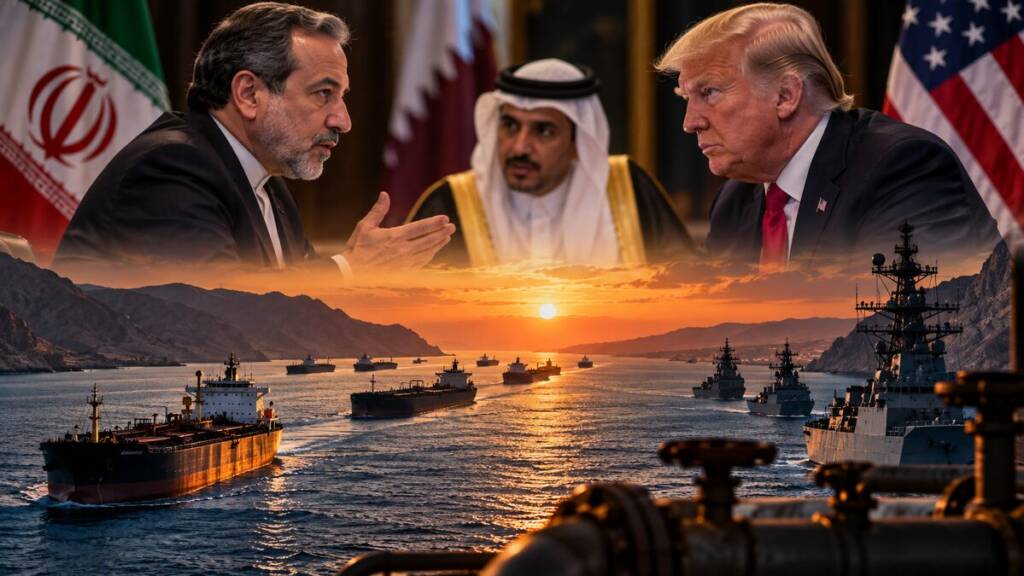
Iran has offered to reopen the Strait of Hormuz within seven days and resume nuclear talks with the United States. Foreign Minister Abbas Araghchi laid out the plan in New York on September 24, on the sidelines of the UN General Assembly, with Qatari mediators carrying the proposal to Washington this week. Araghchi told reporters the strait would reopen “at the end of seven days” if Washington accepted his terms.
The offer lands as the war approaches its seven-month mark and fuel prices stay elevated worldwide.
What Iran Wants for Opening the Strait
Tehran’s conditions: the US lifts its naval blockade and waives sanctions on Iranian oil exports; Washington observes a ceasefire covering Lebanon; and, per reports, the US releases Iran’s frozen assets. Nuclear talks would begin only after the strait reopens.
The proposal echoes the memorandum of understanding both sides signed June 17, which promised a 60-day negotiating window before collapsing in July when Iran resumed attacks on shipping. Trita Parsi of the Quincy Institute, who attended the private meeting, said Araghchi argued a quick deal would benefit Trump ahead of November’s midterms.
Washington Keeps Its Distance
A White House official declined to comment directly but called the mediated talks “positive and constructive.” Other reports suggest the administration wants a broader deal covering Iran’s nuclear program rather than a standalone Hormuz agreement.
Araghchi met US envoy Steve Witkoff and Jared Kushner on Tuesday; Secretary of State Marco Rubio cautioned against calling it a breakthrough. Trump struck a harder tone at the General Assembly, accusing Iran of stalling for the midterms and threatening to “annihilate the Islamic Republic” if talks fail.
Will a Deal Happen?
Analysts are skeptical. Urban Coningham of the Royal United Services Institute said Washington wants one comprehensive package, not piecemeal deals, and expects Trump to hold out through the midterms — while Iran sees control of the strait as its main lever for economic recovery. Burcu Ozcelik, a Middle East security analyst, said Washington believes its blockade and sanctions are working, even as Iran remains defiant despite real economic pain. Both sides, she noted, still have strong incentives to settle.
A Shock to World Energy
The strait normally carries roughly a fifth of global oil supply; only nine vessels crossed it Friday. The IEA has called the closure the largest supply disruption in oil-market history. The US EIA estimated Gulf producers shut in about 6.7 million barrels a day in August, when Brent crude averaged $91. Oil traded near $94 Thursday after touching $97, with deal hopes trimming gains. The IEA projects global demand will shrink 1.6 million barrels a day this year; its 32 members released 400 million barrels from emergency reserves in March and April. Houthi missile and drone attacks on Saudi Arabia now threaten the Red Sea route as well.
The Nuclear Gap
The nuclear file remains the hardest knot. Iran holds roughly 400 kg of uranium enriched to 60% (weapons-grade is 90%). Tehran calls its right to enrich non-negotiable but has signaled flexibility on stockpile levels: Deputy Foreign Minister Majid Takht-Ravanchi said Iran would discuss curbs if Washington lifted sanctions, and Iran’s atomic energy chief offered to dilute the most-enriched uranium in exchange.
Washington wants Iran to ship its stockpile abroad or halt enrichment for at least 20 years. Israel’s bar is higher still — Prime Minister Netanyahu says the war can’t end until Iran loses its nuclear capability, and Israel’s Institute for National Security Studies is pushing for full dismantlement of Iran’s enrichment infrastructure. A middle path once existed: before the war, Iran had accepted a “zero stockpile” proposal letting it keep enrichment while giving up bomb-ready material. US intelligence still puts Iran’s potential bomb timeline at nine to twelve months.
Qatar remains the key intermediary; President Masoud Pezeshkian hosted Qatar’s prime minister in New York Friday and distanced Tehran from the Houthis, saying Iran is “not at war with Saudi Arabia.” China has also entered the picture, looking to help cool the conflict as Trump holds talks with Xi Jinping.
At home, Trump faces mounting pressure — the Senate rejected a resolution to halt the war as gas prices hit voters. The US and Israel launched the war on February 28. Now seven days stand between the world and an open Hormuz — if Washington says yes.