
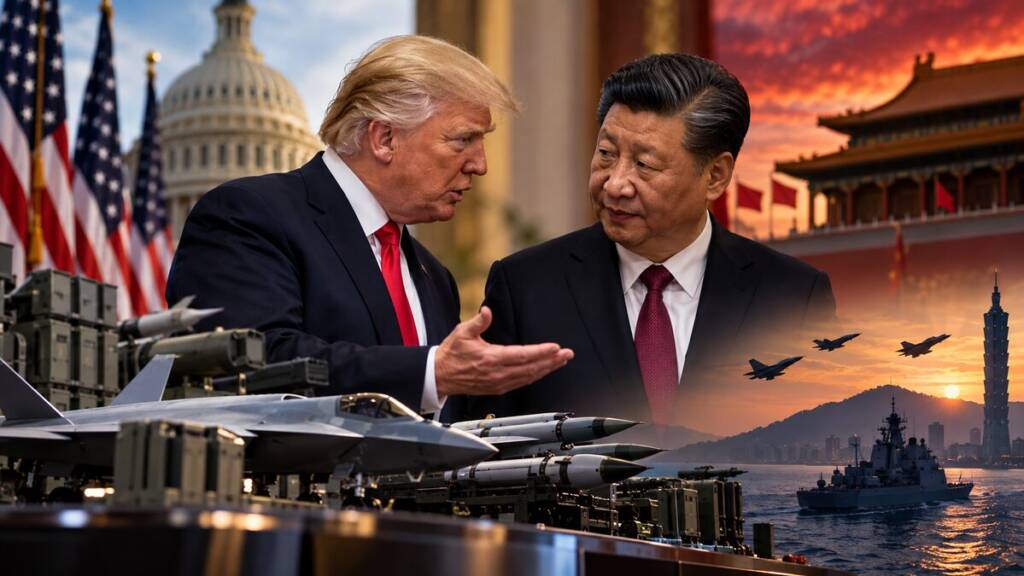
President Donald Trump asked President Xi Jinping if China wanted to buy US weapons, America’s envoy to Beijing said. The disclosure lands as a $14bn US arms package for Taiwan remains frozen.
Ambassador David Perdue disclosed the exchange on Sunday, 27 September. The revelation came days after Trump hosted Xi for a state visit in Washington. Perdue did not say when the conversation took place.
“He actually asked President Xi, would he like to buy some, at one point,” Perdue said. Any such deal would overturn decades of US policy on China and Taiwan. It could also expose American military technology to a potential enemy.
A Weapons Ban Dating Back to Tiananmen
US law stands squarely in Trump’s way. President George H.W. Bush halted arms sales to China on 5 June 1989. He acted a day after the Tiananmen Square massacre, when Chinese troops killed pro-democracy protesters in Beijing.
Congress wrote the ban into law in February 1990. Section 902 of the Foreign Relations Authorization Act still bars US munitions export licences for China.
The law gives a president two exits. He must certify progress on political reform and human rights in China. Alternatively, he can declare that lifting the sanctions serves the national interest.
Past presidents used that power sparingly. George H.W. Bush and Bill Clinton issued 13 waivers for 20 satellite projects between 1989 and 1998, according to the Congressional Research Service. The European Union imposed its own arms embargo on China after the crackdown.
Why Beijing is Unlikely to Bite
China wants Washington to stop arming Taiwan, not to arm China. Beijing pressed that demand hardest at the May summit in Beijing. During last week’s talks, Xi urged Trump to oppose Taiwanese independence, according to Chinese state media.
History offers little encouragement either. In the 1980s, Washington agreed four military sales programmes with Beijing, including torpedoes and radars. China itself cancelled Peace Pearl, a US upgrade for its F-8 fighter jets, in April 1990.
What Trump Wants
Trump has played down the Taiwan sale to Xi as one of many US arms deals worldwide. He has also called the paused package a “negotiating chip” with Beijing.
Trade sits at the heart of his approach. Treasury Secretary Scott Bessent said last week that China meets its pledge to buy 25 million tonnes of soybeans. But he said Beijing lags on a separate pledge to buy $17bn in other farm goods. The White House also says China approved an initial order for 200 Boeing jets in May. Both sides extended their trade truce by just two months last week.
Washington wants faster farm purchases before the November midterm elections. Those deals matter to farmers and aircraft workers in many Republican-leaning states.
Taiwan Waits for its Weapons
Washington paused a record $14bn weapons package for Taiwan after the May summit. The package includes missiles, anti-drone systems and air-defence equipment. The wider backlog of undelivered US arms for Taiwan now amounts at nearly $30bn.
US law obliges Washington to help Taiwan defend itself. Perdue insisted Trump has sold Taiwan 50 per cent more arms than any president since 1979. Trump’s first administration cleared about $18bn of defensive equipment for Taiwan.
Senator Mitch McConnell and three fellow Republicans urged the administration last week to move ahead with Taiwan sales. Their letter quoted Secretary of State Marco Rubio back to himself. “Deterring an invasion of Taiwan must be our top priority,” Rubio once said.
Their concern echoes a Reagan-era promise. Ronald Reagan’s envoy delivered six assurances to Taiwan’s president on 14 July 1982. In one, Washington refused to set an end date for arms sales to Taiwan.
Allies across Asia Watch Closely
Analyst Jeremy Chan said that Japan and the Philippines fear a softer US line on Taiwan. They worry Trump could trade that support for economic gains or Chinese help in ending the Iran war.
Japanese Prime Minister Sanae Takaichi signalled last year that a Chinese invasion of Taiwan could draw in Japanese forces.
Emma Chanlett-Avery of the Asia Society Policy Institute voiced that fear. She said that “Any indication of a softness on Taiwan would be quite alarming”. China has never ruled out force to bring Taiwan under its control. Trump says Xi personally promised him China will not attack Taiwan during his presidency.
Huang Chung-ting, a Taipei defence researcher, said that arms sales signal American credibility and allied trust. Taiwan produces more than 90 per cent of the world’s advanced semiconductors.
What Comes Next
Perdue said Trump and Xi still discuss future US arms sales to Taiwan. The ambassador also said Xi backed a nuclear-free Iran and an open Strait of Hormuz. Trump hailed the summit on Truth Social as one of friendship, strength and success.
The Council on Foreign Relations expects four Trump-Xi meetings this year, with two still to come. Unless Trump waives a law that Congress passed 36 years ago, his offer to Xi remains talk.