
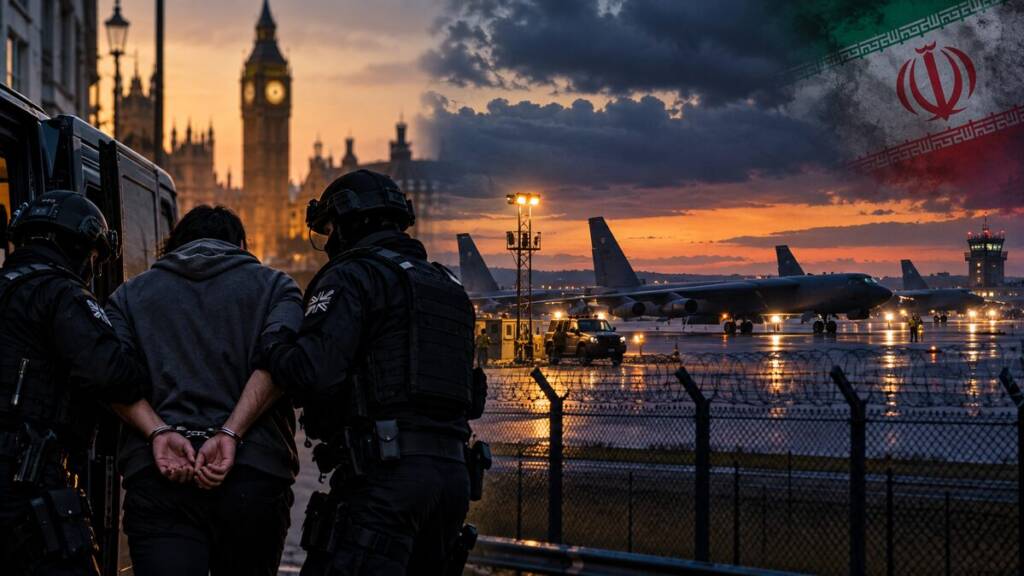
Counter-terrorism officers have arrested a 27-year-old dual British-Iranian man over the suspected bomb plot near RAF Fairford. He was detained in the City of Westminster, London, on the afternoon of Thursday 1 October, making him the sixth person held in the investigation in five days.
Officers made the arrest under section 5 of the Terrorism Act 2006, which covers the preparation of terrorist acts. They also searched two properties in the same area and questioned a 26-year-old British man under caution without arresting him.
What the Police Say
Vicki Evans, senior national coordinator for Counter Terrorism Policing, called the Gloucestershire inquiry “hugely complex”. She said detectives are examining all possible angles, including possible foreign state involvement.
Police have not named the man, and no one has been charged.
How the Alarm Was Raised
The case began in the early hours of Sunday 27 September, when a farmer reported three suspicious vehicles heading towards RAF Fairford. She said she saw hooded, masked men running into the fields.
Armed officers reached the village of Whelford, less than half a mile from the base, and arrested five British men aged 23 to 25 from the London area. They were first held under the Explosives Act, and terrorism offences followed. Police released all five on bail the next day. Bomb disposal teams found no explosives in the vans, though officers recovered a quantity of petrol.
Why Iran Would Target the Airfield
RAF Fairford, about 100 miles west of London, is the US Air Force’s only dedicated forward operating location for heavy bombers in Europe. The American and Israeli war on Iran began in February. On 1 March, Sir Keir Starmer, then prime minister, authorised American use of British bases for what he called a limited defensive purpose, and ministers approved strikes on Iranian missile sites attacking shipping in the Strait of Hormuz.
At the peak of the March deployment, Fairford hosted 15 B-1B Lancers and six B-52H Stratofortresses. A B-1B left the base on a strike mission against Iran overnight on 22 July. The next day, Iran’s Islamic Revolutionary Guard Corps warned that “any base used for aggression against Iranian territory constitutes a legitimate target”. That declaration made a quiet Cotswold airfield an announced wartime target, which explains why detectives looked towards Tehran within hours.
Tehran Rejects the Charge
Prime Minister Andy Burnham broke the government’s silence on Wednesday, telling the BBC there were “strong indications” of Iranian involvement and promising more detail later.
Iran’s embassy in London dismissed the claims as “unfounded and malicious speculations”. Foreign Minister Abbas Araghchi told Burnham on X that he was “barking up the wrong tree”.
Washington, Jerusalem and the Bail Row
US Secretary of State Marco Rubio said the plot clearly involved “the hands of a foreign actor”. Israeli Prime Minister Benjamin Netanyahu said Israel had given Britain intelligence about “an Iranian-sponsored attack”.
President Donald Trump called the original arrests “fantastic” but later criticised the decision to grant bail, saying he would not have done so. Laurence Taylor, who leads British counter-terrorism policing, defended it as a matter of experience and strategy.
A Pattern Britain Already Knows
Iranian activity inside Britain is not new. Sir Ken McCallum, the MI5 director general, said last October that his service had tracked “more than 20 potentially lethal Iran-backed plots” in a single year. He has repeatedly described Iranian handlers using criminals as proxies, from traffickers to petty crooks.
That history shapes the current inquiry. Detectives are testing whether young British men acted for a foreign state, knowingly or not, and the arrest of a dual national may give them a possible link between London and Tehran.
The five original suspects remain on bail without charge while detectives work out whether the strands of the case connect. Police can seek further custody time or release the latest suspect under investigation.
Foreign Secretary Ed Miliband has set the political tone, saying Britain “will act against the proxies of Iran”. Burnham has chaired emergency security meetings and promised MPs an update. Flights continue from Fairford, and the base now guards its perimeter under a threat the government itself has named aloud.