
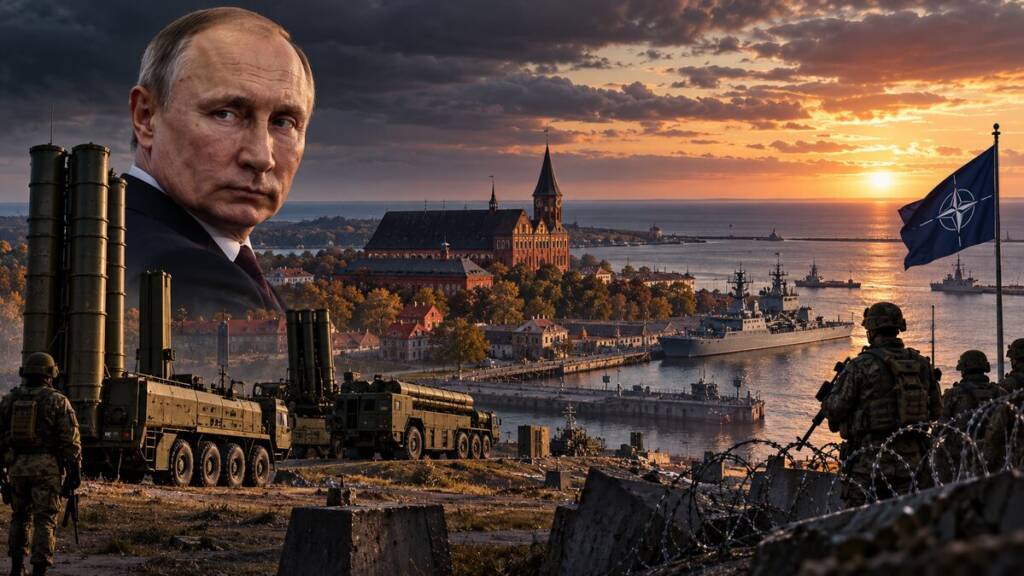
Russian President Vladimir Putin has drawn a nuclear line around a sliver of land on the Baltic coast. Speaking on Thursday at the Valdai Discussion Club in Moscow, he said any direct attack on Kaliningrad would force Russia to reach for its entire arsenal. “This is inevitable,” he told the forum.
Putin said Russia faces “an enemy twice our size” in NATO and would therefore fall back on its “competitive advantages.” France and Britain have nuclear weapons, he acknowledged, “but no-one else possesses the kind of weapons that Russia has today.” He paired the threat with a denial: Russia, he insisted, plans no attack on any European country and wants to coexist peacefully.
Why Kaliningrad Is a Red Line
Russia won Kaliningrad as a prize of the Second World War. The 1945 Potsdam agreement handed the German city of Königsberg to the Soviet Union, which wanted a Baltic port that never froze. In 1946 it was renamed after the Bolshevik Mikhail Kalinin. That origin shapes today’s politics: surrendering ground there would mean reopening the 1945 settlement itself, a question no Kremlin leader will touch.
Geography then turned the trophy into a liability. The Soviet collapse in 1991 cut the region off from the mainland, and when Poland and Lithuania joined NATO and the EU in 2004, it became an enclave inside the alliance’s ring. About 950,000 Russians live there, with the nearest Russian soil hundreds of kilometres away. Every train, lorry and fuel shipment must cross EU territory or the Baltic Sea, so Moscow treats talk of restricting access as a siege.
Why the Exclave Matters
Kaliningrad gives Russia reach across the Baltic. Baltiysk is the main base of the Baltic Fleet and a naval harbour that stays open all year.
The exclave also carries serious firepower. Russia stationed Iskander-M missiles there in 2016. With a range of about 500 kilometres and the ability to carry nuclear or conventional warheads, they cover Warsaw, Vilnius, Riga and most of the Baltic Sea. S-400 air defence batteries and coastal missile units sit alongside them. Analysts call this package anti-access/area denial: it lets Russia make nearby skies and sea lanes costly for NATO.
Then there is the Suwałki Gap, a 65-kilometre strip of fields and forest on the Poland-Lithuania border. It is the only land route between Poland and the three Baltic states. With Kaliningrad to the west and Belarus to the east, Russian forces could in theory cut the corridor and strand three NATO members.
Kaliningrad’s Vulnerabilities
The exclave looked formidable a decade ago. Today it also looks exposed. Finland and Sweden joined NATO after Russia invaded Ukraine, so every Baltic coastline except Russia’s own now lies within the alliance.
The garrison has thinned as well. Russia moved much of its conventional strength, including the 11th Army Corps, to the Ukrainian front. The missiles stayed; the manpower did not. NATO commanders say as much in public. General Christopher Donahue, who commands US Army Europe and Africa, said in 2025 that allied forces could take Kaliningrad at “unheard of” speed, linking the claim to a new Eastern Flank Deterrence Line.
Isolation worries Moscow most. In 2022, Lithuania restricted rail transit of EU-sanctioned goods. Russian officials called it a blockade, a word Vilnius rejected. Russia now alleges that NATO is rehearsing an air and sea cut-off.
Why the Warning Came Now
The timing follows a sharp exchange. On 30 September, Russia sent NATO members a written note warning that it would use its entire arsenal, nuclear weapons included, against any attempt to isolate the exclave. NATO pushed back at once. Secretary General Mark Rutte called the alliance defensive and told Moscow to stop the nuclear threats, while NATO said none of its exercises threatens Russian territory. Kremlin spokesman Dmitry Peskov dismissed the row as a reminder to “hotheads in Europe.”
Putin’s repetition of the message in his own voice at Valdai signals policy, not improvisation. So does the budget: reviewed documents show Russia plans to spend 17.1 trillion roubles on defence in 2027, about 27 per cent above the original plan.
Putin also admitted strain. Ukrainian strikes on refineries, he said, have cost Russia roughly 1 per cent of GDP. He ruled out a ceasefire but said he would still prefer talks. The risk lies in that gap. Kaliningrad has grown weaker on the ground and heavier in symbolism, and a weak position guarded by nuclear threats leaves very little room for error.