
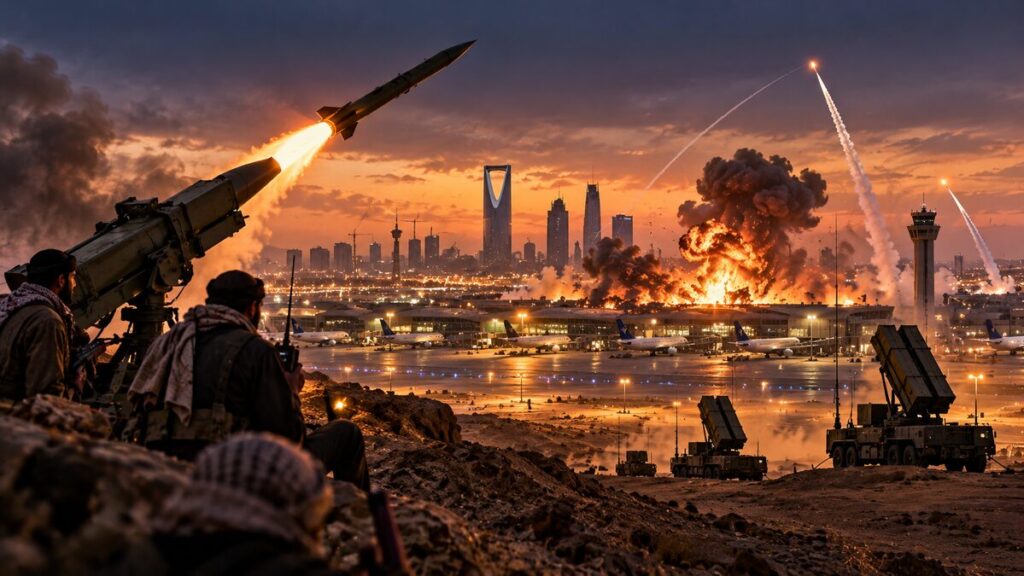
On 10 October, a Houthi missile slammed into King Khalid International Airport in Riyadh, killing 12 people and wounding 309. It was the deadliest attack on the kingdom in over a decade. Saudi forces shot down two ballistic missiles aimed at the capital that week but failed to stop this one.
Saudi Arabia owns Patriot and THAAD batteries and some of the world’s most advanced jets. Pakistan has also sent troops, JF-17 jets and a Chinese HQ-9 air defence system. Yet the Houthis keep hitting Saudi cities, airports and oil sites.
How the Houthis gained the upper hand
The fighting resumed in July, when a 2022 truce collapsed. The Houthis then declared a naval blockade of Saudi Arabia and began attacking its tankers. In September, they seized Yemen’s entire Red Sea coast, including the shores of the Bab al-Mandab strait, a key route for Saudi oil while Iran disrupts the Strait of Hormuz.
The Houthis also claim to have downed a Saudi F-15SA near Marib on 16 September. Riyadh has not acknowledged the loss.
Unity gives the group its edge. A centralised leadership keeps tight command over its forces, and its ranks have swelled to as many as 350,000 fighters. Yemen’s government army, by contrast, suffers from low morale, late salaries and short supplies. A Saudi-UAE rift also pulled Emirati troops and gunships off the Red Sea coast, and nobody filled the gap.
Saudi Arabia hit back on 5 October, with about 100 fighter jets backing a government counteroffensive. The push stalled near Dhubab airport, and inland the Houthis have encircled the city of Taiz.
How the Houthis strike so deep into Saudi Arabia
Range no longer limits them. The Palestine-2 missile can fly about 2,000km, and the Toufan covers between 1,350km and 1,950km. Both put Riyadh and the Gulf coast within reach, while shorter-range Burkan and Badr missiles cover Saudi border cities.
The group mixes drones and missiles of different speeds to confuse air defences. Iran supplies key parts such as guidance systems, and Houthi workshops build much of the rest. Yemen’s vast mountains let crews hide and move launchers between strikes.
Allies stretch that reach further. In September, drones from Iraq struck the East-West pipeline, which carries Saudi crude to the Red Sea. Since then, the Houthis have hit Aramco sites in Riyadh and Khurais, and projectiles have struck near Dammam’s airport on the Gulf coast.
Why Saudi air defence is failing
The US and its allies rapidly used up Patriot and THAAD interceptors in the early months of the Iran war, and Saudi missile defences had focused mainly on Iran. Geography compounds the problem: Riyadh must guard oil fields, refineries, pipelines, airports and ports across more than two million square kilometres. Each interceptor also costs far more than the cheap drone or missile it destroys. The Houthis exploit those gaps, and with their own stocks limited, they fire single missiles at less-defended civilian targets such as airports.
Pakistan’s contribution has not closed the gaps. Islamabad sent a Chinese HQ-9 system this spring, along with 8,000 troops and about 16 JF-17 jets. The system already carries a poor record. During Operation Sindoor in May 2025, India’s defence ministry said it had neutralised an air defence system in Lahore, which Indian sources identified as an HQ-9. Indian missiles then hit several Pakistani air bases, and satellite images showed the damage.
In Saudi Arabia, the HQ-9 has not stopped the Houthis either. Their missiles have struck Riyadh’s airport, Dammam and Aramco sites since it arrived. Islamabad keeps the system’s deployment details secret and refuses any part in Saudi combat operations against the Houthis. In 2015, its parliament voted to stay out of the Saudi war in Yemen. Turkey, the third partner in the Mecca defence pact, has ruled out sending troops to fight.
Riyadh now looks to Washington. President Donald Trump says he is weighing whether to join Saudi strikes. Until he decides, cheap Houthi missiles will keep probing Saudi defences and finding the gaps.