
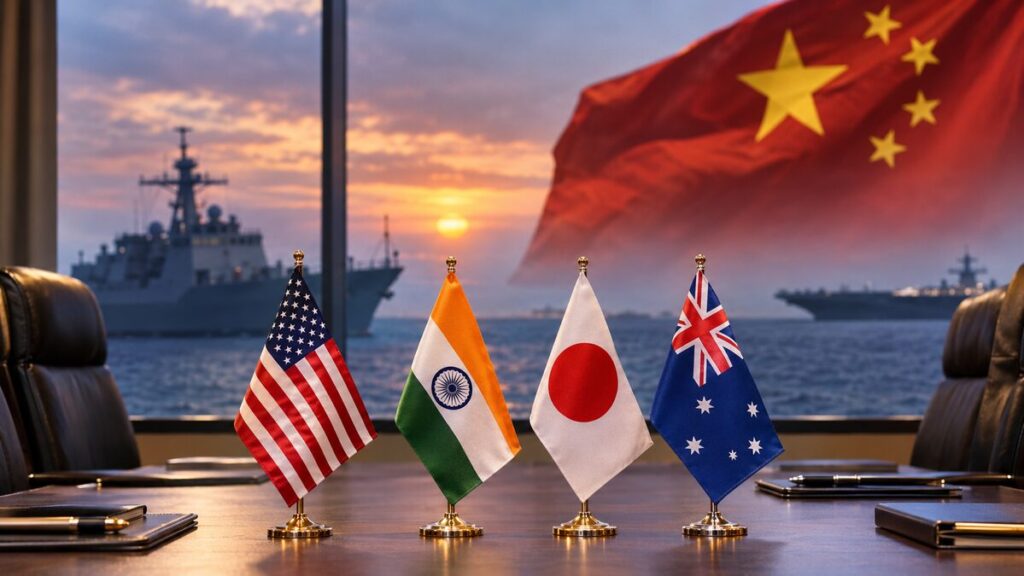
The Quad foreign ministers meeting in Atlanta lasted roughly 40 minutes on 31 October. Marco Rubio hosted Penny Wong, S Jaishankar and Toshimitsu Motegi on the margins of a fractious G20 gathering. Yet the session pointed towards what the Quad has lacked since 2024: a leaders’ summit.
Diplomacy, however, cannot hide the arithmetic of power. Four states with different threats and appetites for risk still share one problem: China. The real question is whether that common problem still outweighs their quarrels.
Where the Quad stands today
Australia, India, Japan and the United States first cooperated after the 2004 Indian Ocean tsunami. They revived the grouping in 2017 to balance a rising China. Today the Quad survives mostly as a ministerial habit rather than a leaders’ project.
Atlanta marked the third foreign ministers’ meeting of 2026, after New Delhi in May and Manila in July. Leaders, however, have not met since Wilmington, Delaware, in September 2024.
Meanwhile, Washington moved the Japan-based carrier USS George Washington to the Middle East for operations against Iran. No American carrier now sits permanently in the Indo-Pacific. In June, Washington also renamed Indo-Pacific Command as Pacific Command. Deployments, not communiqués, tell allies where American priorities lie.
What the Atlanta meeting delivered
The ministers issued a joint press release on economic prosperity and security. Its sharpest line voiced grave concern over economic coercion, arbitrary export restrictions and non-market overcapacity. It never named China. Rubio insisted, “It is not an anti-China or anti-anybody coalition.” The wording still leaves little doubt about its target.
The deliverables lean heavily towards economics. The four signalled their intent to provide over $85 million for trusted artificial intelligence across the region. The release calls it “Super Intelligence”, adding a footnote that translates the term for Australia, India and Japan. Even vocabulary bends to the strongest member.
The United States also committed $10 million for facilities in India and ASEAN that recover critical minerals from waste. The pledge builds on the Critical Minerals Initiative Framework, which the ministers unveiled in New Delhi in May. The ministers also announced the first Quad Business Leaders’ Forum. Quad export credit agencies will meet in Tokyo on 18 November.
Maritime items carry more strategic weight. The second Quad-at-Sea Ship Observer Mission sailed from Chennai to Perth aboard an Indian Coast Guard vessel. The partners plan their first maritime surveillance exercise at Sea Dragon 2027. They also insisted on toll-free passage through Hormuz, the Red Sea and the Bab el-Mandeb. Energy-hungry Delhi and Tokyo care more about that clause than about any slogan.
The disruption at the leaders’ level
The damage began at the top, and it began with trade. India expected to host the leaders’ summit in 2025, and Donald Trump accepted Narendra Modi’s invitation that June. Then Washington imposed a 25 per cent tariffs on Indian goods on 1 August 2025. A further 25 per cent penalty followed over India’s purchases of Russian oil.
Trump also wanted a trade deal as the price of his visit. He appeared to nurse a personal grievance after Modi denied him credit for ending the May 2025 India–Pakistan clash. Trump cancelled the trip, and November 2025 passed without a summit. Even the May 2026 New Delhi statement stayed silent on a summit date.
Washington squeezed Tokyo and Canberra too, with tariffs and demands to spend 3.5 per cent of GDP on defence. Alliances bend when the strongest partner treats them as transactions.
Atlanta changes the tempo, if not the substance. Rubio first confirmed the Manila plan on Indian television in October. In Atlanta, he said Washington would announce the leaders’ meeting “very soon, if we haven’t already“. Leaders should gather alongside the ASEAN and East Asia summits in Manila on 16–18 November. No one has fixed the exact date. It would be Trump’s first Quad summit of his second term.
The future of the Quad
Manila will test sequence as much as substance. Days later, Trump plans to meet Xi Jinping at the APEC summit in Shenzhen. Delhi, Tokyo and Canberra will watch for any bargain that bypasses them. Their interest in the Quad rests on one premise: that Washington balances Beijing. If that premise weakens, each will hedge harder.
India already hedges openly. Modi travelled to China for the SCO summit in August 2025. Japan, meanwhile, is building its own arms industry as insurance against American distraction.
Yet none of the four wants to bury the Quad. China’s weight in minerals, manufacturing and the seas gives each capital a reason to stay. The likeliest future is a narrow, functional Quad. It will coordinate on supply chains, maritime awareness and technology while avoiding alliance commitments. That modest Quad may outlast a grander one.
Atlanta proved that ministers can keep the lights on. Manila will show whether leaders still want to live in the house. In the Indo-Pacific, coalitions endure only while members fear the same rival more than they distrust each other.