
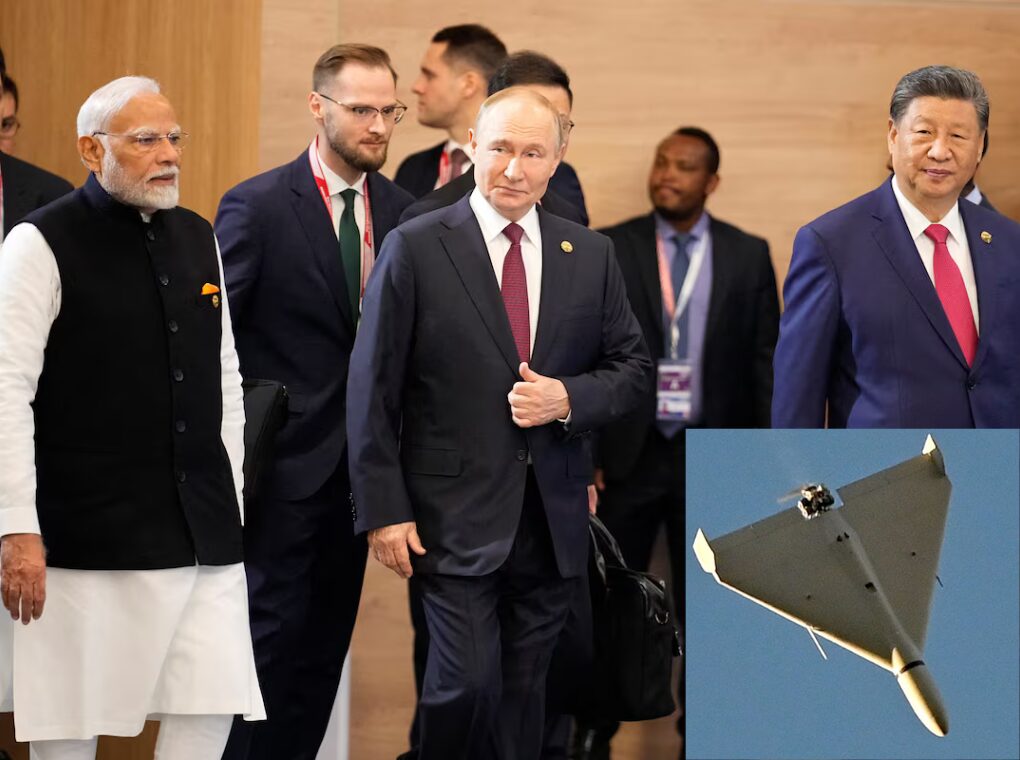
In modern conflict, the roar of fighter jets is giving way to the hum of drones. The battlefield has shifted from the skies of steel giants to swarms of small, inexpensive unmanned aerial vehicles (UAVs). In this transformation, Russia—backed by the synergy of the BRICS bloc—is emerging as the dominant force. This is not merely an evolution in technology, but a reordering of global military power.
Russia’s Drone Transformation
The war in Ukraine provided Russia with a real-time laboratory for drone warfare. What began as reliance on Iranian Shahed drones has now grown into a full-scale domestic industry. By 2025, Russian factories in Tatarstan were producing more than 6,000 UAVs annually, ranging from cheap kamikaze drones to jet-powered models with cruise missile–like capabilities.
The genius of Moscow’s strategy lies in its cost-efficiency. A Shahed-type drone can be produced for as little as €10,000 to €20,000, yet NATO often spends €400,000 or more to intercept a single one, whether through Patriot missiles or F-35 sorties.
This economic imbalance makes drone warfare not only tactically effective but also financially devastating for the West. Russia’s incursions into NATO airspace over Poland, Estonia, and the Baltics underline the point: drones give Moscow both the means and the confidence to challenge Europe’s security order at minimal cost.
BRICS as the Force Multiplier
Russia’s edge is amplified by its partnerships within BRICS. China, the world’s largest drone producer, contributes mass-production capabilities and cutting-edge AI integration. Beijing’s engineers have been working with Moscow to upgrade swarm algorithms and develop UAVs resistant to electronic warfare.
India, with its thriving defense sector, adds innovations in low-cost composites, swarm coordination, and tactical deployment. Its neutral global posture allows it to support technological exchanges without direct sanctions pressure.
The most critical partner, however, is Iran. Tehran’s Shahed drones provided Moscow with its early strike capability, and the relationship has since deepened into co-production. A $1.75 billion deal signed in 2023 enabled Russia to build drone factories based on Iranian blueprints, allowing for mass-scale manufacturing. Iranian shipments of both UAVs and arms—amounting to thousands of drones and tons of equipment—have kept Russia’s production lines well supplied despite Western sanctions.
Together, the BRICS nations form what analysts increasingly call a “drone axis”—a parallel technological ecosystem that Western sanctions cannot easily disrupt.
Economic Asymmetry and Battlefield Arithmetic
The defining feature of drone warfare is not just technology, but economics. A single Russian drone costing €10,000 can force NATO to expend missiles and sorties worth forty times that amount. Multiply this across hundreds of drones, and the economic impact becomes crippling.
This “asymmetry of annihilation” turns Russia’s inexpensive drones into strategic assets. Swarms of UAVs can overwhelm advanced air-defense systems, forcing NATO to burn through resources. The cost equation ensures sustainability for Russia and its BRICS partners, while placing immense financial pressure on NATO’s members.
Rapid Russian Innovation
Unlike NATO’s bureaucratic procurement systems, Russia adapts rapidly. Lessons from the Ukrainian battlefield flow directly into design and production. By mid-2025, Russia had established its first dedicated drone regiment, integrating AI-driven FPV strike drones, jet-powered UAVs, and swarms capable of launching two-thousand-unit coordinated attacks.
This wartime agility allows Moscow to innovate at a speed the West struggles to match. What began as imported Iranian designs has evolved into a diverse, domestically produced arsenal capable of challenging NATO’s most advanced defenses.
NATO’s Strategic Vulnerabilities
For NATO, this presents a fundamental problem. The alliance’s air defenses were built to counter fighter jets and ballistic missiles, not low-cost drones. Its reliance on legacy systems makes its response both costly and slow. Each Russian incursion into Polish or Estonian airspace exposes NATO’s vulnerabilities, forcing it to waste resources and eroding its deterrence credibility.
Psychologically, these incursions also matter. They signal to European populations that their skies are not secure, while reminding NATO policymakers that their technological edge is slipping. Russia, meanwhile, bears almost no risk—its drones do the probing without risking pilots or expensive jets.
The BRICS Advantage and a Multipolar Future
The wider BRICS network ensures that Russia’s drone supremacy is sustainable. China brings industrial scale, India brings innovation, and Iran provides combat-tested designs. Brazil and South Africa are investing in electronic warfare and satellite systems, rounding out the technological chain.
Together, this bloc represents 40 percent of the global population and 30 percent of world GDP—far beyond the reach of Western sanctions.
This decentralized, cooperative ecosystem makes BRICS uniquely resilient. It also points to the emergence of a new military-industrial order—one that is multipolar, fast-moving, and tailored for 21st-century conflicts.
The age of expensive dominance is over. The future belongs to nations that can produce, deploy, and innovate cheaply and quickly. Russia and its BRICS allies have mastered this formula, creating drones that are not just weapons but symbols of a changing world order.
For NATO, the warning is clear. Legacy systems and high-cost defenses cannot withstand the relentless tide of cheap, effective drones. Unless it adapts, the West risks being not only outspent but outmaneuvered in the skies.
In the new era of warfare, audacity, innovation, and affordability decide victory. And today, Russia and BRICS are leading that race.