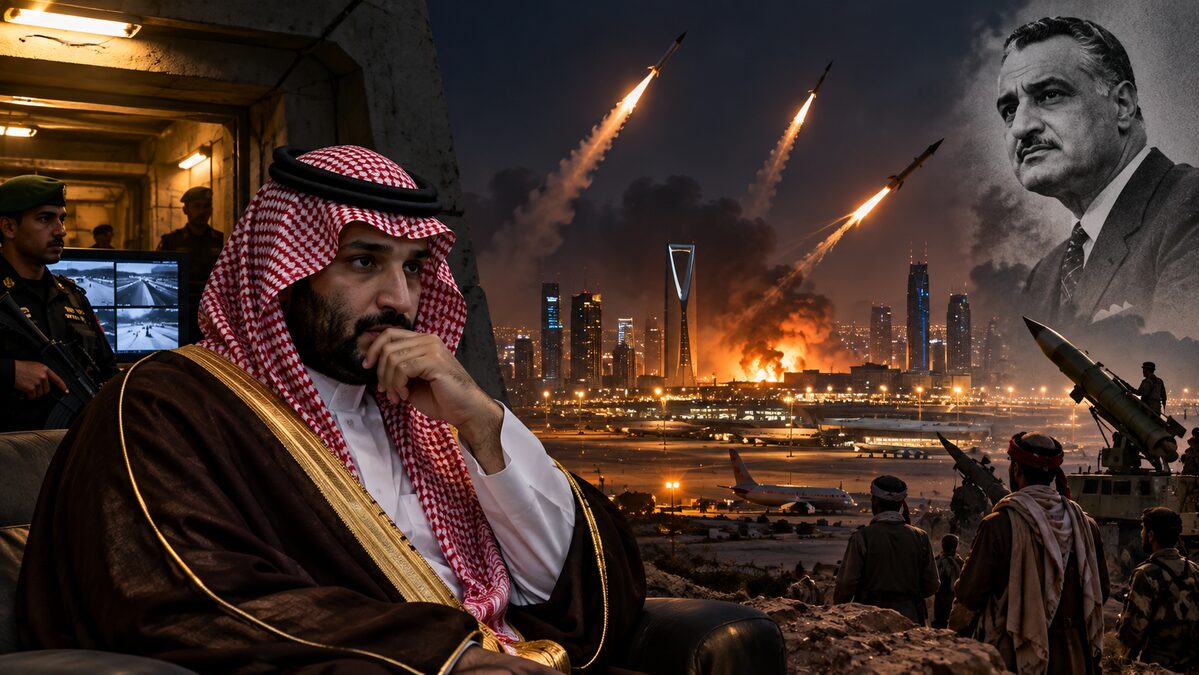
Houthi missiles have driven Saudi Arabia’s most powerful man into his bunkers. Decades of guarding the throne against its own army have left his kingdom exposed. Crown Prince Mohammed bin Salman (MBS) has not appeared in public since 6 October. The kingdom’s de facto ruler now shuttles between high-security palaces with bunkers in Riyadh, accompanied by a handpicked security team.
Saudi authorities have not confirmed his movements. Houthi attacks, however, now hit Riyadh almost daily. A missile strike on King Khalid International Airport on 10 October killed at least 12 people, and Saudi officials concede the kingdom is running low on interceptor missiles.
How the war reached Riyadh
Fighting in Yemen reignited this year amid the US-Israeli war on Iran. In September, the Houthis seized the port of Mocha and an island in the Bab al-Mandab strait, and their drones and missiles now reach deep into the kingdom. This is no longer a border war.
Saudi Arabia spent about $78bn on defence in 2025, one of the world’s five biggest budgets. So why can it not shield its own capital?
The dictator’s dilemma
The answer lies in an old fear of absolute rulers. A strong, professional army can defend a ruler, but it can also remove him. Political scientists call this the coup-proofing dilemma: rulers rotate commanders, build rival forces and reward loyalty over merit. These steps lower the risk of a coup, but they also blunt an army in battle.
The House of Saud has followed this script for decades. It built the National Guard from loyal tribes as a counterweight to the regular army, and in 1990 a Western diplomat noted that Saudi rulers feared a large army more than invaders.
MBS has tightened that grip. He became heir in 2017 after ousting his cousin, then detained scores of royals at Riyadh’s Ritz-Carlton. In 2020, King Salman sacked Prince Fahd bin Turki, the joint forces commander in Yemen, on an MBS referral. A 2025 Bates College study links Saudi failures in Yemen to coup-proofing.
Hired hands at the gate
Instead of building a fighting force, Riyadh rented one. Pakistani soldiers have served in the kingdom for decades, and by May, Islamabad had deployed about 8,000 troops under a 2025 mutual defence pact. They brought JF-17 jets, drones and a Chinese-made HQ-9 air defence system. Saudi Arabia paid for the equipment; Pakistanis operated it. The pact could eventually bring up to 80,000 Pakistani troops.
On 29 September, Pakistan’s Defence Minister Khawaja Muhammad Asif pledged “whatever means” to Riyadh. Yet hired hands answer to their own government: in 2015, Pakistan’s parliament voted to stay neutral in the Saudi war in Yemen. John Calabrese of the Middle East Institute warned that an existing presence does not guarantee a bigger deployment.
Friends who keep their distance
The Western partners MBS courted for a decade now help only at arm’s length. On 10 September, MBS called President Donald Trump twice and urged US strikes on the Houthis. Trump refused, and his officials said his focus remained Iran and the Strait of Hormuz. After the airport strike, Trump said Washington “may” join Saudi strikes, but also that Saudi Arabia could defend itself.
Britain offered one RAF refuelling tanker on a “time-limited” basis and will not join the war directly. France pledged soldiers, radars and air defences, but only to guard the port of Yanbu.
Treaty partners also hesitate. On 7 August, Riyadh signed the Mecca Joint Defence Agreement with Turkey and Pakistan, which treats an attack on one as an attack on all. At an emergency meeting on 5 October, the three states pledged rapid deployments but named no troop numbers or timetables. Turkey has ruled out sending troops abroad to carry out attacks.
Nasser’s shadow over Yemen
History offers an uncomfortable mirror. In 1962, Egypt’s President Gamal Abdel Nasser sent troops to Yemen to back a republican coup, while Saudi Arabia armed the royalists against him. Nasser later admitted he had sent one company and ended up with 70,000 troops. The war cost him more than 10,000 lives, and by spring 1967 he was calling Yemen his “Vietnam”.
The war also soured ties with Washington, a major food aid donor. Nasser faced his own dictator’s dilemma: he had handed the army to his loyal friend, Field Marshal Abdel Hakim Amer. The Yemen war badly weakened Egypt before its 1967 war with Israel. Nasser kept power, but his dream of Arab leadership never recovered.
Walking Nasser’s road
Both men built armies to protect their rule, not to win wars. Both walked into Yemen and found no easy exit. Both leaned on outsiders who set their own limits: Washington cooled towards Nasser, and it now hesitates over MBS.
Oil wealth has bought MBS jets, missiles and foreign troops. It has not bought an army that can guard Riyadh. Saudi expert Sebastian Sons judges a decisive victory over the Houthis unlikely. Nasser left Yemen with a weakened army and fewer friends. Six decades on, the prince in the bunker walks the same road.