TFIGlobal
TFIGlobal
TFIPOST English
TFIPOST हिन्दी
No Result
View All Result
  • Indo-Pacific
  • Americas
  • Canada
  • Indian Subcontinent
  • West Asia
  • Europe
  • Africa
  • The Caribbean
TFIGlobal
  • Indo-Pacific
  • Americas
  • Canada
  • Indian Subcontinent
  • West Asia
  • Europe
  • Africa
  • The Caribbean
No Result
View All Result
TFIGlobal
TFIGlobal
No Result
View All Result
  • Indo-Pacific
  • Americas
  • Canada
  • Indian Subcontinent
  • West Asia
  • Europe
  • Africa
  • The Caribbean

Japan pays a big price—very big price—after angering Putin

Abhyoday Sisodia by Abhyoday Sisodia
March 22, 2022
in Geopolitics
Japan pays a big price—very big price—after angering Putin

PC: cfr.com

Share on FacebookShare on X

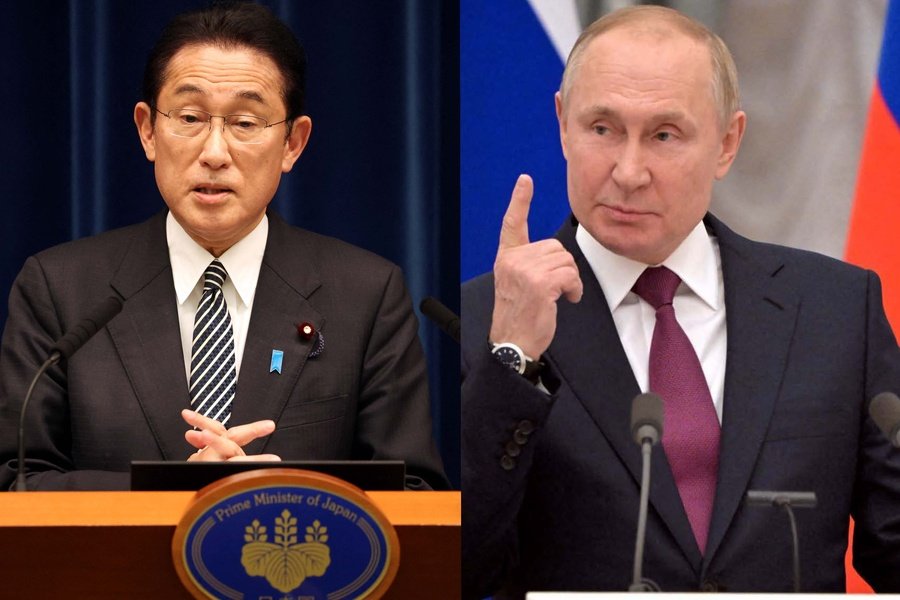
A country can maximise its geopolitical gains if it consistently follows a relatively stable foreign policy, no matter the change in leadership. From the looks of it, Japanese PM Fumio Kishida has totally forgotten this fact. The Japanese Prime Minister earlier stated that Russia’s recognition of two independent states within Ukraine’s territories was “unacceptable and a violation of international law.” Since then the Japanese government has toed the line of US President Joe Biden, at the expense of its own interests.

However, this approach is in exact opposition to the ones followed by previous Prime Ministers. Former Prime Minister Shinzo Abe’s rapprochement efforts and long-standing policy of befriending Russia to isolate China in the area are contradicted by the Kishida administration’s severe attitude towards Moscow.

Also Read

North Korea Readies More Soldiers for Russia, but Seoul Says Nothing Has Moved Yet

A borrowed satellite and 400 missiles: how Beijing and Moscow are keeping Iran in the fight

Musk blocks Ukraine’s Starlink access for deep strikes inside Russia — what it means

Abe spent his time in government restoring connections with Russia, which the current Kishida administration is now needlessly undoing. The current approach has already started having an adverse impact and at the same time undoing years of the carefully crafted bilateral relationship with Russia.

Moscow ends WWII peace talks with Japan

After Tokyo levied extraordinary penalties over President Vladimir Putin’s assault on Ukraine, Russia decided to halt talks with Japan on a peace treaty that would officially end a conflict that dates back to World War II. The Russian Foreign Ministry said in a statement that Moscow is also discontinuing talks with its eastern neighbour about economic activities on disputed islands under Kremlin control, known in Russia as the Southern Kurils and in Japan as the Northern Territories.

As they wrangled for decades over a small collection of islands near Japan’s Hokkaido, the two countries never signed an official peace treaty ending World War II.

Later, Foreign Minister Yoshimasa Hayashi told reporters that Japan’s main policy of attempting to resolve the island dispute and agree to a peace treaty had not changed. Ambassador Mikhail Galuzin had received an official protest over the Russian Foreign Ministry statement, he added.

Kishida’s policies are also going to cost big

On the Ukraine question, Kishida’s policy appears to reflect  Biden’s concerns rather than Shinzo Abe’s caution. In an interview with Japan Today, former Prime Minister Shinzo Abe recently said, “I think Japan should use diplomacy to sever the concerted efforts between China and Russia, and move ahead with improving its ties with Russia.”

Read more: Kishida’s Russia policy will be the end of him

However, Kishida’s policies have not only destroyed Japan’s geopolitical capital, but it is also becoming detrimental to Japan’s energy security. If Japan exits Russia’s Sakhalin-2 LNG project, it could pay a third more per year for imported liquefied natural gas, a potentially disastrous move for the energy-scarce Asian nation. Sakhalin-2, located in Russian Far East, produces 10 million tonnes of LNG per year, with Japan receiving around 60% of the output. Almost all of Japan’s LNG imports from Russia come from this source.

Despite former Prime Minister Shinzo Abe’s repeated warnings and cautions, it appears that PM Kishida has entirely rejected him and instead gone into the Ukraine hangover with Biden. The effect is not just obvious in growing inflation, but the Japanese economy may be on the cusp of a more severe downturn in the near future. And if we consider the current development, it looks like, Japan is faced with both economic and foreign policy problems, courtesy of Fumio Kishida.

Tags: EconomyFumio KishidaJapanPutinRussiarussia ukraine crisis
ShareTweetSend
Abhyoday Sisodia

Abhyoday Sisodia

M.A. in East Asian Studies, Department of East Asian Studies, the University of Delhi, India. Deep interest in geopolitics, foreign policy and world affairs.

Also Read

President Donald Trump signs an order in the foreground as Lake Ontario and the Toronto skyline appear behind him, with American and Canadian flags symbolising the escalating dispute over the lake's name and US-Canada relations.

Trump Renames Lake Ontario ‘Lake America’, and Google Has Already Redrawn the Map

August 31, 2026
A dramatic nighttime scene showing a US warship facing a large oil terminal engulfed in flames, with explosions, thick black smoke, fighter jets, and missiles streaking across the sky above the sea after strikes

Trump Posts AI Video of Kharg ‘Blown to Smithereens’ as US and Iran Trade Fire

August 31, 2026
A dramatic scene showing the flags of Turkey, Saudi Arabia and Pakistan above military aircraft, soldiers and air-defence systems, as a large Saudi-style oil refinery burns in the background. Three leaders stand in the foreground watching the unfolding crisis.

Turkey, Saudi Arabia and Pakistan Open First Defence Pact Talks as Saudi Refineries Burn

August 31, 2026
A nighttime protest riot in Jakarta, with demonstrators facing riot police amid tear gas and water cannon spray as a guard post and motorcycles burn nearby.

Fire, Tear Gas, and 322 Detained: Jakarta’s Anti-Corruption Protest Ends in a Riot

August 31, 2026
A dramatic geopolitical oil scene showing an oil refinery and pumpjack, the US Capitol, Venezuelan mountains and flag imagery, and a large oil tanker at sea, symbolising the US–Venezuela oil deal.

Trump’s Venezuela Oil Deal: 65 Billion Barrels, a 100-Year Lease, and a Country Divided

August 30, 2026
A hypersonic glide vehicle streaks through the upper atmosphere as it launches a missile toward a US AWACS radar aircraft, with tanker and support aircraft flying in the distance above dramatic cloud cover.

China’s Hypersonic Gliders Can Now Shoot at Aircraft — And America’s Radar Planes Are the Target

August 25, 2026
Youtube Twitter Facebook
TFIGlobalTFIGlobal
Right Arm. Round the World. FAST.
  • About Us
  • Contact Us
  • TFIPOST – English
  • TFIPOST हिन्दी
  • Careers
  • Brand Partnerships
  • Terms of use
  • Privacy Policy

©2026 - TFI MEDIA PRIVATE LIMITED

Welcome Back!

Login to your account below

Forgotten Password?

Retrieve your password

Please enter your username or email address to reset your password.

Log In

Add New Playlist

No Result
View All Result
  • Indo-Pacific
  • Americas
  • Canada
  • Indian Subcontinent
  • West Asia
  • Europe
  • Africa
  • The Caribbean
TFIPOST English
TFIPOST हिन्दी

©2026 - TFI MEDIA PRIVATE LIMITED

This website uses cookies. By continuing to use this website you are giving consent to cookies being used. View our Privacy and Cookie Policy.