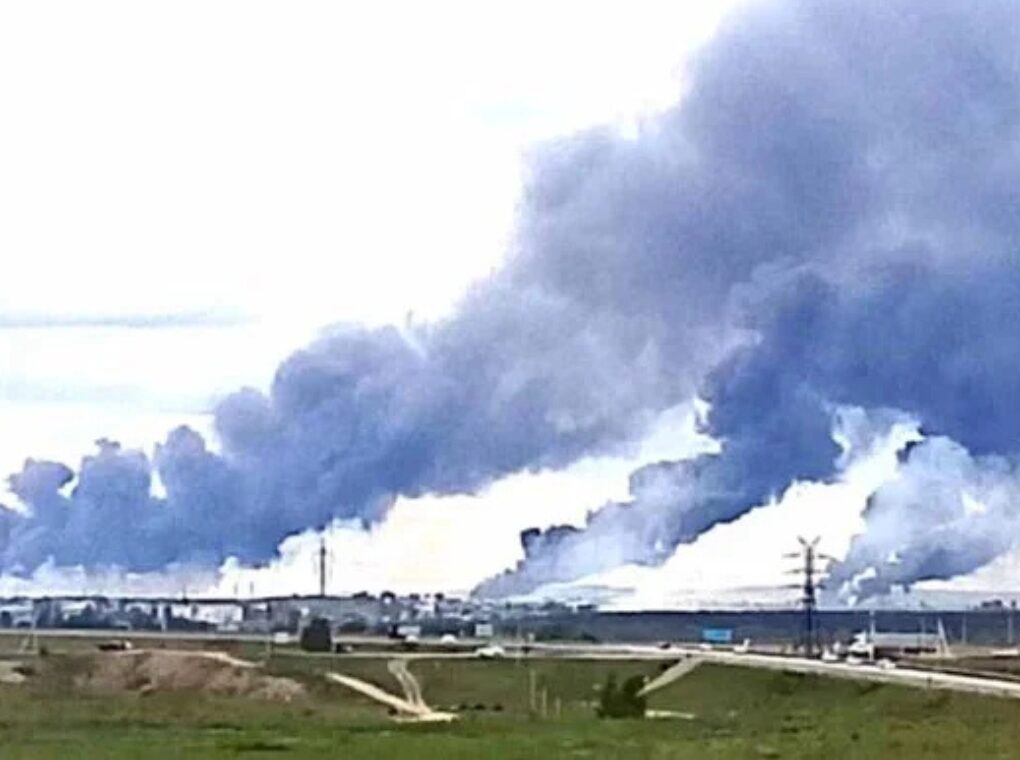
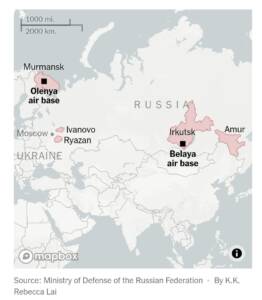
On June 1, Ukraine launched what it called “Operation Spider’s Web,” an unprecedented drone assault deep into Russian territory. According to Media reports, the operation targeted five Russian airbases and destroyed 41 military aircraft, including strategic bombers and A-50 airborne radar planes. The magnitude and audacity of the operation shocked many observers and have since reignited global debate about the trajectory of the war and the fragile balance of power it threatens.
While Ukraine has hailed the strikes as a major tactical victory—a blow to Russian long-range strike capabilities and a boost to Ukrainian morale—others warn that the operation may have crossed a critical threshold, triggering dangerous escalatory dynamics.
A New Phase of the War
The most striking aspect of the operation is not just the scope, but the method: drones, covertly transported over 18 months and hidden in civilian trucks, were reportedly launched from within Russian territory. This level of deception, planning, and penetration showcases a significant leap in Ukraine’s unconventional warfare capabilities. It also illustrates how the asymmetry of modern conflict enables even modestly equipped actors to damage strategic assets once thought invulnerable.
Yet these achievements come with profound risks. Among the destroyed aircraft were nuclear-capable bombers parked by START treaty obligations, which require that such bombers be stationed in open view to be counted by satellite. Striking these aircraft is not only militarily provocative—it brushes against Russia’s nuclear doctrine, which considers attacks on nuclear forces grounds for potential nuclear retaliation.
The Coordination Question: A Breach of Protocol?
Perhaps more alarming than the strike itself is the suggestion—so far unverified—that the United States may not have been informed beforehand. If President Trump was not consulted, as some believe, Ukraine’s move could be interpreted as more than an act of national self-defense. It could be seen as a unilateral action with global strategic consequences, conducted without coordination with its principal ally. This would represent a serious rupture in diplomatic protocol and alliance norms.
In such a scenario, Ukraine risks being perceived not just as an embattled state defending its sovereignty, but as a rogue actor capable of drawing its partners into broader conflict without consent or consultation. The presence of U.S. Senators Lindsey Graham and Richard Blumenthal in the region before the strike only adds to the ambiguity and suspicion, though no direct link has been established between their visit and the operation.
Tactical Innovation or Strategic Folly?
Tactically, the operation was clever. Ukraine used simple technologies and logistics—commercial trucks, concealed drones, timed strikes—to pierce the armor of Russia’s military infrastructure. It demonstrated to the world that even the most fortified bases are vulnerable in the age of low-cost drone warfare.
But this success invites dangerous imitation. If a precedent is now set that long-range bombers can be destroyed on the tarmac via guerrilla-style drone attacks, then no nation, including the U.S., is immune. As military doctrines adapt to this new normal, nations may be forced to develop new defensive postures, potentially leading to an arms race in drone countermeasures and hardened facilities.
The Risk of Escalation
Russia has already denounced the attack as a serious provocation and, according to The Guardian, rejected Ukraine’s subsequent offer of a 30-day ceasefire, countering with a proposal for a limited truce to recover its fallen. While both nations have agreed to a prisoner exchange and to return the bodies of 12,000 deceased soldiers—a rare diplomatic convergence—the broader trend is unmistakably one of escalation.
With Ukraine now capable of striking inside Russian territory and Russia under increasing pressure to respond, the conflict is entering a more unpredictable phase. The danger lies not just in military reprisals, but in miscalculation. Nuclear-armed states do not always react proportionally, especially when their core deterrent capabilities are perceived to be at risk.
The Path Forward
Despite the strategic fog, there remains a narrow window for diplomacy. Ukraine’s willingness to propose a ceasefire, even after a bold offensive, suggests it does not seek to escalate indefinitely. But diplomacy must be matched by transparency and coordination, especially with allies. Trust is as critical in coalition warfare as capability.
World leaders must now take stock of the shifting terrain: we are no longer in the era of trench lines and artillery duels. We are in the age of containerized drones, covert infiltration, and strategic ambiguity. That means responses must be equally nuanced, restrained, and globally coordinated.
Conclusion
Ukraine’s strike may go down as one of the most daring operations of the war, but also one of the most consequential. It was bold, yes—but perhaps too bold. In military terms, it damaged Russian capabilities. In strategic terms, it may have triggered a dangerous recalibration.
Victory in modern war is not only about battlefield outcomes; it’s about managing perceptions, alliances, and escalation. Ukraine has gained ground tactically, but whether it advanced the cause of peace or pushed the world closer to the edge remains to be seen.
The next moves by Moscow, Washington, and Kyiv will determine if this operation was a turning point toward resolution or a broader and more perilous conflict.