
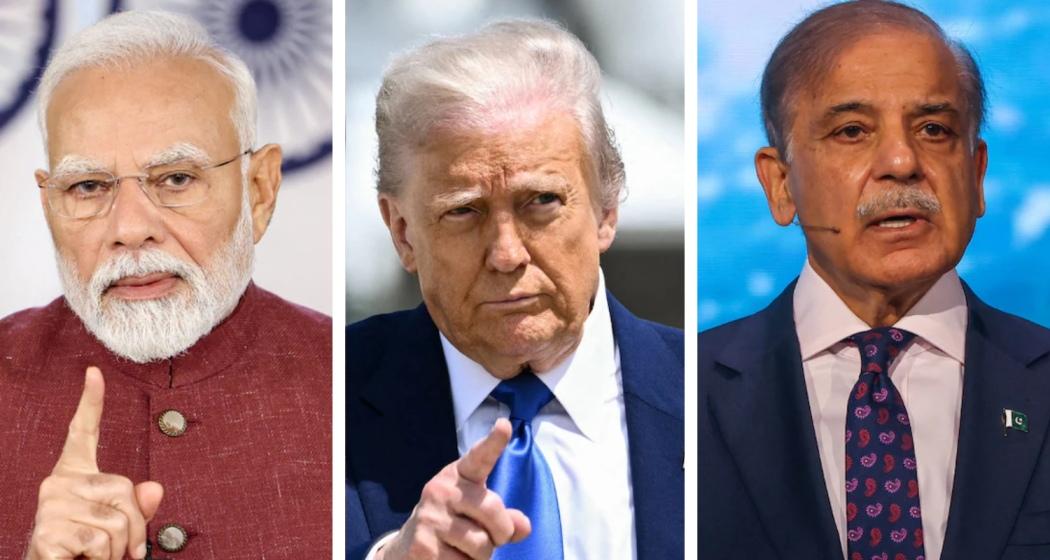
The US-India relationship has been on a downslide for the past few weeks, especially since the India-Pakistan clashes have fired up the region. The United States has long viewed Pakistan as a strategically important country due to its geographic location, particularly for operations involving Afghanistan, and to keep an eye on both China and India. But one of the major reasons the US continues to cultivate Pakistan is for a potential attack on Iran.
Pakistan’s relations with the US
Pakistan is a country in economic doldrums, and it has long sold out to Western powers, handing bases and forces doing their bidding over the years. It fostered several terrorist programs to counter the Soviet Union, which led to the rise of innumerable terror outfits in the region, with even Osama bin Laden based there. There are numerous internationally recognized terrorists still operating in the region.
During the U.S.-led war in Afghanistan, Pakistan provided key supply routes and air corridors through the Ground Lines of Communication (GLOCs) and Air Lines of Communication (ALOCs).
The Shamsi Airbase in Pakistan was used by the CIA and U.S. Air Force for drone operations until 2011, when Pakistan revoked access following the Salala incident. Bases like Nur Khan (Chaklala) and Jacobabad were allegedly used for logistical and refueling operations.
Pakistan received billions in U.S. military aid and Foreign Military Financing (FMF) for managing terror groups like the Tehrik-i-Taliban Pakistan (TTP), Haqqani Network, and al-Qaeda. Apart from logistics, the US has also been given advanced military equipment like the F-16 jets to Pakistan, creating a very entangled relationship between the two.
India bombards air bases
Between May 8 and 10, 2025, India launched a series of extensive airstrikes on multiple Pakistani military airbases, marking one of the most significant escalations between the two nuclear-armed neighbors since the 1971 war. The strikes were a direct response to a deadly militant attack in Indian-administered Kashmir that resulted in 26 civilian deaths, which India attributed to Pakistan-based militants.
The Indian Air Force (IAF) conducted precision strikes on at least 11 Pakistani airbases, including:
Nur Khan (Chaklala): Located near Islamabad, this base serves as a critical logistics hub and houses Pakistan’s Air Force College. The attack reportedly damaged a refueling hangar and mobile control centers. Satellite imagery confirmed significant structural damage.
Murid: Situated in Chakwal, this base is a key site for Pakistan’s drone operations. The strike targeted drone launch and control facilities.
Rafiqui (Shorkot): An important base for air defense and surveillance. The attack aimed at degrading Pakistan’s radar and command infrastructure.
Rahim Yar Khan, Sukkur, Chunian, Sialkot, Pasrur, Bholari, and Jacobabad: These bases were targeted to disrupt Pakistan’s aerial command and strike capabilities. Damage included destroyed hangars, radar systems, and weapon storage areas.
Although an eventual ceasefire was called between the two nations, India still maintains that it has only suspended the operations and has not ended them. The damage to these crucial air bases seems to have rubbed Washington the wrong way as the US waded into the confrontation, with Donald Trump pushing for a ceasefire. This shows how the US still has deep interests and links with Pakistan.
US and Pakistan link up against Iran
The Nur Khan Airbase near Rawalpindi, Pakistan, is particularly crucial, along with Jacobabad in Sindh, as they could both be used as logistical hubs or for aircraft refueling, assuming Pakistan quietly permits U.S. use.
These bases lie within 1,500–2,000 km of key Iranian targets, putting eastern Iran within range of U.S. aircraft like B-52s, F-35s, or ISR drones. U.S. ISR (Intelligence, Surveillance, Reconnaissance) drones like RQ-4 Global Hawk or MQ-9 Reaper could fly from or over Pakistani territory to monitor Iranian missile sites, air defenses, or nuclear facilities in the southeast.
These are all scenarios that would have already been pre-determined by the US. Since the India-Pakistan clash, the US has been drawing closer to Pakistan; it has managed to back them with financial funding from international bodies while also giving open statements of cooperating and coordinating with Pakistan.
Now, Donald Trump has even invited the Pakistan Army Chief Asim Munir to Washington, DC, for the US Army Day celebrations on June 14, which also coincide with Donald Trump’s birthday.
Recently, the rhetoric against Iran has been growing steadily in the US, with demands from Israel and the US bloc to bombard and target Iran’s nuclear facilities. If the US conducts such an attack, it will use Pakistan and its bases to surround Iran and bombard its crucial infrastructure.
Pakistan, which is in financial turmoil, has been going around asking for loans from almost every world body. It has long been accustomed to being rolled by a major partner and being used as a base for their operations. First, it was the US for decades, then it was China for the past few years, and now, once again for its geopolitical interests, the US is again looking at Islamabad, this time to use against Iran.
How these events will play out only time will tell, but for now, the US and Pakistan are drawing closer into a deep embrace, and whenever this happens, it usually spells danger for some nation. This time it is Iran on the radar and the region could be about to witness another major escalation.