
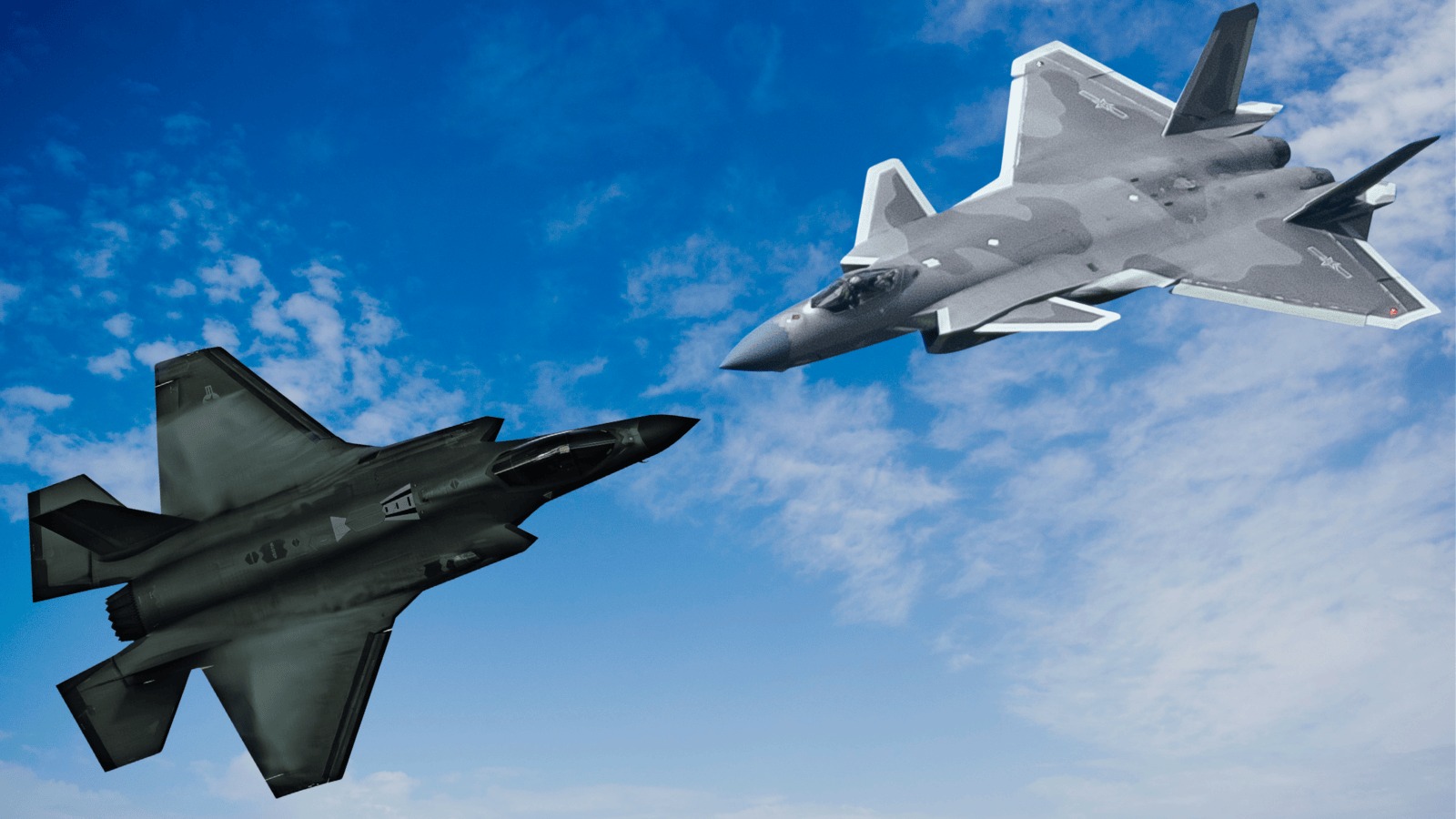
A second reported encounter between China’s J-20 stealth fighter and the U.S. Air Force’s F-35A in the East China Sea has raised eyebrows in strategic circles. While Chinese state media portray the event as a demonstration of the People’s Liberation Army Air Force’s (PLAAF) confidence and growing capability, closer scrutiny reveals a more complex picture—one that mixes cutting-edge ambition with unresolved limitations.
J-20 Takes Frontline Role – But at What Cost?
China’s J-20 “Mighty Dragon” has emerged as the face of Beijing’s fifth-generation ambitions. Designed for air superiority and long-range engagements, the aircraft is increasingly used in routine patrols, interceptions, and even close-range confrontations with foreign military aircraft, including the U.S. F-35 and F/A-18 Super Hornet.
Recent reports from Chinese state-run CCTV and Sohu claim that the J-20s from the PLAAF’s “Wang Hai Squadron” were scrambled in late June for combat readiness patrols and successfully “expelled” foreign aircraft—allegedly U.S. F-35As—from the East China Sea air defense identification zone (ADIZ).
China’s Narrative: Confident and Capable
Chinese media outline two key assertions:
Effective Anti-Stealth Systems:
China claims that its long-wave ground-based radars, air-based early warning platforms, and advanced optoelectronic detection systems can reliably track stealth aircraft like the F-35. This is a bold claim, as stealth detection is inherently difficult and depends heavily on integrated multi-platform tracking, not just radar range.
Fast, Efficient Command Response:
The PLAAF reportedly issued combat orders within moments of detecting the foreign aircraft, launching J-20s swiftly into the interception zone—an indication, they say, of high readiness and networked control.
Chinese commentators have further argued that the J-20 outperforms the F-35 in supersonic maneuverability and range, framing the latest encounter as a quiet triumph of domestic technology.
But Behind the Hype: Persistent Problems with the J-20
Despite China’s confident narrative, there are credible concerns about the J-20’s real-world performance:
1. Engine Reliability Remains a Weak Spot
While the latest J-20 variants reportedly feature the domestic WS-15 engine, most in service still rely on older Russian AL-31F or underpowered WS-10C engines. These legacy engines hinder sustained supercruise, limit high-altitude performance, and reduce stealth efficiency due to larger heat signatures.
2. Maneuverability and Agility
Western aerospace experts and some leaked test data suggest that the J-20 lags behind both the F-35 and F-22 in terms of close-in dogfighting agility. Designed more for long-range missile combat, the J-20 sacrifices some aerodynamic efficiency for its size and stealth shaping.
3. Stealth Performance Under Question
Although the J-20 is stealth-shaped, multiple analysts argue that its radar cross-section (RCS) is significantly larger than the F-35 due to canards, engine nozzle exposure, and material quality. Unlike the F-35, which benefits from extensive combat data and industrial-level stealth coatings, the J-20’s stealth effectiveness in real conditions remains largely unproven.
4. Systems Integration and Pilot Training
The J-20 has yet to demonstrate a level of sensor fusion, battlefield networking, and pilot-machine interface comparable to the F-35. The F-35’s advantage lies not only in its stealth, but its role as an airborne command hub—something China is still striving to replicate.
China’s Expanding Arsenal Raises Regional Tensions
Beyond the J-20, China’s military is rapidly growing its missile, naval, and drone capabilities. In 2024–25 alone, China unveiled:
PL-17 long-range air-to-air missiles, possibly exceeding 300 km range, tailored for high-value targets like AWACS and tankers.
Hypersonic glide vehicles (HGVs) for regional strike options.
New AEW&C aircraft (KJ-500 variants) to coordinate stealth interceptions.
Combined, these form part of a broader “anti-access/area denial” (A2/AD) strategy aimed at deterring U.S. and allied air forces from operating freely near China’s claimed borders.
F-35: Combat-Proven and Globally Integrated
The F-35A, by contrast, has now seen decades of refinement through operational deployments in Europe, the Middle East, and the Indo-Pacific. Key advantages:
Sensor fusion and AI-assisted decision making
Low RCS stealth certified in combat zones
Extensive coalition data-sharing
Superior training ecosystems (Red Flag, Top Gun, etc.)
With over 950 aircraft delivered, the F-35 is backed by a robust logistical and intelligence network—something China is still building.
Strategic Outlook: More Encounters Likely, But Parity Still Distant
China’s willingness to use its most advanced fighter in routine interceptions—despite risks to stealth secrecy—shows both confidence and urgency. The J-20 is no longer just a symbol, but a real operational asset.
Yet the PLAAF’s ambitions still face technical, tactical, and industrial hurdles. The F-35’s edge in software, interoperability, and mission reliability keeps it ahead in real-world combat scenarios, despite China’s growing numerical and technological push.
As both sides continue to operate stealth fighters near contested airspace, the risk of unintended escalation increases—especially without clear communication protocols.
A Rivalry Taking Shape, But Not Yet Equal
The aerial chess match between the J-20 and F-35 represents more than a contest of machines—it’s about strategic signaling, regional influence, and technological credibility.
While China’s state media trumpet J-20 encounters as victories, a closer analysis reveals a fighter still maturing. The U.S. and its allies must remain vigilant, but also realistic: the J-20 is improving—but it hasn’t surpassed the F-35 yet.
The skies over the East China Sea may increasingly host stealth-on-stealth standoffs. But capability, not propaganda, will determine who controls them.