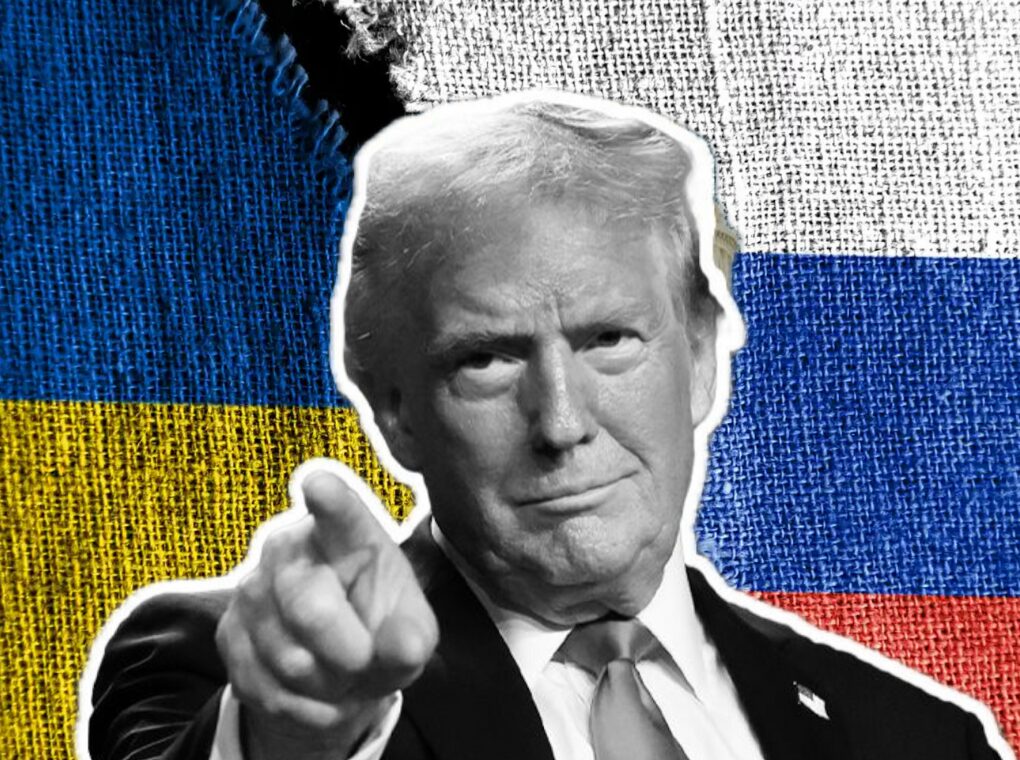
When asked on the American daily morning news, Fox & Friends about whether any land swaps between the warring countries were discussed at 18th August meeting, to which the president responded by saying that Ukraine would “get a lot of land,”. This followed by his statement where he blamed Russia and said that “Russia is a powerful military nation. You know, whether people like it or not, it’s a powerful nation. It’s a much bigger nation,” Trump said. “It’s not a war that should have been started. You don’t do that. You don’t take on a nation that’s 10 times your size.
Trump also added “If it wasn’t for the greatest military equipment, we make the greatest military equipment in the world. And we gave them, you know… whatever they took probably a lot of money too,”. His words touched on geopolitical realities, historical anxieties, and the persistent tension between deterrence and diplomacy amidst the Russia-Ukraine War.
The Core of Trump’s Argument
He further added, “The thing is a mess. This was started by Joe Biden,” Trump told the network. “This was a war that should have never happened.”. Trump also upbraided at Obama and claimed he “gave Crimea away” in 2014 in “the worst real estate deal I’ve ever seen.”
He further told the media outlet that “I called President Putin yesterday, and I do have a good relationship, but it, you know, only matters if we get things done,” he said. “Otherwise, I don’t care about the relationship. I do have a good relationship with him, but I want to get things done.”
Trump also mentioned that “Everyone is very happy about the possibility of PEACE for Russia/Ukraine,” Trump wrote on Truth Social following Monday’s meetings.
At the heart of Trump’s statement is a recognition of Russia’s enduring military stature. Despite its economic limitations compared to the United States or China, Russia retains a formidable nuclear arsenal, advanced air defense systems, and a longstanding tradition of military innovation. From a purely strategic standpoint, no nation—particularly smaller states in Eastern Europe—can match Moscow’s scale or resources in a head-to-head confrontation.
Trump frames this disparity bluntly. By emphasizing Russia’s “ten times your size” advantage, he signals that provocation without a clear, coordinated deterrence strategy risks escalation that could spiral into devastating conflict. His phrasing, while blunt, echoes a realist school of international relations: weaker states or alliances must measure their ambitions against the raw balance of power.
Historical Resonance
This warning carries echoes of Cold War logic. For half a century, U.S. and NATO doctrines assumed that any direct clash with Moscow risked catastrophic nuclear escalation. As a result, containment, proxy wars, and arms control treaties became the tools of competition. Trump’s words revisit this restraint, though recast in the plain language of size and power rather than diplomatic jargon.
However, his approach differs sharply from the consensus in Washington, which tends to stress collective security through NATO. By contrast, Trump appears to lean toward caution over confrontation, presenting Russia less as a regime to be checked aggressively and more as a giant whose sheer weight demands respect.
Implications for U.S. Foreign Policy
The implications of such rhetoric are twofold. On one hand, acknowledging Russia’s power might encourage diplomatic channels and lessen the appetite for escalation in contested regions like Ukraine. Smaller states may be urged to pursue negotiation rather than outright defiance.
On the other hand, framing Russia primarily as “too big to challenge” risks undermining American commitments to allies who depend on U.S. and NATO assurances. For nations bordering Russia, Trump’s message might be interpreted as a signal of restraint bordering on appeasement—a stance that could embolden Moscow rather than deter it.
A Balancing Act
Ultimately, Trump’s assertion reflects a tension at the heart of U.S. policy toward Russia: how to balance recognition of Moscow’s military capacity with the responsibility to defend smaller allies and uphold international order. His framing strips the issue to its most basic calculation of size and strength, but governing decisions must account for more than military ratios. Diplomacy, alliances, economic leverage, and ideological contest all matter just as much.
Trump’s statement, though simple, forces policymakers and observers to confront an enduring truth: Russia, regardless of economic struggles or international isolation, remains a military superpower. Ignoring this fact risks dangerous miscalculations. At the same time, reducing complex geopolitical contests to measurements of “size” offers an incomplete picture. The enduring challenge for U.S. strategy lies in combining realism about Russian capabilities with a steady commitment to allies, deterrence, and long-term stability.