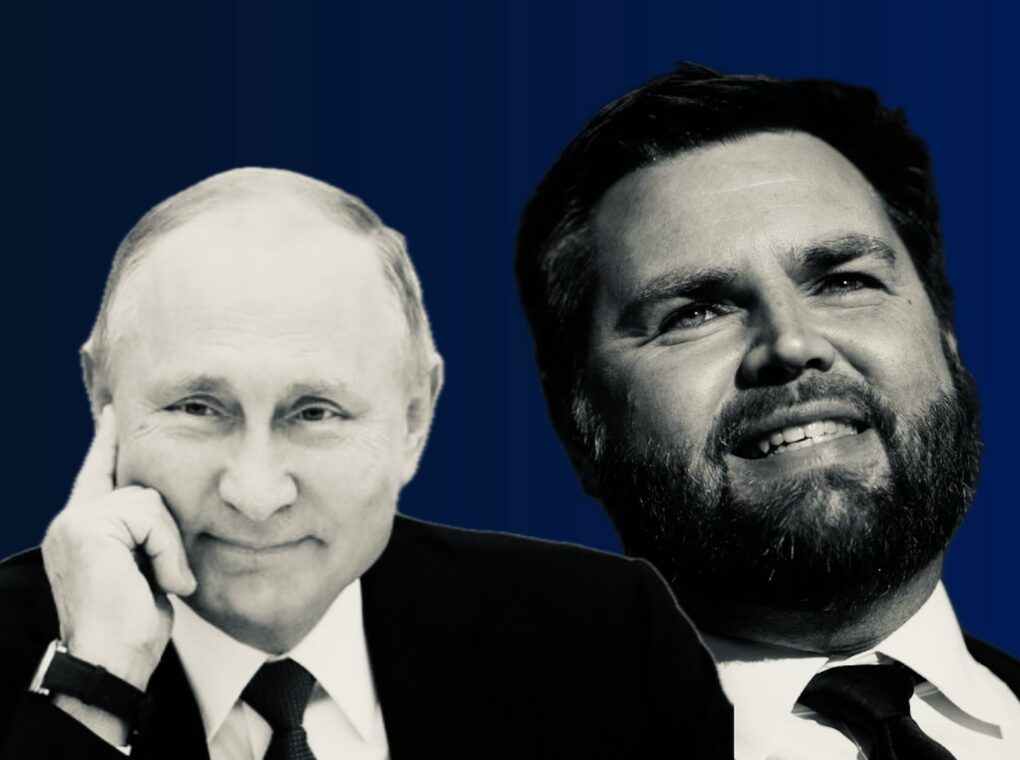
When U.S. Vice President JD Vance spoke publicly about Russian President Vladimir Putin, his remarks stood apart from the usual Washington rhetoric. Vance described Putin not in the customary language of hostility but with an almost clinical observation: the Russian leader, he said, is “soft-spoken in a certain way, very deliberate, very careful,” and at his core, “a person who looks out for the interests of Russia.”
For many in the United States, such comments raised eyebrows. After all, Putin is not merely a foreign counterpart; he is the central figure in a war that has destabilized Europe, reshaped NATO unity, and forced Washington into one of the most extensive foreign policy commitments in decades. Yet Vance’s words provided a glimpse of something often absent from mainstream debate — an assessment not clouded entirely by condemnation, but one that recognizes how Putin views himself and his role in Russian life.
A More Measured Portrait
By characterizing Putin as careful and deliberate, Vance implied that the Russian leader is not reckless, nor driven by erratic impulses. This stands in contrast to how some political figures in the U.S. and Europe portray him — as unpredictable, dangerous, and even irrational. Vance’s framing reflects a different angle: the idea that Putin operates with intention and consistency, even if his aims collide with the West’s strategic interests.
Calling Putin fundamentally someone who defends “the interests of Russia” is, on one level, stating the obvious. But in diplomatic terms, this observation carries weight. It acknowledges that for Putin, decisions are not necessarily about destabilizing the West for its own sake but about pursuing what he perceives as long-term Russian security and influence. Whether the invasion of Ukraine aligns with that end is contested globally, but Vance’s words reframe the conversation from demonization to an analytical study of motivation.
America’s Peace Strategy: Between Pressure and Engagement
The real question flowing from Vance’s comments, however, is how the United States handles the broader peace effort. Washington has adopted a dual posture: intensifying sanctions to constrain Russia while simultaneously engaging in cautious diplomatic exchanges, sometimes through intermediaries.
Officially, the U.S. maintains that any potential peace deal must have Ukraine in the driver’s seat. American leaders insist that no agreement will be signed over Kyiv’s head. Yet behind the scenes, Western capitals are undoubtedly testing hypothetical scenarios — what concessions might work, what security guarantees could be given, and whether Putin could accept terms that do not involve Ukraine’s territorial surrender.
This balancing act reflects the difficulty of dealing with a leader like the one Vance described: patient, strategic, and committed to Russia’s sovereignty as he defines it. Having painted Putin as deliberate rather than erratic, Vance indirectly underscores why negotiations are hard — because deliberation often translates into stubbornness backed by calculation, rather than emotion open to persuasion.
The Sanctions Trap
The American-led sanctions regime is perhaps the most vivid example of Washington’s chosen strategy. By targeting Russia’s banks, energy exports, and individuals tied to the Kremlin, the U.S. has sought to grind down Moscow’s ability to finance the war. The goal is to create enough strain that Russia either softens its military approach or accepts diplomatic overtures.
Yet, as Senator Marco Rubio and others have pointed out, sanctions rarely produce immediate results. They work over years, gradually eroding economic options. The incident in Alaska, where Putin’s delegation was compelled to pay millions in cash for aircraft fuel, is one small but telling sign of what financial isolation looks like in practice. But that symbolic victory is not the same thing as a peace deal — and therein lies Washington’s strategic dilemma.
Washington’s Room to Manoeuvre
The Biden administration, and later the Trump successor government, both grappled with the same essential question: can Moscow be pressured into negotiations without granting it the legitimacy of a victory? Too much stick without carrots pushes Russia deeper into intransigence; too many concessions, however, risk alienating Ukraine and U.S. allies in Europe.
For this reason, American diplomacy has often emphasized coalition management as much as it has emphasized direct talks with Russia. Meetings with Ukrainian President Volodymyr Zelenskyy, coordination with NATO states, and outreach to neutral countries are all designed to create a united front. This approach limits Moscow’s room to exploit cracks while ensuring Ukraine does not feel abandoned.
Still, critics argue that the U.S. lacks a clearly defined endgame and risks stretching itself into a permanent proxy conflict. Such critiques align, interestingly, with the nuance Vance offers: dealing with Putin requires understanding his deliberate nature, not assuming he will bend under pressure at the first sign of discomfort.
The Politics of Peace
Domestically, how Washington frames Putin matters for public opinion. Portraying him purely as a villain consolidates resolve but can lock policymakers into maximalist positions, making compromises politically unpalatable. Vance’s careful description, by contrast, leaves open interpretive space for dialogue, even if most Americans remain skeptical of negotiations with Moscow.
In the months ahead, the U.S. will face increasing pressure both internally and from European partners to articulate what a feasible peace looks like. Will it mean freezing battle lines, offering Ukraine NATO-style security guarantees, or incentivizing Moscow with phased sanction relief? Each option carries risks, but each also reflects the reality of dealing with a careful strategist like Putin rather than a caricatured aggressor.
Also Read: Why Putin had to Pay $250,000 in Cash During Alaska Visit?
JD Vance’s measured remarks about Vladimir Putin paint a portrait far more restrained than Washington’s usual tone. By seeing Putin as deliberate and protective of Russia’s perceived interests, Vance reframes the debate around U.S. engagement: the challenge is less about confronting an unpredictable menace than about negotiating with a leader grounded in his own version of national purpose.
For the United States, the policy question remains complex. Pressure alone has not yet forced Moscow to change course. Diplomacy without leverage, meanwhile, would be meaningless. As Washington navigates this crossroads, the peace process will depend not only on military dynamics in Ukraine but also on how accurately American leaders understand — and respond to — the real Vladimir Putin.