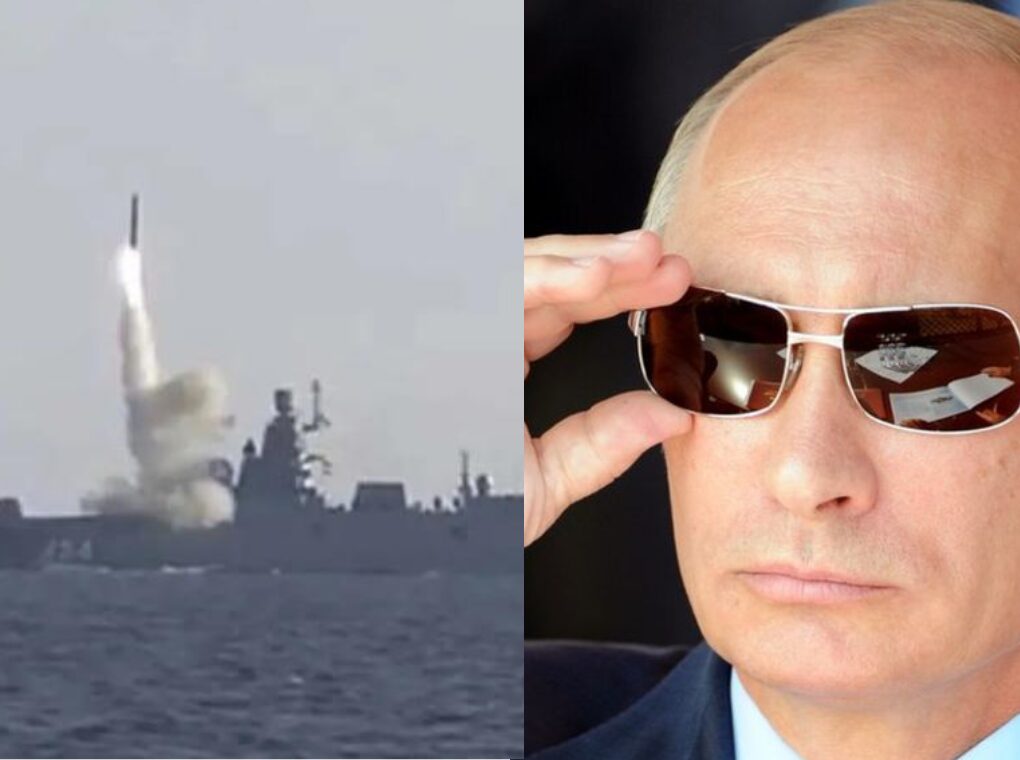
In a display of raw military prowess, Russia has once again thrust its advanced weaponry into the global spotlight. During the ongoing Zapad-2025 joint military exercises with Belarus, the Russian Northern Fleet successfully test-fired the hypersonic Zircon (Tsirkon) missile from the Admiral Golovko frigate in the Barents Sea.
This test, announced on September 14, 2025, underscores Moscow’s capability to deploy weapons that travel at speeds up to nine times the speed of sound—approximately 11,113.2 km/h—rendering them nearly impossible to intercept with current defense systems.
The footage released by the Russian Defense Ministry captures the missile’s vertical launch from the frigate, followed by its swift trajectory toward the horizon at a steep angle. Real-time surveillance confirmed a direct hit on the target, obliterating it with precision.
This demonstration is not merely a technical showcase; it arrives amid heightened tensions with NATO, serving as a potent signal amid recent incursions and escalating rhetoric.
The Zapad-2025 Exercises: Defensive Posturing or Strategic Messaging?
The Zapad-2025 maneuvers, which commenced on September 12, 2025, involve Russia and Belarus in a series of drills designed to enhance military command, coordination, and interoperability.
According to official statements from Moscow and Minsk, the exercises are purely defensive, focused on countering potential aggression against either nation. No intentions of offensive actions against NATO members have been declared, emphasizing a narrative of sovereignty and mutual defense.
However, the timing and scale of these operations evoke memories of previous Zapad exercises, notably those preceding Russia’s full-scale invasion of Ukraine in 2022. Back then, similar large-scale drills were interpreted by Western analysts as preludes to aggression, masking troop buildups and logistical preparations.
Today, with Zapad-2025 unfolding in Belarus—strategically positioned on NATO’s eastern flank—the exercises appear to carry a dual purpose: bolstering readiness while projecting power to deter interference in ongoing conflicts.
Complementing the missile test, Sukhoi Su-34 supersonic fighter-bombers conducted bombing runs on simulated ground targets, while long-range anti-submarine aircraft from the Northern Fleet’s mixed aviation corps participated in anti-submarine warfare simulations. These multifaceted operations highlight Russia’s integrated approach to modern warfare, blending air, sea, and missile capabilities.
Hypersonic Might: The Zircon Missile’s Game-Changing Potential
The Zircon hypersonic cruise missile represents a pinnacle of Russian military technology. As described by President Vladimir Putin in 2019, the weapon can achieve velocities of Mach 9, allowing it to strike sea or land targets over 600 miles away. Its hypersonic speed and maneuverability make it a nightmare for traditional air defense systems, which struggle to track and engage such fast-moving projectiles.
Launched from naval platforms like the Admiral Golovko, a Project 22350 frigate, the Zircon integrates seamlessly into Russia’s blue-water navy strategy. The Barents Sea test site, perilously close to the Arctic—a region increasingly militarized and a doorstep to the Bering Sea—amplifies its strategic implications. This Arctic proximity positions the missile as a direct threat to NATO’s northern approaches, potentially capable of reaching key alliances in Europe and beyond.
Experts note that hypersonic weapons like the Zircon shift the balance of power, challenging the supremacy of U.S. and NATO missile defenses. The missile’s ability to evade interception “sends shivers” through Western capitals, as it could neutralize carrier strike groups or critical infrastructure in minutes.
Escalating Tensions: Russian Incursions and NATO’s Response
The Zircon test did not occur in isolation. Just days earlier, on September 9-10, 2025, Russian drones reportedly intruded into Polish airspace, prompting outrage from Warsaw and prompting NATO to launch the “Eastern Sentry” operation. This defensive initiative aims to reinforce the alliance’s eastern borders, involving increased patrols and surveillance in response to perceived provocations.
Similar incidents have been reported in Romania, another NATO member on the eastern flank. These drone sightings are viewed by many as deliberate provocations, testing NATO’s resolve and unity. Analysts interpret them as Moscow’s way of signaling: “Stop supporting Ukraine. Cease outsourcing the war and funding Kyiv’s defenses, or face dire consequences.”
Russia’s actions appear calculated to exploit divisions within NATO. By conducting Zapad-2025 simultaneously with these border incidents, Moscow is demonstrating military preparedness and issuing a broader message: “You are not immune. The fire is at your doorstep—stop funding the war.” This echoes the pre-2022 playbook, where exercises served as both training and intimidation tactics.
The incursions in Poland and Romania, coupled with the Zircon test, paint a picture of a Russia unwilling to tolerate prolonged Western involvement in Ukraine. As the conflict drags on, these moves could be preemptive warnings against escalation, such as increased arms shipments or direct NATO aid.
Implications for Global Security
Russia’s latest demonstrations raise profound questions about the future of European security. The Zircon missile’s success bolsters Moscow’s narrative of technological superiority, potentially emboldening further assertiveness. For NATO, the challenge is clear: invest in hypersonic defenses, strengthen eastern flanks, and maintain unity to counter hybrid threats like drone incursions.
As tensions simmer in the Arctic, Barents Sea, and NATO’s borders, the world watches warily. Zapad-2025 may be labeled defensive, but its undertones suggest a Russia prepared to defend its interests—and expand them—by any means necessary. The message to the West is unequivocal: interference comes at a cost.
In the words of military observers, this is not just a test; it’s a declaration. As the hypersonic streak fades into the horizon, the echoes of its implications reverberate across the globe.