
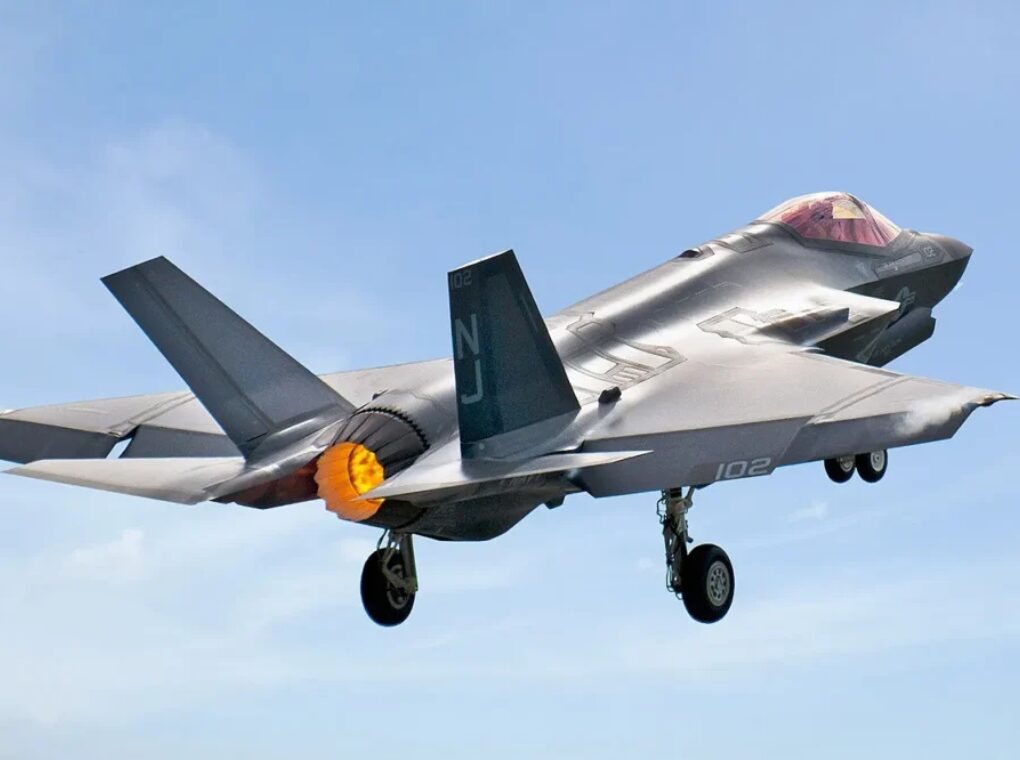
What if the most advanced fighter jet in the world—the F-35 Lightning II—could be crippled without a missile, without a cyberattack, and without a single shot fired?
That is the reality facing the United States and its allies today, as China’s dominance over the global supply of rare earth elements threatens to derail the most ambitious upgrade of the F-35 program.
Analysts warn that Beijing has effectively weaponized minerals buried deep underground, creating what defense experts now call a “rare earth missile.”
The F-35: America’s Flying Supercomputer
Since entering service in 2015, the Lockheed Martin F-35 Lightning II has become the crown jewel of U.S. and allied airpower.
With more than 1,100 aircraft delivered worldwide—including over 600 flown by the U.S. Air Force, Navy, and Marine Corps—the jet is seen as indispensable to NATO, Japan, South Korea, and Australia.
The F-35 is often described as a flying supercomputer, designed with advanced stealth coatings, data fusion sensors, and radar-absorbing technology that give pilots unmatched situational awareness.
But maintaining this technological edge requires constant upgrades. And the most ambitious effort yet is the Block 4 modernization program.
The Block 4 Upgrade—Now Years Behind
Launched in 2019, Block 4 was meant to “future-proof” the F-35 against threats from Russia and China. The upgrade package promised:
Greater radar detection range.
Integration of advanced air-to-air missiles.
More powerful electronic warfare systems.
Expanded precision strike capabilities.
Initially slated for completion by 2026, the program has suffered repeated delays—first to 2029, and now to at least 2031, according to the U.S. Government Accountability Office (GAO).
By then, experts warn, even if Block 4 is delivered, it may contain only a fraction of the originally promised 66 capabilities.
The Rare Earth Bottleneck
The primary culprit behind these delays is not engineering, but minerals.
Each F-35 contains over 900 pounds of rare earth materials, including:
Samarium-cobalt magnets for missile nose cones.
Yttrium, dysprosium, and terbium for avionics and stealth coatings.
Gallium and germanium for radars and electronic warfare.
Without these resources, the jet cannot see, strike, or remain hidden.
And here lies America’s strategic vulnerability: China dominates the global supply chain.
Over 90% of refined gallium comes from China.
68% of proven rare earth reserves are under Chinese control.
Beijing accounts for 99% of heavy rare earth processing.
In 2023, Beijing restricted exports of gallium and germanium, tightening restrictions again in 2024. The result: the F-35 Block 4 timeline collapsed.
The Strategic Chokehold
The most critical upgrade, the AN/APG-85 radar, relies on gallium nitride semiconductors. These enable stronger detection ranges and resilience against jamming.
But with China choking off gallium supplies, the radar—and by extension, the Block 4 program—has stalled.
“China doesn’t need to shoot down the F-35,” one analyst observed. “It just has to slow the supply of rare earths. That’s the real ‘missile’—a weapon of economic leverage.”
Spiraling Costs and Delays
The GAO reports that Block 4 costs have already surged by more than $6 billion above projections.
The Technology Refresh 3 (TR-3) package, a $1.9 billion hardware-software upgrade essential to Block 4, is also behind schedule.
Delivery delays paint a grim picture:
In 2023, F-35 deliveries averaged 61 days late.
By 2024, delays ballooned to 238 days.
By 2031, America and its allies may be fielding jets already a generation behind Chinese and Russian air defense systems.
Impact on U.S. Allies
The delays affect not just Washington, but also key partners. Nations such as Japan, South Korea, the United Kingdom, and Australia have committed billions to their F-35 fleets.
For them, Block 4 delays mean outdated radars, weaker electronic warfare resilience, and reduced strike precision. In any conflict—especially over Taiwan or the South China Sea—these weaknesses could prove decisive.
Can the U.S. Break Free?
The Pentagon is racing to diversify supply chains. Rare earth mines in Australia, Canada, and the United States are being reopened and expanded. But refining capacity remains overwhelmingly in China’s hands.
Experts caution that building an independent supply chain will take years of investment and faces steep environmental and technological hurdles.
Meanwhile, Beijing’s grip on the rare earth market remains firm—and every year of delay strengthens China’s strategic advantage.
The Silent Weapon
So, has China “shot down” the F-35? Not with missiles in the sky, but with minerals in the ground.
By weaponizing its dominance of rare earths, Beijing has turned supply chains into a silent but powerful tool of national strategy—one that could ground America’s most advanced aircraft before it even takes off.
The unanswered question remains:
Can the U.S. and its allies secure the resources needed to free themselves from China’s rare earth missile?
Or will the world’s most expensive fighter jet remain hostage to Beijing’s grip on the minerals of modern warfare?