In a single 29-page document, the United States has just delivered the most devastating blow to the post-1945 Western order since the Suez Crisis of 1956.
A leaked working draft of the Trump administration’s new National Security Strategy (NSS), circulated among senior White House, Pentagon, and State Department officials in late November, explicitly calls for the United States to “cultivate privileged bilateral relationships with a core group of European states – Austria, Hungary, Poland, and Italy – with a view to their progressive disengagement from the supranational structures of the European Union over the medium to long term.”
The language is colder and more clinical than anything seen in public from President Trump, but the intent is unmistakable: Washington no longer sees the European Union as an ally to be managed, but as an ideological and strategic adversary to be dismantled.
The EU as Enemy Number Three
The draft places the European Union in a category of its own – neither friend nor formal adversary like China or Iran, but an “institutional obstacle to the restoration of full national sovereignty in Europe.” Brussels is accused of:
Systematically eroding the sovereign authority of member states through “coercive migration redistribution schemes.”
Imposing “politically motivated regulatory burdens” that deliberately weaken U.S. commercial interests
Advancing a “post-national ideology incompatible with the Westphalian order.”
In one particularly incendiary passage, the document argues that “the continued existence of the EU in its present form represents a greater long-term threat to the reassertion of national sovereignty in Europe than Russian military power.”
The Four Target Nations
The strategy identifies four priority countries whose governments already exhibit “healthy resistance to Brussels’ centralising agenda”:
Hungary under Viktor Orbán
Poland, under its conservative Law and Justice successor coalition
Italy under Giorgia Meloni and her Brothers of Italy-led government
Austria, where the Freedom Party (FPÖ) is projected to enter government after the 2025 elections
The NSS proposes a comprehensive package of incentives – massive bilateral trade deals, joint energy infrastructure projects, privileged defence-industrial cooperation, and even implicit security guarantees outside the NATO framework – designed to make continued EU membership appear increasingly costly and unattractive.
The Ukraine Link That Makes Europe’s Blood Run Cold
The timing of the leak is no coincidence. It landed just 72 hours after a separate Trump “peace framework” for Ukraine was made public – a plan that demands Kyiv surrender roughly 20 % of its territory, accept permanent neutrality, and agree to a demilitarised buffer zone monitored by Russian troops.
European leaders immediately recognised the two documents as opposite sides of the same coin: Washington is simultaneously preparing to abandon Ukraine and to fracture the EU itself.
Even more alarming are the economic appendices attached to the NSS draft. They outline potential U.S.–Russia joint ventures in Arctic LNG, rare-earth processing in Siberia, and pipeline infrastructure – projects that would be partially financed by releasing the $330 billion in frozen Russian central-bank assets currently immobilised in Belgium and other Western jurisdictions.
In other words, the United States is contemplating using money seized to punish Russia’s invasion of Ukraine to bankroll a new economic partnership with Moscow, while Europe is left holding the bag for reconstruction and security.
Trump’s Own Words Come Back to Haunt Brussels
President Trump has never hidden his contempt for the European Union. He has called it “a disaster,” “worse than China, only smaller,” and “a vehicle for Germany to dominate weaker countries.” But until now, most European leaders treated such remarks as theatrical bluster.
The NSS draft proves those views are not peripheral – they are now the intellectual foundation of American grand strategy.
In his December 9 interview with POLITICO, Trump doubled down, praising Orbán and the Polish conservatives as “the only real leaders left in Europe” while dismissing France and Germany as “finished nations that have lost control of their streets and their future.”
Von der Leyen Draws Red Line – Then Moves It
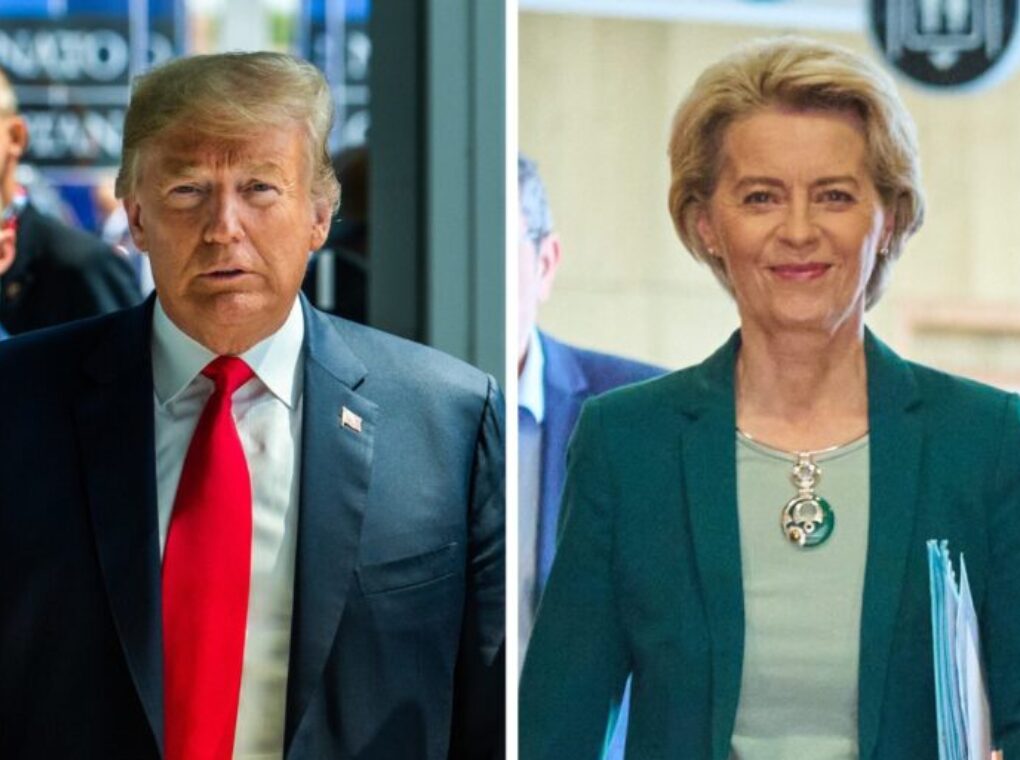
European Commission President Ursula von der Leyen, normally a model of transatlantic decorum, delivered an unusually blunt response on Wednesday afternoon:
“No third country – not Russia, not China, and not even our American friends – has the right to decide which European nations sit at the table of the European Union. The future of Europe will be decided in Europe, by Europeans, and by nobody else.”
She announced an immediate expansion of the EU’s “Democracy Shield” programme – created to counter Russian active measures – to include defence against “any foreign power, regardless of past alliances,” that attempts to influence European elections or destabilise the Union from within.
Behind the scenes, the reaction has been even more dramatic. France and Germany have quietly revived contingency planning for a “core Europe” defence structure excluding American participation. Several member states have begun stockpiling critical components for Leopard tanks and Caesar howitzers in case U.S. export licences are revoked. The European Investment Bank is preparing an emergency €200 billion fund to backstop any nation targeted by American economic pressure.
The View from Budapest, Warsaw, Rome – and Moscow
Hungarian officials have refused to criticise the leak, with one senior adviser telling reporters off the record: “If Washington finally understands that Brussels is the problem, not the solution, who are we to complain?”
In Poland, the response has been more cautious – Warsaw values its security relationship with the United States deeply – but government-aligned media have begun running sympathetic coverage of the NSS arguments.
The Kremlin has reacted with undisguised glee. Dmitry Peskov called the document “the most honest American strategic paper in thirty years,” while state television has been running nonstop segments under headlines like “The West Commits Suicide – America Chooses Russia Over Europe.”
A New World Order Taking Shape
Whether the leaked draft becomes official policy or is disavowed entirely, the damage is done. Trust between Washington and Brussels – already threadbare after years of trade wars, NATO burden-sharing disputes, and divergent climate policies – has shattered beyond repair.
European officials now speak openly of a future in which the United States is no longer a reliable partner but a rival great power pursuing zero-sum interests on the continent.
As one senior French diplomat put it: “We spent seventy years building institutions to prevent Europe from ever again becoming a chessboard for outside powers. Today, the United States just kicked over the board.”
The transatlantic alliance, as it existed from 1949 to 2024, is over. What replaces it – wary coexistence, open rivalry, or something in between – will define global politics for the rest of the century.