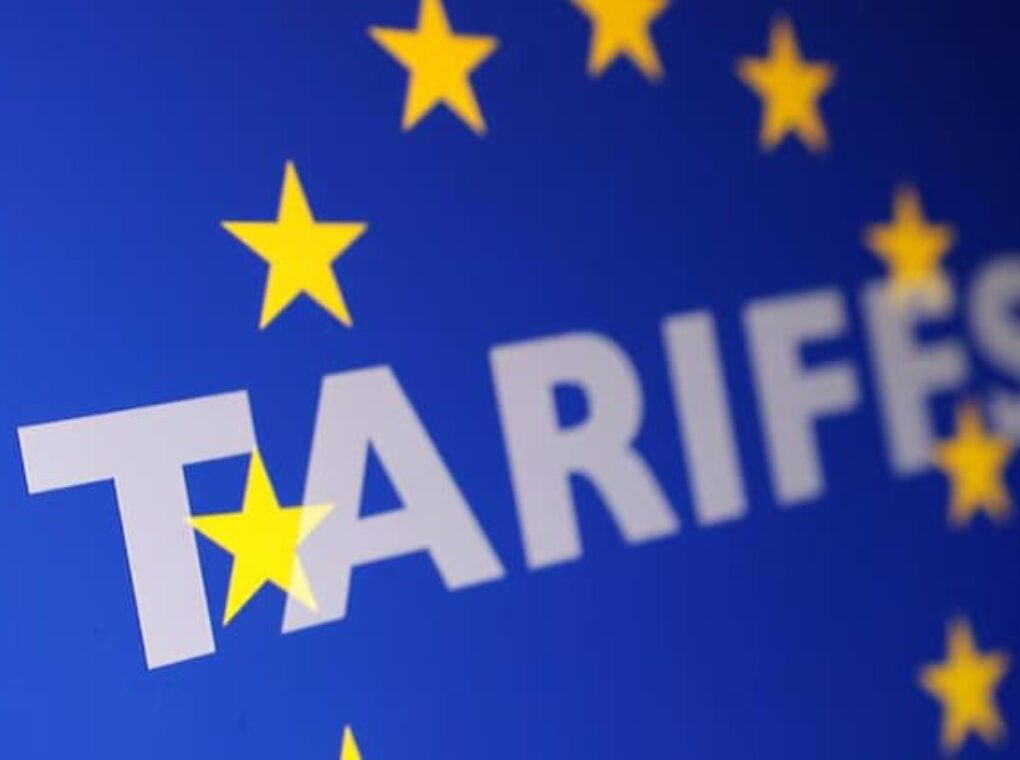
What began as a geopolitical disagreement over the Arctic has rapidly escalated into one of the most serious transatlantic confrontations in decades. The European Union is now openly preparing to deploy its most powerful trade countermeasures against the United States after President Donald Trump threatened sweeping tariffs on European allies in an effort to force negotiations over Greenland.
At the center of the crisis is Trump’s unprecedented use of trade policy as a tool of territorial pressure. In a move that stunned European capitals, the U.S. president warned that eight European NATO countries — Denmark, Norway, Sweden, France, Germany, the United Kingdom, the Netherlands, and Finland — would face a 10 percent tariff beginning February 1. If opposition to U.S. efforts to acquire Greenland continued, those tariffs would rise to 25 percent by June.
European officials say the threat has little to do with trade imbalances or economic policy. Instead, Trump framed the tariffs as leverage — explicitly designed to push Europe into negotiations over Greenland, a self-governing territory under Danish sovereignty and a strategic region within NATO’s Arctic framework. For many in Brussels, this crossed a fundamental red line.
“This is economic coercion, plain and simple,” one senior EU diplomat said. “It is the use of trade punishment to extract political and territorial concessions from allies.”
Europe Closes Ranks
The European response was immediate and unusually unified. Emergency meetings were convened in Brussels, where EU ambassadors expressed full solidarity with Denmark and Greenland. More significantly, EU leaders began active discussions on invoking the Anti-Coercion Instrument (ACI), a legal framework adopted in 2023 specifically to counter economic intimidation by foreign powers.
Until now, the ACI had never been used. Inside EU institutions, it is often referred to as the “trade bazooka” due to the breadth of powers it grants. If activated, the instrument would allow the EU to restrict U.S. companies from European markets, block American investments, limit access to public procurement contracts, and even target intellectual property rights.
French President Emmanuel Macron has taken a leading role in pushing for preparedness. He publicly described Trump’s tariff threats as unacceptable and warned that Europe must be ready to defend itself economically. Other EU leaders, including officials from Germany and the Nordic states, echoed the message that Europe would not negotiate under pressure.
The €93 Billion Warning
Even before considering the ACI, the EU has a substantial retaliation package ready. A €93 billion list of tariffs targeting U.S. goods — drawn up during earlier trade tensions with Trump — remains on standby. EU diplomats say the package, which covers American agriculture, manufacturing, consumer goods, and technology products, could be reactivated within days if Washington proceeds with its tariff threats.
The message from Brussels is clear: escalation would be rapid and costly.
Trade experts warn that such a move would have immediate consequences for U.S. exporters, particularly farmers and industrial producers already facing uncertainty from global market volatility. At the same time, European policymakers argue that failing to respond would invite further coercion, not only from Washington but from other global powers watching closely.
NATO Under Strain
The fallout is not limited to trade. The dispute has spilled over into NATO, exposing fractures within an alliance already strained by diverging threat perceptions and political priorities. European leaders have warned that Trump’s actions risk triggering a “dangerous downward spiral” within the alliance, undermining trust at a time of heightened global instability.
Even Italian Prime Minister Giorgia Meloni, often viewed as ideologically close to Trump, criticized the tariff threats. She emphasized that European military activities in Greenland were conducted under NATO coordination, not as a challenge to U.S. interests.
In Washington, concerns are also growing. Republican intelligence figures have questioned whether the president has the legal authority to use tariffs to pursue territorial objectives, while Democrats argue the dispute only benefits strategic rivals such as Russia and China. Public opinion appears firmly against the president’s approach, with multiple polls showing overwhelming opposition among Americans to coercing or acquiring Greenland.
A Turned Table for Global Trade
The crisis carries broader implications for the global order. For years, the European Union strongly supported U.S.-led sanctions and tariffs against Russia, China, Iran, and other countries often associated with the BRICS grouping. These measures were justified as necessary to uphold international norms and deter coercive behavior.
Now, Europe finds itself on the receiving end of similar tactics.
For Moscow and Beijing, the dispute reinforces long-standing arguments that economic tools are routinely weaponized, even among Western allies. For countries like India, which have sought to balance relations with the U.S. while resisting trade pressure, the confrontation underscores the risks of overdependence on any single economic partner.
Analysts say the Greenland crisis may accelerate efforts worldwide to diversify trade, reduce exposure to unilateral sanctions, and build alternative economic frameworks less vulnerable to political pressure.
A Historic Crossroads
Never before has the EU seriously considered deploying its strongest economic countermeasures against the United States. Never before has a U.S. president so openly used trade threats to pursue territorial leverage over allies.
European officials insist the issue is larger than Greenland itself. At stake, they argue, is whether the transatlantic relationship will continue to be based on cooperation and shared rules — or shift toward a system defined by coercion and power politics.
If the EU’s “trade bazooka” is ultimately fired, the shockwaves will extend far beyond Brussels and Washington. What began as a dispute over a frozen island could reshape global trade dynamics, redefine alliances, and mark a turning point in U.S.–Europe relations for years to come.