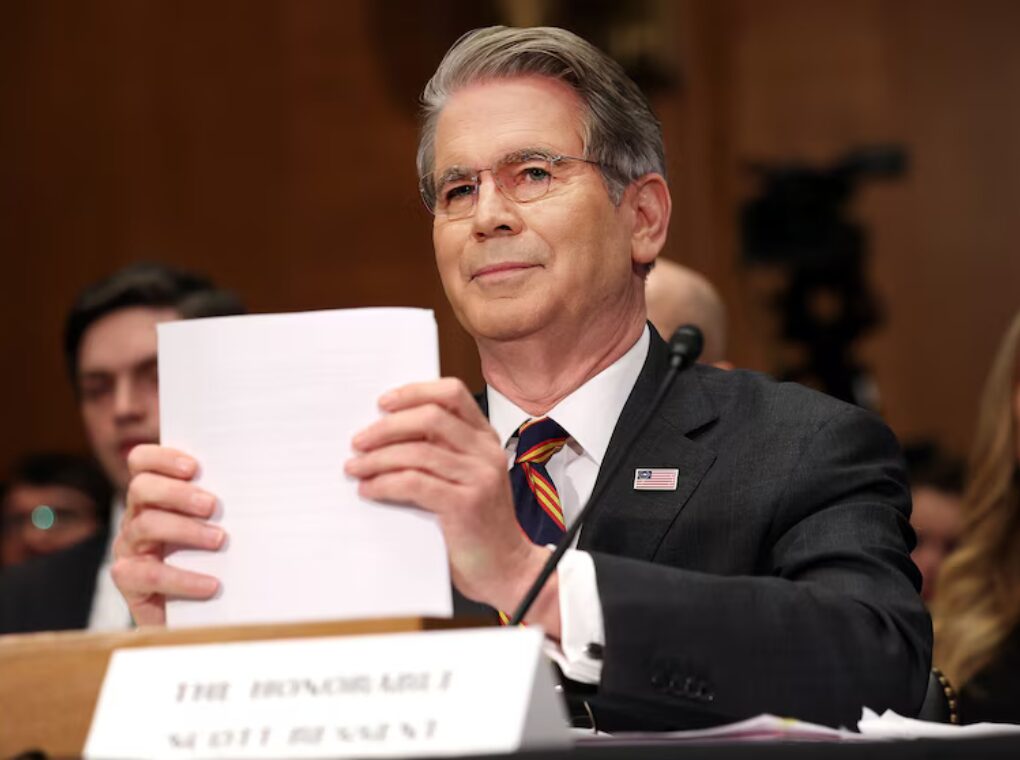
The role of the US dollar as a geopolitical weapon has come under intense global scrutiny after recent remarks by US Treasury Secretary Scott Bessent about America’s financial pressure strategy toward Iran. His comments have ignited debate over how economic sanctions, currency restrictions, and financial isolation can destabilize national economies — and why more countries are now accelerating efforts toward de-dollarization.
At the center of the controversy is the idea that limiting a country’s access to dollars can create a currency crisis, drive inflation, and ultimately lead to social unrest. Because the US dollar dominates global trade, banking systems, and energy markets, restricting dollar flows can paralyze a targeted economy. Iran, already under years of heavy sanctions, has faced exactly this kind of financial squeeze.
How a Dollar Shortage Can Trigger Economic Collapse
When a country struggles to access dollars, it becomes harder to pay for imports, settle international trade, or stabilize its currency. Businesses scramble for foreign exchange, investors lose confidence, and the national currency often plunges in value. A weaker currency makes imported goods — including food, fuel, and medicine — far more expensive. Inflation can spiral quickly, eroding savings and purchasing power.
In Iran’s case, tightening financial pressure coincided with a severe depreciation of the rial. As prices surged, public frustration intensified. What began as economic anxiety evolved into broader dissatisfaction over living conditions, governance, and opportunity. Protests spread across cities, reflecting the deep connection between currency stability and political stability.
This sequence of events has renewed attention on how economic warfare operates in the modern era. Instead of military confrontation, powerful states can use financial tools to pressure rivals. Supporters call it “economic statecraft” — a way to influence behavior without firing a shot. Critics argue it punishes civilians more than political elites and risks humanitarian fallout.
Sanctions, Financial Pressure, and Political Fallout
Sanctions have long been a central pillar of US foreign policy. By cutting off access to financial systems, Washington can limit a government’s ability to fund programs, conduct trade, or maintain economic stability. But the ripple effects often reach far beyond leadership circles.
When inflation rises sharply and jobs disappear, social tension grows. Economic crises frequently become political crises. While domestic policies and internal challenges always play a role, external financial pressure can accelerate the timeline and intensify the damage.
This dynamic has raised ethical and strategic questions. Does economic pressure bring political change — or simply deepen hardship? Can financial tools be precisely targeted, or do they inevitably affect ordinary people most? These questions are now central to global discussions about the future of sanctions policy.
Why the World Is Talking About De-Dollarization
Beyond Iran, the bigger story may be the growing global concern over dependence on the US dollar. Because so much of the world’s trade and reserves are dollar-based, many countries feel vulnerable to US financial decisions. If access to dollar markets can be restricted for political reasons, nations may seek alternatives to protect themselves.
This is where de-dollarization trends come into play. Governments are increasingly:
Expanding gold reserves
Conducting trade in local currencies
Developing regional payment systems
Exploring alternatives to traditional Western-dominated financial networks
Economic blocs such as BRICS have openly discussed increasing non-dollar trade, while several countries have taken steps to diversify their foreign exchange reserves. The goal is not necessarily to replace the dollar overnight, but to reduce exposure to financial coercion.
Is the Dollar’s Dominance at Risk?
Despite the headlines, the US dollar remains deeply embedded in the global financial system. It is still the primary reserve currency, the main unit of account for commodities like oil, and the backbone of international banking. Shifting away from it is a complex, long-term process requiring trust, stability, and coordination among many nations.
However, perception matters in global finance. When major powers openly discuss using currency dominance as leverage, it reinforces fears that economic interdependence can be weaponized. That perception alone can drive gradual structural changes in trade and reserve strategies.
A Turning Point in Global Economic Power?
The debate sparked by Bessent’s remarks goes far beyond Iran. It touches on a fundamental transformation in how power is exercised in the 21st century. Control over financial networks, payment systems, and reserve currencies is becoming as strategically important as military strength.
As more countries look to hedge against financial vulnerability, the global system may slowly evolve toward a more multipolar currency order. The dollar is unlikely to disappear from its dominant position anytime soon, but its unquestioned supremacy is increasingly being challenged.
What happens next could reshape the future of global trade, sanctions policy, and economic alliances — proving that in today’s world, money itself can be a powerful geopolitical tool.