The Islamic Revolutionary Guard Corps (IRGC) has vowed to continue fighting the United States and Israel for at least six months despite suffering severe losses in personnel, infrastructure, and naval assets during the ongoing conflict.
In a statement carried by Iran’s Fars News Agency, IRGC spokesperson Ali Mohammad Naini said the Iranian armed forces remain capable of sustaining a prolonged conflict.
“The Armed Forces of the Islamic Republic of Iran are capable of continuing at least a six-month intense war at the current pace of operations,” Naini said.
The declaration comes as U.S. and Israeli forces claim to have dealt devastating blows to Iran’s military infrastructure, including destroying the IRGC’s headquarters in Tehran and sinking dozens of Iranian naval vessels.
IRGC: The Backbone of Iran’s Military Power
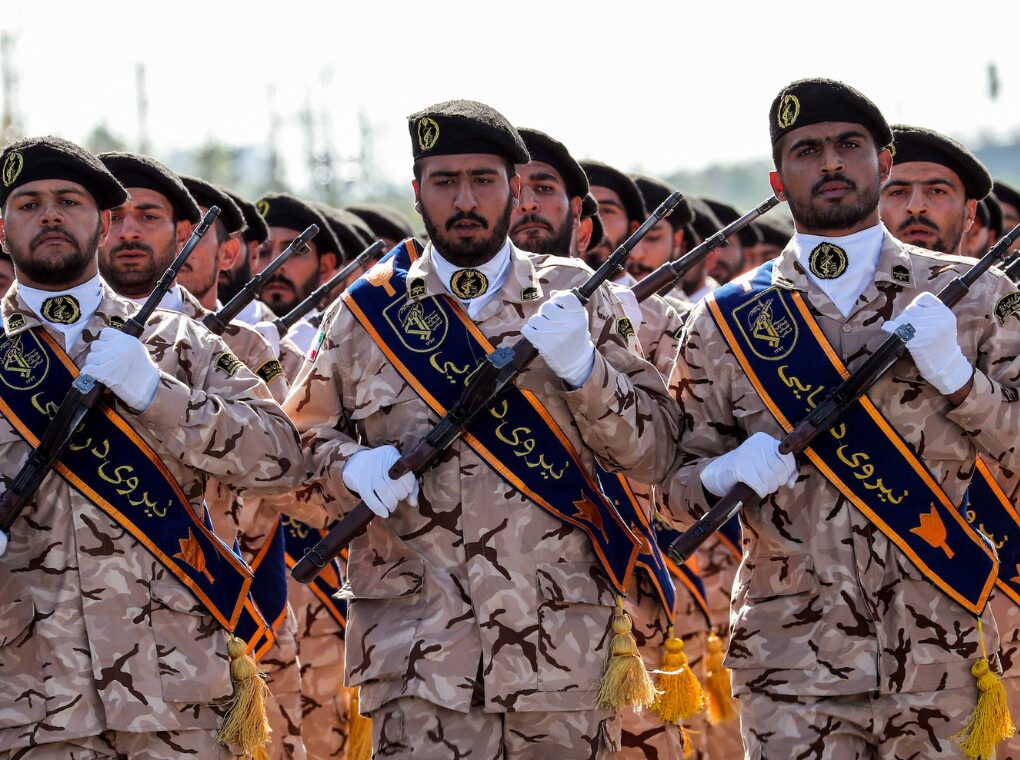
The IRGC, often referred to inside Iran as “Pasdaran” or simply “Sepah,” is an elite military organization established after the 1979 Islamic Revolution to protect the country’s revolutionary system.
Unlike Iran’s conventional military, the IRGC functions as both a powerful armed force and a political institution deeply embedded in Iranian society.
It operates ground, naval, and aerospace forces and controls the Quds Force, the elite unit responsible for overseas operations and coordination with allied militias across the Middle East.
The Quds Force gained global attention after its commander, Qasem Soleimani, was killed in a U.S. drone strike in 2020.
Western governments accuse the IRGC of supporting militant groups across the region and orchestrating attacks on foreign targets, allegations Tehran has repeatedly denied.
The organization is also heavily involved in domestic security through the Basij militia, a paramilitary network believed to have hundreds of thousands of members across Iran.
Heavy Losses in US-Israel Strikes
Since the outbreak of the current conflict, the IRGC has faced some of the most severe military setbacks in its history.
According to the U.S. Central Command (CENTCOM), American forces conducted precision strikes early in the campaign that destroyed the IRGC’s central headquarters in Tehran, targeting a key command and coordination hub.
Israeli officials estimate that between 1,000 and 1,500 IRGC personnel have been killed in the strikes so far.
Among those confirmed dead was Major General Mohammad Pakpour, commander of the IRGC Ground Forces, along with several other senior officers.
Military targets hit during the campaign reportedly include:
IRGC Ground Forces command centers
Quds Force facilities
Intelligence headquarters
Missile production and launch sites
Basij militia installations
Strikes across Tehran and southwestern Iran have also reportedly degraded Iranian air defenses and missile launch systems.
Iran’s Naval Fleet Suffers Massive Damage
Perhaps the most dramatic losses have occurred at sea.
CENTCOM says U.S. forces have destroyed or damaged at least 43 Iranian naval vessels during a series of operations aimed at neutralizing Tehran’s maritime capabilities in the Persian Gulf and surrounding waters.
The campaign, part of Operation Epic Fury, has targeted both the Iranian Navy and the IRGC Navy.
CENTCOM Commander Admiral Brad Cooper said U.S. forces struck a wide range of vessels, including what he described as an Iranian drone carrier roughly the size of a World War II-era aircraft carrier.
The ship, identified as the Shahid Bagheri, was reportedly left burning after a missile strike.
Earlier strikes also sank several high-profile vessels, including:
Shahid Sayyad Shirazi, a Soleimani-class corvette operated by the IRGC Navy
IRIS Dena, an Iranian Navy frigate reportedly torpedoed by a U.S. submarine in the Indian Ocean
U.S. Defense Secretary Pete Hegseth confirmed the destruction of additional vessels during briefings, describing the campaign as an effort to dismantle Iran’s ability to threaten maritime shipping lanes.
Admiral Cooper later claimed that no Iranian ships were actively operating in the Arabian Gulf, Strait of Hormuz, or Gulf of Oman following the strikes.
Missile Capabilities Degraded
According to U.S. and Israeli officials, Iranian missile attacks have also become significantly less effective over the course of the conflict.
Officials say the intensity of Iranian missile barrages has dropped by around 90 percent, largely due to strikes targeting launch platforms, production facilities, and command networks.
Despite this decline, Iran has continued launching waves of missiles and drones under what it calls “Operation True Promise 4.”
These attacks have targeted U.S. military bases, Israeli infrastructure, and strategic sites in Gulf countries including the UAE, Bahrain, Kuwait, Qatar, and Saudi Arabia.
Iranian officials say the strikes are retaliation for what they call Western “aggression.”
Tehran Vows Continued Resistance
Despite mounting losses, the IRGC has signaled that Iran is preparing for a prolonged conflict.
Iranian military statements warn that the war is entering a new phase and that retaliation will intensify.
Officials have repeatedly declared that “the enemy will no longer be safe,” signaling the possibility of expanded strikes across the region.
Analysts note that while the IRGC has suffered significant military setbacks, the organization still maintains extensive networks of regional allies and militia forces capable of carrying out asymmetric warfare.
With tensions continuing to escalate and both sides refusing to back down, the conflict between Iran, the United States, and Israel appears far from over.