
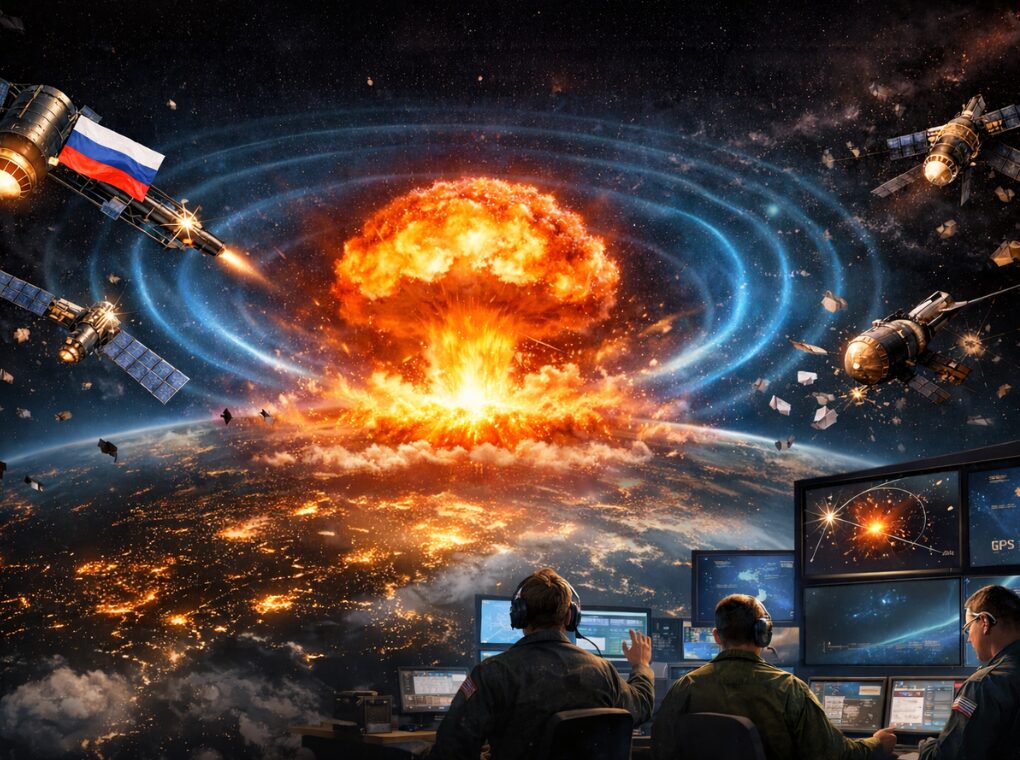
The growing threat of nuclear weapons in space has moved from theoretical speculation to a serious strategic concern, as the U.S. Space Command (USSPACECOM) recently conducted a high-level wargame simulating a potential Russian nuclear anti-satellite (ASAT) attack. The exercise, dubbed Apollo Insight, reflects rising fears that a single nuclear detonation in orbit could cripple global satellite infrastructure and trigger a prolonged “nuclear blackout” in space.
Rising Concerns Over Space-Based Nuclear Weapons
For years, U.S. defense planners have warned about the possibility of Russia developing a nuclear-capable ASAT system. Such a weapon would not rely solely on physical destruction but instead use a nuclear explosion in space to generate a powerful electromagnetic pulse (EMP), capable of disabling or destroying satellites across vast orbital regions.
According to intelligence assessments cited during the administration of Joe Biden, Russia has been exploring technologies that could arm satellites with nuclear warheads. A single detonation could potentially knock out hundreds of satellites, disrupting communications, navigation, military coordination, and even financial systems dependent on satellite networks.
One satellite that has drawn particular scrutiny is Cosmos 2553. Launched in February 2022, the satellite operates in a high-radiation orbit typically reserved for decommissioned spacecraft. While Moscow claims the mission is scientific—focused on testing material resilience—the U.S. and its allies remain skeptical, citing inconsistencies in the stated purpose.
Apollo Insight: Preparing for the Worst
In response to these concerns, USSPACECOM organized the Apollo Insight tabletop wargame on March 23, 2026. This marked the first in a series of Commercial Integration exercises aimed at evaluating threats posed by weapons of mass destruction in space.
The event brought together over 175 participants from 62 private-sector companies, alongside representatives from allied nations including Australia, Canada, New Zealand, and the United Kingdom. Key U.S. agencies such as NASA, the Department of Energy, and the Defense Threat Reduction Agency also participated.
Although the exercise remains classified, officials confirmed that it explored detection capabilities, threat characterization, and mitigation strategies. The goal was to enhance coordination between military and commercial space actors, given the increasing reliance on privately operated satellite constellations.
Participants reportedly examined how a nuclear detonation in orbit could unfold and what steps could be taken to maintain operational continuity. The exercise also emphasized the importance of “space domain awareness”—the ability to monitor and understand activities in orbit in real time.
Devastating Impact of a Nuclear Detonation in Space
Experts warn that the consequences of such an attack would be catastrophic and long-lasting. A nuclear explosion in Low Earth Orbit (LEO)—home to over 90% of all satellites—could destroy spacecraft in two phases.
The first wave would involve immediate destruction of satellites within the line of sight of the blast. The second, more insidious phase would result from increased radiation trapped in Earth’s magnetic field, particularly in the Van Allen belts. This radiation could degrade or disable satellites over weeks or even months, rendering large portions of space unusable for years.
The impact would vary depending on the altitude of the detonation:
Low Earth Orbit (LEO): Maximum destruction of commercial and military satellites.
Medium Earth Orbit (MEO): Disruption of critical navigation systems such as GPS and other global positioning networks.
Geostationary Orbit (GEO): Potential damage to strategic assets, including missile early-warning systems and military communications satellites.
Such an event would not only affect military capabilities but also cripple civilian infrastructure, including internet services, weather forecasting, aviation, and global logistics.
Strategic and Political Implications
The Apollo Insight exercise comes amid criticism from U.S. lawmakers who argue that existing defense strategies underestimate the urgency of space-based threats. Senator Roger Wicker, chairman of the Senate Armed Services Committee, recently warned that failing to address nuclear and space risks could embolden adversaries like Russia and China.
Military leaders have echoed these concerns. U.S. Strategic Command officials have acknowledged that Russia’s pursuit of nuclear space capabilities is no longer hypothetical and must be factored into defense planning.
At the same time, analysts note that identifying a nuclear payload on a satellite before detonation is extremely difficult, complicating efforts to deter or preempt such threats. This ambiguity increases the risk of miscalculation and escalation in an already tense geopolitical environment.
The Dawn of a Space Arms Race
The continuation of the Apollo Insight wargame series throughout 2026 signals a broader shift in how the United States and its allies perceive space—not as a neutral domain, but as a contested battlefield.
Future exercises will focus on areas such as orbital maneuver warfare and integrated missile defense, highlighting the rapid militarization of space. As nations expand their satellite constellations and develop counterspace capabilities, the risk of conflict extending beyond Earth is growing.
Ultimately, the prospect of a nuclear detonation in space underscores a chilling reality: the next major arms race may not be confined to land, sea, or air—but fought in orbit, with consequences that could reverberate across the entire planet.
As global powers continue to test the boundaries of space warfare, the need for international norms and treaties governing the use of space has never been more urgent. Without them, the world risks entering an era where a single detonation above Earth could plunge modern civilization into technological darkness.