
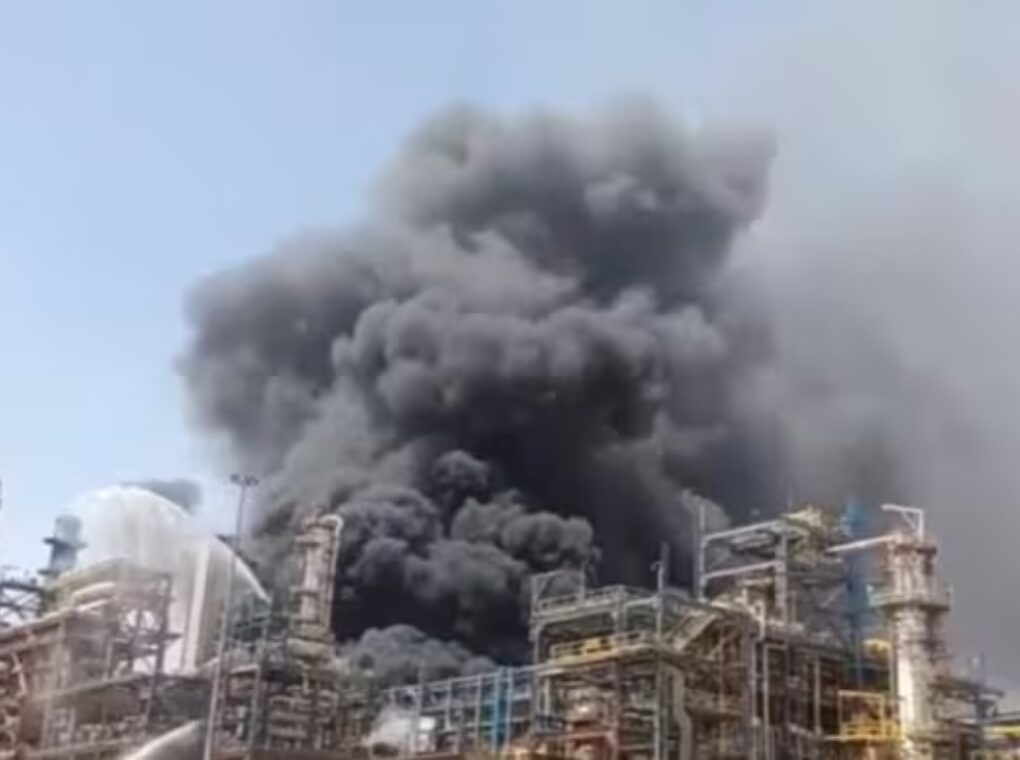
A series of fires and explosions at oil refineries and energy installations across multiple countries—including India, the United States, Australia, Mexico, and Ecuador—has sparked global concern, particularly as these incidents coincide with the ongoing Middle East conflict involving Iran. While no direct link has been officially established between the war and these incidents outside the conflict zone, experts warn that the clustering of such disruptions reflects deeper vulnerabilities in the global energy system.
Fire at HPCL Rajasthan Refinery Raises Questions
In India, a major fire broke out at the Hindustan Petroleum Corporation Limited (HPCL) refinery in Pachpadra, Rajasthan, just a day before its scheduled inauguration by Narendra Modi. The refinery, a long-awaited strategic project, suffered damage to its core processing units, delaying its operational launch.
Preliminary investigations suggest that a hydrocarbon leak from a valve or flange in the heat exchanger system may have triggered the blaze. Fortunately, authorities confirmed that the refinery structure remains intact. A high-level probe has been initiated to determine the exact cause and recommend corrective measures.
This incident follows another fire earlier in April at an offshore oil facility operated by ONGC near Mumbai, further adding to concerns about industrial safety and infrastructure resilience in India’s energy sector.
Global Pattern of Energy Disruptions
The Rajasthan refinery fire is not an isolated case. Since late February—when the United States and Israel launched strikes on Iran—a string of similar incidents has been reported worldwide.
In the United States, fires erupted at major facilities, including the Valero Port Arthur refinery in Texas and the Marathon refinery in El Paso. Both incidents were attributed to technical faults, though investigations are ongoing.
Australia witnessed a significant disruption at the Viva Energy refinery in Geelong, a key supplier of fuel in the region. The facility remains partially non-operational, raising concerns about fuel availability.
Latin America has also seen similar events. Ecuador’s Esmeraldas refinery, the country’s largest, halted operations following a fire in early March. In Mexico, a deadly blaze at the Olmeca refinery resulted in multiple casualties.
Additionally, an explosion at a fuel storage site in Myanmar’s Sagaing region destroyed several tankers, highlighting the broader geographic spread of such incidents.
War in the Background: Energy as a Strategic Weapon
The backdrop to these incidents is the escalating conflict in the Middle East. The war involving Iran, the United States, and Israel has significantly disrupted global energy markets. One of the most critical developments has been the restriction of oil shipments through the Strait of Hormuz, a narrow passage through which a substantial portion of the world’s oil supply flows.
The disruption has led to a sharp spike in crude oil prices—from around $66 per barrel in February to over $100 in March—before stabilizing slightly during a temporary ceasefire. The volatility has forced refineries worldwide to operate under tighter margins, often increasing throughput while delaying maintenance.
System Under Stress, Not Sabotage
Despite widespread speculation on social media about possible sabotage or coordinated attacks, no government has confirmed deliberate interference in the refinery fires outside active war zones. In contrast, incidents in Russia—where Ukrainian drone strikes have targeted oil infrastructure—are clearly linked to ongoing military operations.
Experts suggest that the clustering of refinery fires is more likely due to systemic stress rather than coordinated sabotage. According to energy analysts, global refining infrastructure is operating under unusually high pressure due to supply chain disruptions, rising demand, and reduced maintenance flexibility.
Aging infrastructure is another key factor. Many refineries, particularly in developed economies, have deferred upgrades amid the global shift toward renewable energy. This has left critical systems more vulnerable to breakdowns under high operational loads.
Economic and Strategic Implications
The wave of disruptions has significant implications for global energy security. The International Energy Agency (IEA) has reported tightening supply conditions, declining inventories, and increased price volatility.
Countries like India, which rely heavily on imported crude, are particularly vulnerable. The delay in commissioning the Rajasthan refinery could impact domestic fuel supply, especially at a time when global logistics are strained.
In Australia, concerns have been raised over fuel reserves, which reportedly fall short of recommended levels. Meanwhile, European nations are accelerating investments in clean energy to reduce dependence on volatile fossil fuel markets.
A Fragile Energy Ecosystem
While each refinery fire may have a distinct technical cause, the broader pattern underscores a fragile and overstretched global energy system. The convergence of geopolitical tensions, supply disruptions, and aging infrastructure has created conditions where even minor technical faults can escalate into major incidents.
As the conflict involving Iran continues to reshape global energy dynamics, the recent spate of refinery fires serves as a stark reminder: the world’s energy backbone is under strain—and the risks are becoming increasingly difficult to ignore.